








TransUnion
Company Details
Linkedin ID:
transunion
Website:
Employees number:
16,669
Number of followers:
552,281
NAICS:
5415
Industry Type:
Homepage:
transunion.com
IP Addresses:
0
Company ID:
TRA_2672901
Scan Status:
In-progress


TransUnion Vendor Cyber Rating & Cyber Score
transunion.comTransUnion is a global information and insights company that makes trust possible in the modern economy. We do this by providing an actionable picture of each person so they can be reliably represented in the marketplace. As a result, businesses and consumers can transact with confidence and achieve great things. This picture is grounded in our legacy as a credit reporting agency which enables us to tap into both credit and public record data; our data fusion methodology that helps us link, match and tap into the awesome combined power of that data; and our knowledgeable and passionate team, who stewards the information with expertise, and in accordance with local legislation around the world. A leading presence in more than 30 countries across five continents, TransUnion provides solutions that help create economic opportunity, great experiences and personal empowerment for hundreds of millions of people. We call this Information for Good® — it’s our purpose, and what drives us every day. Contact Us Customer support: https://transu.co/60024D64I Business support: https://transu.co/60044D67G
Company Details
transunion
16,669
552,281
5415
transunion.com
0
TRA_2672901
In-progress
 TransUnion Risk Score (AI oriented)
Between 0 and 549
 TransUnion Global Score (TPRM)
XXXX
Description: Salesforce Data Breach Lawsuits Remain Fragmented, Except for TransUnion Case A series of lawsuits tied to social engineering attacks targeting Salesforce databases will not be consolidated into a single multidistrict litigation (MDL), with one exception: complaints against TransUnion, which will proceed in federal court in Illinois. The U.S. Judicial Panel on Multidistrict Litigation ruled that the cases lack sufficient commonality, as each breach involves distinct incidents with varying details. Most complaints do not directly implicate Salesforce or allege a shared vulnerability in its platform as a key factor. Instead, the lawsuits stem from separate attacks where unique circumstances will shape the legal proceedings. The decision underscores the fragmented nature of these breaches, with no overarching pattern linking them beyond the use of social engineering tactics. The TransUnion case will move forward independently, while other claims remain dispersed across different jurisdictions.
Description: TransUnion, a major credit reporting agency, suffered a significant data breach linked to the extortion group ShinyHunters, who exploited vulnerabilities in Salesforce-hosted databases. The attack exposed 4.4–4.5 million customers’ sensitive personal information, including Social Security Numbers (SSNs), which heightens risks of identity theft, financial fraud, and long-term misuse of personal data. Unlike prior breaches involving less critical data, this incident involved highly sensitive identifiers, prompting TransUnion to offer 24 months of free credit monitoring and proactive fraud assistance to affected individuals. The same group has allegedly targeted other high-profile entities like Google, Allianz Life, Cisco, and Workday, indicating a broader campaign. The breach underscores vulnerabilities in third-party hosted systems and the escalating sophistication of cybercriminal tactics targeting financial institutions.
Description: TransUnion, a major credit reporting firm, confirmed a significant data breach affecting 4,461,511 U.S. consumers after attackers exploited vulnerabilities in a third-party application linked to its U.S. consumer support operations. The breach, discovered on July 30, 2025 (occurring two days prior), exposed highly sensitive personal data, including names, Social Security numbers, dates of birth, billing addresses, email addresses, phone numbers, customer transaction reasons (e.g., free credit report requests), and support tickets/messages. While TransUnion claimed its core credit database and credit reports remained uncompromised, hackers allegedly stole over 13 million records in total, with ~4.4 million tied to U.S. individuals. The attack was attributed to the extortion group ShinyHunters, leveraging malicious third-party integrations or OAuth-connected apps disguised as legitimate Salesforce tools. TransUnion responded by offering 24 months of free credit monitoring and identity theft protection to affected individuals and collaborating with law enforcement and cybersecurity experts for forensic analysis.
Description: Maine Consumers Lose Over $33 Million to Fraud as Data Breaches Fuel Identity Theft Risks During National Consumer Protection Week, cybersecurity experts are highlighting the growing threat of identity theft after Maine residents lost more than $33 million to fraud in 2023. With data breaches exposing personal information including Social Security numbers consumers are urged to take proactive steps to secure their identities. One of the most effective defenses is a credit freeze, a free service offered by the three major credit bureaus Experian, Equifax, and TransUnion. By freezing their credit, individuals can block fraudsters from opening new accounts in their name, even if stolen data is in circulation. The freeze can be temporarily lifted for legitimate credit applications and does not affect credit scores or access to annual credit reports. To further protect Social Security numbers (SSNs), often targeted by scammers, two key measures are recommended: 1. E-Verify’s “Self Lock” – This federal tool prevents unauthorized use of an SSN for employment or background checks, with an annual renewal requirement. 2. Social Security Administration (SSA) Account Block – Restricts online access to SSA records, requiring in-person verification to lift the block. Fraud prevention advocates, including Phil Chin of AARP Maine’s Fraud Watch Network, emphasize that scammers exploit convenience, making these extra security steps critical. While the process may require additional effort, experts argue the safeguards are necessary to counter increasingly sophisticated identity theft schemes. The warnings come as data breaches continue to expose sensitive information, leaving consumers vulnerable to financial and reputational harm.
Description: The Vermont Office of the Attorney General disclosed on October 2, 2024, that TransUnion Risk and Alternative Data Solutions (TRADS) suffered a data breach involving unauthorized access to consumer personal data. The incident occurred over an unspecified period, with the investigation launched on July 24, 2024, and concluding on September 10, 2024. While TRADS’s internal security systems were confirmed not compromised, the breach resulted in the exposure of consumer information, including names and other unspecified personal data elements. The exact scope of the exposed data remains undisclosed, but the incident highlights vulnerabilities in third-party data handling, raising concerns over potential misuse of sensitive consumer information. No evidence of financial fraud or large-scale identity theft has been reported thus far, but the exposure of personal identifiers poses risks of targeted phishing, identity theft, or reputational harm to affected individuals.
Description: The California Office of the Attorney General reported a data breach involving TransUnion Risk and Alternative Data Solutions, Inc. (TRADS) on October 2, 2024. The breach occurred between February 8, 2024, and April 16, 2024, involving unauthorized access attempts to personal information, specifically names and certain impacted data elements, although the number of affected individuals is unknown.
Description: FBI hacker 'USDoD' reportedly released private information from consumer credit reporting company TransUnion. Highly sensitive data that was purportedly stolen from the credit reporting bureau was leaked, according to a threat actor going by the handle "USDoD." The disclosed database, which is over 3GB in size, contains private information about 58,505 individuals from all around the world, including America and Europe. The hacker allegedly possessed information on 1000 of Airbus suppliers. 3,200 people that were connected to Airbus vendors had their personal information stolen by threat actors; the information that was revealed included names, job titles, residences, email addresses, and phone numbers.
Description: The Vermont Office of the Attorney General reported on March 10, 2023, that TransUnion LLC experienced a data breach where unauthorized actors may have accessed personal information of consumers potentially between December 1, 2022, and January 13, 2023. Sixty-seven cases were identified, involving the bypass of verification measures, but the specific types of personal information affected are not detailed in the report.
Description: TransUnion LLC reported a data breach incident after information in the company’s possession was subject to unauthorized access. The breach compromised the names, Social Security numbers, financial account numbers and driver’s license numbers. TransUnion investigated the incident and sent out data breach letters to all affected parties.
Description: TransUnion South Africa servers were attacked by N4ughtysecTU hacker group by using an authorised client’s credentials The attackers stole about 4TB of the personal data of 54 million customers of the company and threaten to release the data if ransom not paid.
Description: The Maine Office of the Attorney General reported a data breach involving TransUnion LLC on November 7, 2022. From January 16, 2022, to July 15, 2022, unauthorized actors potentially accessed personal information of 213 individuals, including names, Social Security numbers, dates of birth, financial account numbers, and driver's license numbers. TransUnion offered one year of complimentary identity theft protection and credit monitoring services to affected individuals.
Description: On August 4, 2022, the California Office of the Attorney General reported a data breach by TransUnion LLC that involved attempts to access personal information from credit files. The breach occurred between August 4, 2021, and January 31, 2022, with the specific number of individuals affected and the types of compromised information remaining unknown.
Description: The Maine Office of the Attorney General reported a data breach at TransUnion LLC involving impersonation attempts. The incident affected 24 Maine residents and potentially impacted a total of 10,814 individuals. The suspicious activity occurred between January 1, 2021, and March 28, 2022. Notification letters were sent to affected individuals on August 4, 2022, and one year of complimentary credit monitoring services was offered.


No incidents recorded for TransUnion in 2026.
No incidents recorded for TransUnion in 2026.
No incidents recorded for TransUnion in 2026.
TransUnion cyber incidents detection timeline including parent company and subsidiaries

TransUnion is a global information and insights company that makes trust possible in the modern economy. We do this by providing an actionable picture of each person so they can be reliably represented in the marketplace. As a result, businesses and consumers can transact with confidence and achieve great things. This picture is grounded in our legacy as a credit reporting agency which enables us to tap into both credit and public record data; our data fusion methodology that helps us link, match and tap into the awesome combined power of that data; and our knowledgeable and passionate team, who stewards the information with expertise, and in accordance with local legislation around the world. A leading presence in more than 30 countries across five continents, TransUnion provides solutions that help create economic opportunity, great experiences and personal empowerment for hundreds of millions of people. We call this Information for Good® — it’s our purpose, and what drives us every day. Contact Us Customer support: https://transu.co/60024D64I Business support: https://transu.co/60044D67G


LTIMindtree is a global technology consulting and digital solutions company that partners with enterprises across industries to reimagine business models, accelerate innovation, and drive AI-centric growth. Trusted by more than 700 clients worldwide, we use advanced technologies to enable operationa

At IBM, we do more than work. We create. We create as technologists, developers, and engineers. We create with our partners. We create with our competitors. If you're searching for ways to make the world work better through technology and infrastructure, software and consulting, then we want to work

We’re TD SYNNEX (NYSE: SNX), a leading distributor and solutions aggregator for the IT ecosystem. We’re 22,000 of the IT industry’s best and brightest, who share an unwavering passion for bringing compelling technology products, services and solutions to the world. We’re an innovative partner that
LexisNexis is a leading innovator of private, secure, and authoritative Legal AI solutions that help legal and business professionals draft full documents with ease, make informed decisions faster, and deliver outstanding work and improved outcomes, all powered by trusted content. LexisNexis Legal &
DXC Technology helps global companies run their mission-critical systems and operations while modernizing IT, optimizing data architectures, and ensuring security and scalability across public, private and hybrid clouds. The world's largest companies and public sector organizations trust DXC to depl
Infinite is a global leader in technology modernization, next-gen IT services and solutions, and digital engineering, with over two decades of experience helping clients turn digital transformation into business value. Leveraging an AI-first approach, we combine leading technologies, innovative plat
eClerx is a productized services company, bringing together people, technology and domain expertise to amplify business results. Our mission is to set the benchmark for client service and success in our industry. Our vision is to be the innovation partner of choice for technology, data analytics and

At Ricoh, we bring people, processes, and technology together to make information work for you. We unlock the power of information so organizations can unlock the full potential of their people. We're a leader in information management and digital services, creating competitive advantage for over 1.

Appen has been a leader in AI training data for over 25 years, providing high-quality, diverse datasets that power the world's leading AI models. Our end-to-end platform, deep expertise, and scalable human-in-the-loop services enable AI innovators to build and optimize cutting-edge models. We spec
.png)
TransUnion CIBIL Limited has appointed Harish Kumar Soni as Deputy Vice President – Cyber Security, reinforcing its leadership...
Gig worker fraud risks grow as earners report scams, account sharing, and weak identity checks across gig platforms.
TransUnion today added an ability to create digital fingerprints without relying on cookies that identify risky devices.
The TransUnion breach surfaced many challenges for enterprises. Here is how DFIR and OpenText can help your SOC team manage those risks.
Fraud is draining business resources at an alarming and unprecedented rate. According to TransUnion's (NYSE: TRU) newly released H2 2025...
Canadian commercial airline WestJet, headquartered in Calgary, Alberta, is providing notice to United States residents of a recen.
The letter, addressed to individuals using their full name and home address, informs recipients of a cyber incident involving a third-party...
On Sept. 3, thousands of Rhode Islanders received letters from TransUnion notifying them that their information, stored on a third-party...
Clark Howard has been a champion of the credit freeze for years. Here's a deeper look at why it's so critical right now.

Explore insights on cybersecurity incidents, risk posture, and Rankiteo's assessments.
The official website of TransUnion is http://www.transunion.com.
According to Rankiteo, TransUnion’s AI-generated cybersecurity score is 285, reflecting their Critical security posture.
According to Rankiteo, TransUnion currently holds 0 security badges, indicating that no recognized compliance certifications are currently verified for the organization.
According to Rankiteo, TransUnion has not been affected by any supply chain cyber incidents, and no incident IDs are currently listed for the organization.
According to Rankiteo, TransUnion is not certified under SOC 2 Type 1.
According to Rankiteo, TransUnion does not hold a SOC 2 Type 2 certification.
According to Rankiteo, TransUnion is not listed as GDPR compliant.
According to Rankiteo, TransUnion does not currently maintain PCI DSS compliance.
According to Rankiteo, TransUnion is not compliant with HIPAA regulations.
According to Rankiteo,TransUnion is not certified under ISO 27001, indicating the absence of a formally recognized information security management framework.
TransUnion operates primarily in the IT Services and IT Consulting industry.
TransUnion employs approximately 16,669 people worldwide.
TransUnion presently has no subsidiaries across any sectors.
TransUnion’s official LinkedIn profile has approximately 552,281 followers.
TransUnion is classified under the NAICS code 5415, which corresponds to Computer Systems Design and Related Services.
No, TransUnion does not have a profile on Crunchbase.
Yes, TransUnion maintains an official LinkedIn profile, which is actively utilized for branding and talent engagement, which can be accessed here: https://www.linkedin.com/company/transunion.
As of March 28, 2026, Rankiteo reports that TransUnion has experienced 13 cybersecurity incidents.
TransUnion has an estimated 39,819 peer or competitor companies worldwide.
Incident Types: The types of cybersecurity incidents that have occurred include Data Leak and Breach.
Total Financial Loss: The total financial loss from these incidents is estimated to be $33 million.
Detection and Response: The company detects and responds to cybersecurity incidents through an communication strategy with sent out data breach letters to all affected parties, and communication strategy with notification letters sent to affected individuals, and enhanced monitoring with one year of complimentary credit monitoring services offered, and communication strategy with offered one year of complimentary identity theft protection and credit monitoring services to affected individuals, and incident response plan activated with yes (investigation initiated), and communication strategy with public disclosure via vermont attorney general, and incident response plan activated with yes, and third party assistance with engaged third-party cybersecurity experts for independent forensics review, and law enforcement notified with yes, and containment measures with quick containment within hours of discovery, containment measures with isolation of affected third-party application, and remediation measures with forensic investigation, remediation measures with customer notifications, and recovery measures with 24 months of free credit monitoring and identity theft protection for affected individuals, and communication strategy with public disclosure via maine attorney general's office filing, communication strategy with media statements, communication strategy with direct notifications to affected consumers, and incident response plan activated with yes (proactive fraud assistance and credit monitoring offered), and remediation measures with free credit monitoring for 24 months, remediation measures with proactive fraud assistance, and communication strategy with public advisories, communication strategy with customer notifications, and containment measures with credit freezes, e-verify self lock, ssa account block, and communication strategy with public advisories during national consumer protection week..
Title: TransUnion South Africa Data Breach
Description: TransUnion South Africa servers were attacked by N4ughtysecTU hacker group by using an authorized client’s credentials. The attackers stole about 4TB of the personal data of 54 million customers of the company and threatened to release the data if a ransom was not paid.
Type: Data Breach
Attack Vector: Unauthorized access using authorized client's credentials
Vulnerability Exploited: Compromised credentials
Threat Actor: N4ughtysecTU
Motivation: Financial gain (ransom)
Title: TransUnion LLC Data Breach
Description: TransUnion LLC reported a data breach incident after information in the company’s possession was subject to unauthorized access. The breach compromised the names, Social Security numbers, financial account numbers and driver’s license numbers. TransUnion investigated the incident and sent out data breach letters to all affected parties.
Type: Data Breach
Title: USDoD Hacker Releases Private Information from TransUnion
Description: FBI hacker 'USDoD' reportedly released private information from consumer credit reporting company TransUnion. Highly sensitive data that was purportedly stolen from the credit reporting bureau was leaked, according to a threat actor going by the handle 'USDoD.' The disclosed database, which is over 3GB in size, contains private information about 58,505 individuals from all around the world, including America and Europe. The hacker allegedly possessed information on 1000 of Airbus suppliers. 3,200 people that were connected to Airbus vendors had their personal information stolen by threat actors; the information that was revealed included names, job titles, residences, email addresses, and phone numbers.
Type: Data Breach
Attack Vector: Unknown
Threat Actor: USDoD
Motivation: Unknown
Title: TransUnion LLC Data Breach
Description: The Maine Office of the Attorney General reported that TransUnion LLC experienced a data breach involving impersonation attempts, affecting 24 Maine residents. The suspicious activity occurred between January 1, 2021, and March 28, 2022, with a total of 10,814 individuals potentially impacted. Notification letters were sent to affected individuals on August 4, 2022, and one year of complimentary credit monitoring services was offered.
Date Publicly Disclosed: 2022-08-04
Type: Data Breach
Attack Vector: Impersonation
Title: TransUnion LLC Data Breach
Description: The California Office of the Attorney General reported a data breach by TransUnion LLC that involved attempts to access personal information from credit files.
Date Detected: 2022-08-04
Date Publicly Disclosed: 2022-08-04
Type: Data Breach
Title: Data Breach at TransUnion Risk and Alternative Data Solutions, Inc. (TRADS)
Description: The California Office of the Attorney General reported a data breach involving TransUnion Risk and Alternative Data Solutions, Inc. (TRADS) on October 2, 2024. The breach occurred between February 8, 2024, and April 16, 2024, involving unauthorized access attempts to personal information, specifically names and certain impacted data elements, although the number of affected individuals is unknown.
Date Detected: 2024-10-02
Date Publicly Disclosed: 2024-10-02
Type: Data Breach
Attack Vector: Unauthorized Access
Title: TransUnion LLC Data Breach
Description: The Maine Office of the Attorney General reported a data breach involving TransUnion LLC on November 7, 2022. From January 16, 2022, to July 15, 2022, unauthorized actors potentially accessed personal information of 213 individuals, including names, Social Security numbers, dates of birth, financial account numbers, and driver's license numbers. TransUnion offered one year of complimentary identity theft protection and credit monitoring services to affected individuals.
Date Detected: 2022-07-15
Date Publicly Disclosed: 2022-11-07
Type: Data Breach
Threat Actor: Unauthorized actors
Title: TransUnion LLC Data Breach
Description: Unauthorized actors may have accessed personal information of consumers potentially between December 1, 2022, and January 13, 2023. Sixty-seven cases were identified, involving the bypass of verification measures.
Date Detected: 2023-03-10
Date Publicly Disclosed: 2023-03-10
Type: Data Breach
Attack Vector: Bypass of verification measures
Threat Actor: Unauthorized actors
Title: Unauthorized Access to Consumer Data at TransUnion Risk and Alternative Data Solutions (TRADS)
Description: The Vermont Office of the Attorney General reported that TransUnion Risk and Alternative Data Solutions (TRADS) experienced unauthorized access to consumer data between an unspecified date range. The breach investigation began on July 24, 2024, and concluded on September 10, 2024, confirming no compromise of TRADS's security systems but unauthorized access to personal data, including names and other unspecified data elements.
Date Publicly Disclosed: 2024-10-02
Date Resolved: 2024-09-10
Type: Data Breach / Unauthorized Access
Title: TransUnion Data Breach via Third-Party Salesforce Integration
Description: TransUnion confirmed a major cyber incident affecting over 4.4 million U.S. consumers. Attackers exploited weaknesses in a third-party application used in TransUnion's U.S. consumer support operations, linked to a broader wave of Salesforce-related attacks. The breach exposed highly sensitive personal data, including names, Social Security numbers, dates of birth, and customer support records. The extortion group ShinyHunters and its affiliates are suspected of involvement. TransUnion is offering 24 months of free credit monitoring and identity theft protection to affected individuals.
Date Detected: 2025-07-30
Date Publicly Disclosed: 2025-07-30
Type: Data Breach
Attack Vector: Third-Party Application ExploitationOAuth AbuseMalicious Integrations
Vulnerability Exploited: Weaknesses in third-party integrations with Salesforce-connected applications (not Salesforce itself)
Threat Actor: ShinyHuntersScattered Spider (suspected overlap)UNC6395UNC6040
Motivation: Data TheftExtortionFinancial GainData Exfiltration for Underground Sales
Title: TransUnion Data Breach Impacting Over 4.4 Million People
Description: A cyberattack linked to the extortion group ShinyHunters exposed sensitive personal information, including Social Security Numbers (SSNs), of over 4.4 million TransUnion customers. The breach poses significant risks for identity theft, financial fraud, and long-term misuse of personal data. TransUnion is offering proactive fraud assistance and 24 months of free credit monitoring to affected individuals.
Type: Data Breach
Vulnerability Exploited: Vulnerabilities in Salesforce-hosted databases
Threat Actor: ShinyHunters
Motivation: Financial GainData TheftExtortion
Title: Salesforce Data Breach Lawsuits from Social Engineering Attacks
Description: Recent data breach lawsuits stemming from social engineering attacks against Salesforce databases won’t be consolidated, except for complaints filed against TransUnion set for federal Illinois court. The still-disparate Salesforce data breach suits allege separate attacks where different facts will emerge for each event.
Type: Data Breach
Attack Vector: Social Engineering
Title: Maine Consumers Lose Over $33 Million to Fraud as Data Breaches Fuel Identity Theft Risks
Description: During National Consumer Protection Week, cybersecurity experts highlighted the growing threat of identity theft after Maine residents lost more than $33 million to fraud in 2023. Data breaches exposed personal information, including Social Security numbers, increasing identity theft risks. Consumers are urged to take proactive steps like credit freezes and SSN protection measures.
Type: Data Breach, Identity Theft, Financial Fraud
Motivation: Financial Gain
Common Attack Types: The most common types of attacks the company has faced is Breach.
Identification of Attack Vectors: The company identifies the attack vectors used in incidents through Authorized client’s credentials and Third-party application integrated with Salesforce (disguised as legitimate tool).

Data Compromised: 4TB of personal data
Data Compromised: Names, Social security numbers, Financial account numbers, Driver’s license numbers
Data Compromised: Names, Job titles, Residences, Email addresses, Phone numbers
Data Compromised: Personally Identifiable Information
Data Compromised: Personal information from credit files
Data Compromised: Names, Certain impacted data elements
Data Compromised: Names, Social security numbers, Dates of birth, Financial account numbers, Driver's license numbers
Identity Theft Risk: High
Payment Information Risk: High
Data Compromised: Personal information of consumers
Data Compromised: Names, Other unspecified data elements
Identity Theft Risk: Potential (due to exposure of personal data)
Data Compromised: Names, Dates of birth, Social security numbers (ssns), Billing addresses, Email addresses, Phone numbers, Reasons for customer transactions (e.g., free credit report requests), Customer support tickets and messages
Systems Affected: Third-party application used in U.S. consumer support operations
Operational Impact: Disruption to consumer support operationsForensic investigationCustomer notifications
Brand Reputation Impact: Potential loss of trust in credit reporting securityMedia scrutinyConsumer backlash
Legal Liabilities: Potential regulatory finesClass-action lawsuits (risk)
Identity Theft Risk: High (due to exposure of SSNs, dates of birth, and other PII)
Data Compromised: Social security numbers (ssns), Sensitive personal information
Systems Affected: Salesforce-hosted databases
Brand Reputation Impact: High (due to exposure of SSNs and potential for identity theft)
Identity Theft Risk: High
Systems Affected: Salesforce databases
Legal Liabilities: Lawsuits filed
Financial Loss: $33 million (Maine residents in 2023)
Data Compromised: Personal information, Social Security numbers
Identity Theft Risk: High
Average Financial Loss: The average financial loss per incident is $2.54 million.
Commonly Compromised Data Types: The types of data most commonly compromised in incidents are Personal data, Names, Social Security Numbers, Financial Account Numbers, Driver’S License Numbers, , Names, Job Titles, Residences, Email Addresses, Phone Numbers, , Personally Identifiable Information, Personal Information From Credit Files, , Names, Certain Impacted Data Elements, , Names, Social Security Numbers, Dates Of Birth, Financial Account Numbers, Driver'S License Numbers, , Personal information, Personal Data (Names), Unspecified Data Elements, , Personally Identifiable Information (Pii), Customer Support Records, Transaction Histories, , Social Security Numbers (Ssns), Personal Information, , Personal information and Social Security numbers.
Entity Name: TransUnion South Africa
Entity Type: Company
Industry: Credit Reporting
Location: South Africa
Customers Affected: 54 million
Entity Name: TransUnion LLC
Entity Type: Company
Industry: Financial Services
Entity Name: TransUnion
Entity Type: Company
Industry: Consumer Credit Reporting
Location: Global
Customers Affected: 58505
Entity Name: Airbus
Entity Type: Company
Industry: Aerospace
Location: Global
Customers Affected: 3200
Entity Name: TransUnion LLC
Entity Type: Company
Industry: Credit Reporting
Customers Affected: 10814
Entity Name: TransUnion LLC
Entity Type: Company
Industry: Credit Reporting
Entity Name: TransUnion Risk and Alternative Data Solutions, Inc. (TRADS)
Entity Type: Company
Industry: Data Solutions
Entity Name: TransUnion LLC
Entity Type: Company
Industry: Credit Reporting
Customers Affected: 213
Entity Name: TransUnion LLC
Entity Type: Company
Industry: Credit Reporting
Customers Affected: 67 cases identified
Entity Name: TransUnion Risk and Alternative Data Solutions (TRADS)
Entity Type: Corporation
Industry: Credit Reporting / Data Solutions
Location: United States (Vermont jurisdiction reported)
Entity Name: TransUnion
Entity Type: Credit Reporting Agency
Industry: Financial Services
Location: United States
Size: Large (Global)
Customers Affected: 4,461,511 (U.S. consumers)
Entity Name: TransUnion
Entity Type: Credit Reporting Agency
Industry: Financial Services
Customers Affected: 4.4 million
Entity Name: TransUnion
Entity Type: Company
Location: Illinois, USA
Entity Type: Multiple Companies
Entity Name: Maine residents
Entity Type: Consumers
Location: Maine, USA
Communication Strategy: Sent out data breach letters to all affected parties
Communication Strategy: Notification letters sent to affected individuals
Enhanced Monitoring: One year of complimentary credit monitoring services offered
Communication Strategy: Offered one year of complimentary identity theft protection and credit monitoring services to affected individuals
Incident Response Plan Activated: Yes (investigation initiated)
Communication Strategy: Public disclosure via Vermont Attorney General
Incident Response Plan Activated: Yes
Third Party Assistance: Engaged Third-Party Cybersecurity Experts For Independent Forensics Review.
Law Enforcement Notified: Yes
Containment Measures: Quick containment within hours of discoveryIsolation of affected third-party application
Remediation Measures: Forensic investigationCustomer notifications
Recovery Measures: 24 months of free credit monitoring and identity theft protection for affected individuals
Communication Strategy: Public disclosure via Maine Attorney General's Office filingMedia statementsDirect notifications to affected consumers
Incident Response Plan Activated: Yes (proactive fraud assistance and credit monitoring offered)
Remediation Measures: Free credit monitoring for 24 monthsProactive fraud assistance
Communication Strategy: Public advisoriesCustomer notifications
Containment Measures: Credit freezes, E-Verify Self Lock, SSA Account Block
Communication Strategy: Public advisories during National Consumer Protection Week
Incident Response Plan: The company's incident response plan is described as Yes (investigation initiated), Yes, Yes (proactive fraud assistance and credit monitoring offered).
Third-Party Assistance: The company involves third-party assistance in incident response through Engaged third-party cybersecurity experts for independent forensics review, .
Type of Data Compromised: Personal data
Number of Records Exposed: 54 million
Data Exfiltration: Yes
Type of Data Compromised: Names, Social security numbers, Financial account numbers, Driver’s license numbers
Sensitivity of Data: High
Personally Identifiable Information: namesSocial Security numbersdriver’s license numbers
Type of Data Compromised: Names, Job titles, Residences, Email addresses, Phone numbers
Number of Records Exposed: 58505
Sensitivity of Data: High
Type of Data Compromised: Personally Identifiable Information
Number of Records Exposed: 10814
Type of Data Compromised: Personal information from credit files
Type of Data Compromised: Names, Certain impacted data elements
Personally Identifiable Information: Names
Type of Data Compromised: Names, Social security numbers, Dates of birth, Financial account numbers, Driver's license numbers
Number of Records Exposed: 213
Sensitivity of Data: High
Type of Data Compromised: Personal information
Number of Records Exposed: 67
Type of Data Compromised: Personal data (names), Unspecified data elements
Sensitivity of Data: Moderate (personal identifiers)
Data Exfiltration: Yes (unauthorized access confirmed)
Personally Identifiable Information: Yes (names)
Type of Data Compromised: Personally identifiable information (pii), Customer support records, Transaction histories
Number of Records Exposed: 13,000,000 (total claimed by hackers); 4,461,511 (U.S. consumers confirmed by TransUnion)
Sensitivity of Data: High (includes SSNs, dates of birth, and other sensitive identifiers)
Data Exfiltration: Yes
Personally Identifiable Information: NamesSocial Security Numbers (SSNs)Dates of BirthBilling AddressesEmail AddressesPhone Numbers
Type of Data Compromised: Social security numbers (ssns), Personal information
Number of Records Exposed: 4.4 million
Sensitivity of Data: High (SSNs and sensitive personal information)
Data Exfiltration: Yes
Personally Identifiable Information: Yes
Type of Data Compromised: Personal information, Social Security numbers
Sensitivity of Data: High (SSNs, PII)
Personally Identifiable Information: Yes
Prevention of Data Exfiltration: The company takes the following measures to prevent data exfiltration: Forensic investigation, Customer notifications, , Free credit monitoring for 24 months, Proactive fraud assistance, .
Handling of PII Incidents: The company handles incidents involving personally identifiable information (PII) through by quick containment within hours of discovery, isolation of affected third-party application, , credit freezes, e-verify self lock and ssa account block.
Data Exfiltration: Yes (but not ransomware-specific)
Data Exfiltration: Yes
Data Recovery from Ransomware: The company recovers data encrypted by ransomware through 24 months of free credit monitoring and identity theft protection for affected individuals, .
Regulatory Notifications: Vermont Office of the Attorney General
Regulatory Notifications: Filing with Maine Attorney General's Office
Legal Actions: Lawsuits filed
Ensuring Regulatory Compliance: The company ensures compliance with regulatory requirements through Lawsuits filed.
Lessons Learned: Third-party integrations with Salesforce applications are high-risk targets for attackers., OAuth-connected apps can bypass traditional login protections, enabling persistent access., Rapid containment is critical, but public disclosure timelines may lag for forensic completeness., Credit monitoring services are essential for mitigating post-breach identity theft risks.
Lessons Learned: Even major financial institutions are vulnerable to data breaches. Proactive measures such as credit freezes, fraud alerts, and regular credit monitoring are critical for mitigating risks associated with identity theft and financial fraud.
Lessons Learned: Proactive measures like credit freezes and SSN protection tools (E-Verify Self Lock, SSA Account Block) are critical to mitigating identity theft risks.
Recommendations: Strengthen third-party vendor security assessments, especially for Salesforce-connected applications., Implement stricter OAuth and API access controls., Monitor dark web forums for stolen data sales., Enhance consumer education on phishing risks post-breach., Consider proactive credit freezes for affected individuals., Evaluate legal accountability for credit bureaus in mass exposure incidents.Strengthen third-party vendor security assessments, especially for Salesforce-connected applications., Implement stricter OAuth and API access controls., Monitor dark web forums for stolen data sales., Enhance consumer education on phishing risks post-breach., Consider proactive credit freezes for affected individuals., Evaluate legal accountability for credit bureaus in mass exposure incidents.Strengthen third-party vendor security assessments, especially for Salesforce-connected applications., Implement stricter OAuth and API access controls., Monitor dark web forums for stolen data sales., Enhance consumer education on phishing risks post-breach., Consider proactive credit freezes for affected individuals., Evaluate legal accountability for credit bureaus in mass exposure incidents.Strengthen third-party vendor security assessments, especially for Salesforce-connected applications., Implement stricter OAuth and API access controls., Monitor dark web forums for stolen data sales., Enhance consumer education on phishing risks post-breach., Consider proactive credit freezes for affected individuals., Evaluate legal accountability for credit bureaus in mass exposure incidents.Strengthen third-party vendor security assessments, especially for Salesforce-connected applications., Implement stricter OAuth and API access controls., Monitor dark web forums for stolen data sales., Enhance consumer education on phishing risks post-breach., Consider proactive credit freezes for affected individuals., Evaluate legal accountability for credit bureaus in mass exposure incidents.Strengthen third-party vendor security assessments, especially for Salesforce-connected applications., Implement stricter OAuth and API access controls., Monitor dark web forums for stolen data sales., Enhance consumer education on phishing risks post-breach., Consider proactive credit freezes for affected individuals., Evaluate legal accountability for credit bureaus in mass exposure incidents.
Recommendations: Confirm the legitimacy of breach notifications before taking action., Freeze credit or place a fraud alert to prevent unauthorized account openings., Monitor credit reports regularly for suspicious activity., Report identity theft to the Federal Trade Commission (IdentityTheft.gov) and IRS if SSNs are misused., Leverage free credit monitoring services offered by affected institutions.Confirm the legitimacy of breach notifications before taking action., Freeze credit or place a fraud alert to prevent unauthorized account openings., Monitor credit reports regularly for suspicious activity., Report identity theft to the Federal Trade Commission (IdentityTheft.gov) and IRS if SSNs are misused., Leverage free credit monitoring services offered by affected institutions.Confirm the legitimacy of breach notifications before taking action., Freeze credit or place a fraud alert to prevent unauthorized account openings., Monitor credit reports regularly for suspicious activity., Report identity theft to the Federal Trade Commission (IdentityTheft.gov) and IRS if SSNs are misused., Leverage free credit monitoring services offered by affected institutions.Confirm the legitimacy of breach notifications before taking action., Freeze credit or place a fraud alert to prevent unauthorized account openings., Monitor credit reports regularly for suspicious activity., Report identity theft to the Federal Trade Commission (IdentityTheft.gov) and IRS if SSNs are misused., Leverage free credit monitoring services offered by affected institutions.Confirm the legitimacy of breach notifications before taking action., Freeze credit or place a fraud alert to prevent unauthorized account openings., Monitor credit reports regularly for suspicious activity., Report identity theft to the Federal Trade Commission (IdentityTheft.gov) and IRS if SSNs are misused., Leverage free credit monitoring services offered by affected institutions.
Recommendations: Freeze credit with Experian, Equifax, and TransUnion, Use E-Verify’s Self Lock to protect SSNs, Enable SSA Account Block for online access restrictionsFreeze credit with Experian, Equifax, and TransUnion, Use E-Verify’s Self Lock to protect SSNs, Enable SSA Account Block for online access restrictionsFreeze credit with Experian, Equifax, and TransUnion, Use E-Verify’s Self Lock to protect SSNs, Enable SSA Account Block for online access restrictions
Key Lessons Learned: The key lessons learned from past incidents are Third-party integrations with Salesforce applications are high-risk targets for attackers.,OAuth-connected apps can bypass traditional login protections, enabling persistent access.,Rapid containment is critical, but public disclosure timelines may lag for forensic completeness.,Credit monitoring services are essential for mitigating post-breach identity theft risks.Even major financial institutions are vulnerable to data breaches. Proactive measures such as credit freezes, fraud alerts, and regular credit monitoring are critical for mitigating risks associated with identity theft and financial fraud.Proactive measures like credit freezes and SSN protection tools (E-Verify Self Lock, SSA Account Block) are critical to mitigating identity theft risks.
Source: Maine Office of the Attorney General
Source: California Office of the Attorney General
Date Accessed: 2022-08-04
Source: California Office of the Attorney General
Date Accessed: 2024-10-02
Source: Maine Office of the Attorney General
Date Accessed: 2022-11-07
Source: Vermont Office of the Attorney General
Date Accessed: 2023-03-10
Source: Vermont Office of the Attorney General
Date Accessed: 2024-10-02
Source: Fox News (CyberGuy Report)
URL: https://www.foxnews.com/tech/transunion-data-breach-what-you-need-to-know
Date Accessed: 2025-08-01
Source: Maine Attorney General's Office Filing
Date Accessed: 2025-07-30
Source: CyberGuy.com - TransUnion Breach Coverage
URL: https://www.cyberguy.com/transunion-data-breach/
Date Accessed: 2025-08-01
Source: TechCrunch
Source: BleepingComputer
Source: ITPro
Source: Moneywise (article)
Source: US Judicial Panel on Multidistrict Litigation
Source: AARP Maine’s Fraud Watch Network (Phil Chin)
Additional Resources: Stakeholders can find additional resources on cybersecurity best practices at and Source: Maine Office of the Attorney General, and Source: California Office of the Attorney GeneralDate Accessed: 2022-08-04, and Source: California Office of the Attorney GeneralDate Accessed: 2024-10-02, and Source: Maine Office of the Attorney GeneralDate Accessed: 2022-11-07, and Source: Vermont Office of the Attorney GeneralDate Accessed: 2023-03-10, and Source: Vermont Office of the Attorney GeneralDate Accessed: 2024-10-02, and Source: Fox News (CyberGuy Report)Url: https://www.foxnews.com/tech/transunion-data-breach-what-you-need-to-knowDate Accessed: 2025-08-01, and Source: Maine Attorney General's Office FilingDate Accessed: 2025-07-30, and Source: CyberGuy.com - TransUnion Breach CoverageUrl: https://www.cyberguy.com/transunion-data-breach/Date Accessed: 2025-08-01, and Source: TechCrunch, and Source: BleepingComputerUrl: https://www.bleepingcomputer.com/news/security/transunion-suffers-data-breach-impacting-over-44-million-people/, and Source: ITPro, and Source: Moneywise (article), and Source: US Judicial Panel on Multidistrict Litigation, and Source: AARP Maine’s Fraud Watch Network (Phil Chin).
Investigation Status: Investigated
Investigation Status: Concluded (as of 2024-09-10)
Investigation Status: Ongoing (third-party forensic review in progress, law enforcement involved)
Investigation Status: Ongoing (as of latest reports)
Communication of Investigation Status: The company communicates the status of incident investigations to stakeholders through Sent out data breach letters to all affected parties, Notification letters sent to affected individuals, Offered one year of complimentary identity theft protection and credit monitoring services to affected individuals, Public disclosure via Vermont Attorney General, Public Disclosure Via Maine Attorney General'S Office Filing, Media Statements, Direct Notifications To Affected Consumers, Public Advisories, Customer Notifications and Public advisories during National Consumer Protection Week.
Customer Advisories: Sent out data breach letters to all affected parties
Stakeholder Advisories: Affected Consumers Will Receive Direct Notifications With Details On Credit Monitoring Services., Transunion Emphasizes That Core Credit Databases And Credit Reports Were Not Compromised..
Customer Advisories: Delete old online accounts to reduce exposed data.Avoid phishing scams; verify requests via official channels.Use strong, unique passwords and a password manager.Enable two-factor authentication (2FA) on critical accounts.Keep devices and software updated.Freeze credit with all three major bureaus (TransUnion, Equifax, Experian).Monitor financial accounts and credit reports regularly.Consider identity theft protection services (24 months provided free to affected individuals).
Stakeholder Advisories: TransUnion is offering proactive fraud assistance and 24 months of free credit monitoring to affected individuals.
Customer Advisories: Confirm breach legitimacy before acting on notifications.Freeze credit or place fraud alerts.Monitor credit reports weekly for unauthorized activity.Report identity theft to FTC and IRS if SSN is compromised.
Stakeholder Advisories: Cybersecurity experts and fraud prevention advocates
Customer Advisories: Maine residents urged to secure identities via credit freezes and SSN protection tools
Advisories Provided: The company provides the following advisories to stakeholders and customers following an incident: were Sent out data breach letters to all affected parties, Affected Consumers Will Receive Direct Notifications With Details On Credit Monitoring Services., Transunion Emphasizes That Core Credit Databases And Credit Reports Were Not Compromised., Delete Old Online Accounts To Reduce Exposed Data., Avoid Phishing Scams; Verify Requests Via Official Channels., Use Strong, Unique Passwords And A Password Manager., Enable Two-Factor Authentication (2Fa) On Critical Accounts., Keep Devices And Software Updated., Freeze Credit With All Three Major Bureaus (Transunion, Equifax, Experian)., Monitor Financial Accounts And Credit Reports Regularly., Consider Identity Theft Protection Services (24 Months Provided Free To Affected Individuals)., , TransUnion is offering proactive fraud assistance and 24 months of free credit monitoring to affected individuals., Confirm Breach Legitimacy Before Acting On Notifications., Freeze Credit Or Place Fraud Alerts., Monitor Credit Reports Weekly For Unauthorized Activity., Report Identity Theft To Ftc And Irs If Ssn Is Compromised., , Cybersecurity experts and fraud prevention advocates and Maine residents urged to secure identities via credit freezes and SSN protection tools.
Entry Point: Authorized client’s credentials
Entry Point: Third-party application integrated with Salesforce (disguised as legitimate tool)
High Value Targets: Customer Relationship Management (Crm) Data, Pii-Rich Support Records,
Data Sold on Dark Web: Customer Relationship Management (Crm) Data, Pii-Rich Support Records,
High Value Targets: Salesforce-Hosted Databases,
Data Sold on Dark Web: Salesforce-Hosted Databases,
Root Causes: Unauthorized access (specifics undisclosed)
Root Causes: Insecure Third-Party Integrations With Salesforce Applications., Inadequate Oversight Of Oauth-Connected Apps., Lack Of Segmentation Between Consumer Support Systems And Core Credit Databases (Though Core Systems Were Not Breached).,
Corrective Actions: Engaged Third-Party Cybersecurity Experts For Forensic Review., Providing 24 Months Of Credit Monitoring To Affected Individuals., Collaborating With Law Enforcement For Attribution And Mitigation.,
Root Causes: Exploitation Of Vulnerabilities In Salesforce-Hosted Databases By Shinyhunters,
Root Causes: Data breaches exposing sensitive personal information (e.g., SSNs)
Corrective Actions: Public awareness campaigns, promotion of credit freezes and SSN protection tools
Post-Incident Analysis Process: The company's process for conducting post-incident analysis is described as One year of complimentary credit monitoring services offered, Engaged Third-Party Cybersecurity Experts For Independent Forensics Review, .
Corrective Actions Taken: The company has taken the following corrective actions based on post-incident analysis: Engaged Third-Party Cybersecurity Experts For Forensic Review., Providing 24 Months Of Credit Monitoring To Affected Individuals., Collaborating With Law Enforcement For Attribution And Mitigation., , Public awareness campaigns, promotion of credit freezes and SSN protection tools.
Last Ransom Demanded: The amount of the last ransom demanded was Yes.
Last Attacking Group: The attacking group in the last incident were an N4ughtysecTU, USDoD, Unauthorized actors, Unauthorized actors, ShinyHuntersScattered Spider (suspected overlap)UNC6395UNC6040 and ShinyHunters.
Most Recent Incident Detected: The most recent incident detected was on 2022-08-04.
Most Recent Incident Publicly Disclosed: The most recent incident publicly disclosed was on 2025-07-30.
Most Recent Incident Resolved: The most recent incident resolved was on 2024-09-10.
Highest Financial Loss: The highest financial loss from an incident was $33 million (Maine residents in 2023).
Most Significant Data Compromised: The most significant data compromised in an incident were 4TB of personal data, names, Social Security numbers, financial account numbers, driver’s license numbers, , Names, Job Titles, Residences, Email Addresses, Phone Numbers, , Personally Identifiable Information, personal information from credit files, , Names, Certain impacted data elements, , names, Social Security numbers, dates of birth, financial account numbers, driver's license numbers, , Personal information of consumers, names, other unspecified data elements, , Names, Dates of Birth, Social Security Numbers (SSNs), Billing Addresses, Email Addresses, Phone Numbers, Reasons for Customer Transactions (e.g., free credit report requests), Customer Support Tickets and Messages, , Social Security Numbers (SSNs), Sensitive Personal Information, , Personal information and Social Security numbers.
Most Significant System Affected: The most significant system affected in an incident was Third-party application used in U.S. consumer support operations and Salesforce-hosted databases and .
Third-Party Assistance in Most Recent Incident: The third-party assistance involved in the most recent incident was engaged third-party cybersecurity experts for independent forensics review, .
Containment Measures in Most Recent Incident: The containment measures taken in the most recent incident were Quick containment within hours of discoveryIsolation of affected third-party application, Credit freezes, E-Verify Self Lock and SSA Account Block.
Most Sensitive Data Compromised: The most sensitive data compromised in a breach were driver’s license numbers, Residences, Personal information of consumers, Dates of Birth, Reasons for Customer Transactions (e.g., free credit report requests), Customer Support Tickets and Messages, personal information from credit files, Social Security numbers, Phone Numbers, names, Sensitive Personal Information, other unspecified data elements, Personal information, Social Security numbers, dates of birth, Names, Job Titles, Billing Addresses, Personally Identifiable Information, driver's license numbers, Email Addresses, 4TB of personal data, Certain impacted data elements, financial account numbers and Social Security Numbers (SSNs).
Number of Records Exposed in Most Significant Breach: The number of records exposed in the most significant breach was 75.9M.
Highest Ransom Demanded: The highest ransom demanded in a ransomware incident was Yes.
Most Significant Legal Action: The most significant legal action taken for a regulatory violation was Lawsuits filed.
Most Significant Lesson Learned: The most significant lesson learned from past incidents was Credit monitoring services are essential for mitigating post-breach identity theft risks., Even major financial institutions are vulnerable to data breaches. Proactive measures such as credit freezes, fraud alerts, and regular credit monitoring are critical for mitigating risks associated with identity theft and financial fraud., Proactive measures like credit freezes and SSN protection tools (E-Verify Self Lock, SSA Account Block) are critical to mitigating identity theft risks.
Most Significant Recommendation Implemented: The most significant recommendation implemented to improve cybersecurity was Strengthen third-party vendor security assessments, especially for Salesforce-connected applications., Enhance consumer education on phishing risks post-breach., Freeze credit or place a fraud alert to prevent unauthorized account openings., Report identity theft to the Federal Trade Commission (IdentityTheft.gov) and IRS if SSNs are misused., Monitor dark web forums for stolen data sales., Enable SSA Account Block for online access restrictions, Implement stricter OAuth and API access controls., Monitor credit reports regularly for suspicious activity., Confirm the legitimacy of breach notifications before taking action., Freeze credit with Experian, Equifax, and TransUnion, Consider proactive credit freezes for affected individuals., Evaluate legal accountability for credit bureaus in mass exposure incidents., Leverage free credit monitoring services offered by affected institutions. and Use E-Verify’s Self Lock to protect SSNs.
Most Recent Source: The most recent source of information about an incident are CyberGuy.com - TransUnion Breach Coverage, ITPro, Maine Attorney General's Office Filing, TechCrunch, AARP Maine’s Fraud Watch Network (Phil Chin), BleepingComputer, California Office of the Attorney General, Moneywise (article), US Judicial Panel on Multidistrict Litigation, Maine Office of the Attorney General, Fox News (CyberGuy Report) and Vermont Office of the Attorney General.
Most Recent URL for Additional Resources: The most recent URL for additional resources on cybersecurity best practices is https://www.foxnews.com/tech/transunion-data-breach-what-you-need-to-know, https://www.cyberguy.com/transunion-data-breach/, https://www.bleepingcomputer.com/news/security/transunion-suffers-data-breach-impacting-over-44-million-people/ .
Current Status of Most Recent Investigation: The current status of the most recent investigation is Investigated.
Most Recent Stakeholder Advisory: The most recent stakeholder advisory issued was Affected consumers will receive direct notifications with details on credit monitoring services., TransUnion emphasizes that core credit databases and credit reports were not compromised., TransUnion is offering proactive fraud assistance and 24 months of free credit monitoring to affected individuals., Cybersecurity experts and fraud prevention advocates, .
Most Recent Customer Advisory: The most recent customer advisory issued were an Sent out data breach letters to all affected parties, Delete old online accounts to reduce exposed data.Avoid phishing scams; verify requests via official channels.Use strong, unique passwords and a password manager.Enable two-factor authentication (2FA) on critical accounts.Keep devices and software updated.Freeze credit with all three major bureaus (TransUnion, Equifax, Experian).Monitor financial accounts and credit reports regularly.Consider identity theft protection services (24 months provided free to affected individuals)., Confirm breach legitimacy before acting on notifications.Freeze credit or place fraud alerts.Monitor credit reports weekly for unauthorized activity.Report identity theft to FTC and IRS if SSN is compromised. and Maine residents urged to secure identities via credit freezes and SSN protection tools.
Most Recent Entry Point: The most recent entry point used by an initial access broker were an Third-party application integrated with Salesforce (disguised as legitimate tool) and Authorized client’s credentials.
Most Significant Root Cause: The most significant root cause identified in post-incident analysis was Unauthorized access (specifics undisclosed), Insecure third-party integrations with Salesforce applications.Inadequate oversight of OAuth-connected apps.Lack of segmentation between consumer support systems and core credit databases (though core systems were not breached)., Exploitation of vulnerabilities in Salesforce-hosted databases by ShinyHunters, Data breaches exposing sensitive personal information (e.g., SSNs).
Most Significant Corrective Action: The most significant corrective action taken based on post-incident analysis was Engaged third-party cybersecurity experts for forensic review.Providing 24 months of credit monitoring to affected individuals.Collaborating with law enforcement for attribution and mitigation., Public awareness campaigns, promotion of credit freezes and SSN protection tools.
.png)
A flaw has been found in wandb OpenUI up to 1.0. This affects the function create_share/get_share of the file backend/openui/server.py of the component HTMLAnnotator Component. Executing a manipulation of the argument ID can lead to HTML injection. The attack may be performed from remote. The exploit has been published and may be used. The vendor was contacted early about this disclosure but did not respond in any way.
A vulnerability was detected in QDOCS Smart School Management System up to 7.2. The impacted element is an unknown function of the file /admin/enquiry of the component Admission Enquiry Module. Performing a manipulation of the argument Note results in cross site scripting. The attack is possible to be carried out remotely.
The Ultimate Member plugin for WordPress is vulnerable to Sensitive Information Exposure in all versions up to, and including, 2.11.2. This is due to the '{usermeta:password_reset_link}' template tag being processed within post content via the '[um_loggedin]' shortcode, which generates a valid password reset token for the currently logged-in user viewing the page. This makes it possible for authenticated attackers, with Contributor-level access and above, to craft a malicious pending post that, when previewed by an Administrator, generates a password reset token for the Administrator and exfiltrates it to an attacker-controlled server, leading to full account takeover.
LibJWT is a C JSON Web Token Library. Starting in version 3.0.0 and prior to version 3.3.0, the JWK parsing for RSA-PSS did not protect against a NULL value when expecting to parse JSON string values. A specially crafted JWK file could exploit this behavior by using integers in places where the code expected a string. This was fixed in v3.3.0. A workaround is available. Users importing keys through a JWK file should not do so from untrusted sources. Use the `jwk2key` tool to check for validity of a JWK file. Likewise, if possible, do not use JWK files with RSA-PSS keys.
Locutus brings stdlibs of other programming languages to JavaScript for educational purposes. Starting in version 2.0.39 and prior to version 3.0.25, a prototype pollution vulnerability exists in the `parse_str` function of the npm package locutus. An attacker can pollute `Object.prototype` by overriding `RegExp.prototype.test` and then passing a crafted query string to `parse_str`, bypassing the prototype pollution guard. This vulnerability stems from an incomplete fix for CVE-2026-25521. The CVE-2026-25521 patch replaced the `String.prototype.includes()`-based guard with a `RegExp.prototype.test()`-based guard. However, `RegExp.prototype.test` is itself a writable prototype method that can be overridden, making the new guard bypassable in the same way as the original — trading one hijackable built-in for another. Version 3.0.25 contains an updated fix.

Get company history

Every week, Rankiteo analyzes billions of signals to give organizations a sharper, faster view of emerging risks. With deeper, more actionable intelligence at their fingertips, security teams can outpace threat actors, respond instantly to Zero-Day attacks, and dramatically shrink their risk exposure window.
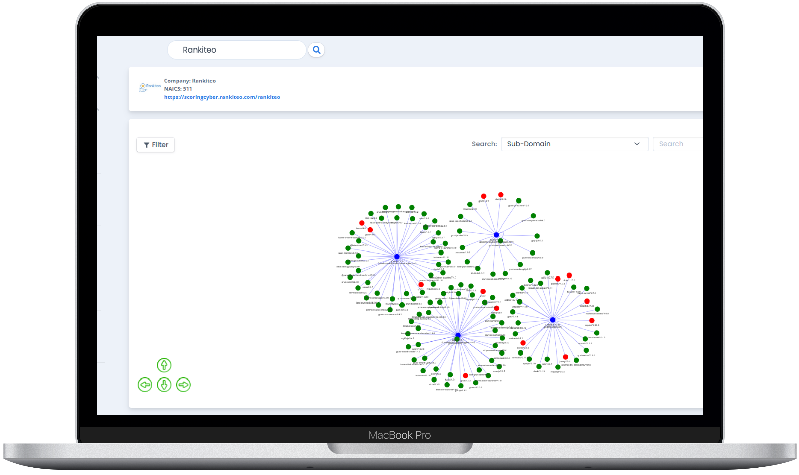
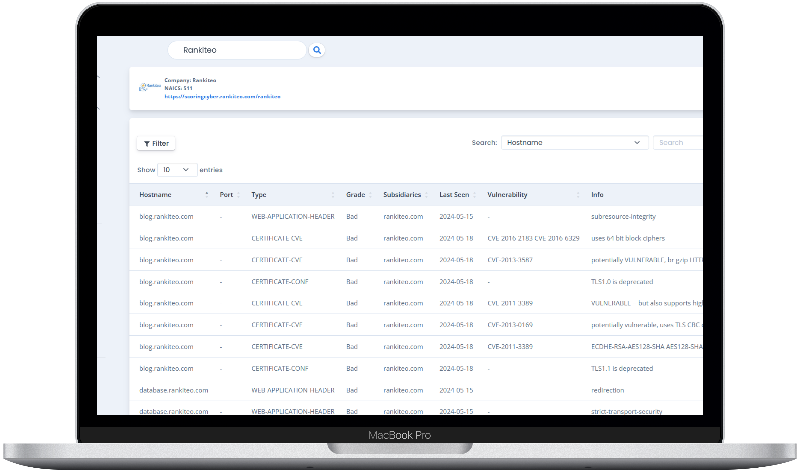
Identify exposed access points, detect misconfigured SSL certificates, and uncover vulnerabilities across the network infrastructure.
Gain visibility into the software components used within an organization to detect vulnerabilities, manage risk, and ensure supply chain security.
Monitor and manage all IT assets and their configurations to ensure accurate, real-time visibility across the company's technology environment.
Leverage real-time insights on active threats, malware campaigns, and emerging vulnerabilities to proactively defend against evolving cyberattacks.






 Rapid
Rapid