








Ingram Micro
Company Details
Linkedin ID:
ingram-micro
Website:
Employees number:
28,560
Number of followers:
583,296
NAICS:
5415
Industry Type:
Homepage:
ingrammicro.com
IP Addresses:
0
Company ID:
ING_5511879
Scan Status:
In-progress


Ingram Micro Vendor Cyber Rating & Cyber Score
ingrammicro.comIngram Micro is a leading technology company for the global information technology ecosystem. With the ability to reach nearly 90% of the global population, we play a vital role in the worldwide IT sales channel, bringing products and services from technology manufacturers and cloud providers to a highly diversified base of business-to-business technology experts. Through Ingram Micro Xvantage™, our AI-powered digital platform, we offer what we believe to be the industry’s first comprehensive business-to-consumer-like experience, integrating hardware and cloud subscriptions, personalized recommendations, instant pricing, order tracking, and billing automation. We also provide a broad range of technology services, including financing, specialized marketing, and lifecycle management, as well as technical pre- and post-sales professional support. Learn more at www.ingrammicro.com.
Company Details
ingram-micro
28,560
583,296
5415
ingrammicro.com
0
ING_5511879
In-progress
 Ingram Micro Risk Score (AI oriented)
Between 0 and 549
 Ingram Micro Global Score (TPRM)
XXXX
Description: Ingram Micro Data Breach Exposes PII of 42,000 Individuals On January 21, 2026, Ingram Micro Inc., a global technology distributor, disclosed a cybersecurity incident that compromised the personal data of approximately 42,000 individuals. An unauthorized actor accessed the company’s network, potentially acquiring sensitive personally identifiable information (PII), including names, contact details, dates of birth, government-issued IDs (such as Social Security, driver’s license, and passport numbers), and employment-related records like work evaluations. The breach is currently under investigation by Lynch Carpenter LLP, a national class action law firm, which is reviewing potential legal claims on behalf of affected individuals. Ingram Micro has not yet provided further details on the timeline of the breach or the methods used by the attacker. This incident adds to a growing list of data breaches exposing sensitive personal and professional information, raising concerns about the security of third-party vendors handling large volumes of PII. Affected individuals may face heightened risks of identity theft and fraud as a result.
Description: Ingram Micro Suffers Ransomware Attack, Disrupting Software Licensing and Operations Ingram Micro, a global technology and electronics distribution giant based in Irvine, California, confirmed a ransomware attack on July 5 that disrupted its network and impacted software licensing services. The incident has prevented customers from using or provisioning certain products reliant on Ingram’s systems, as reported by *TechCrunch*. The company acknowledged the attack in a July 5 statement, stating it was working to restore affected systems. An Ingram spokesperson later directed inquiries to the initial release, indicating no further updates were available at the time. The outage has had financial repercussions, with Ingram Micro’s stock closing down 7.5% at $20.20 per share on the day of the announcement, reducing its market cap to $4.7 billion. With over $54 billion in annual sales, Ingram Micro plays a critical role in the global supply chain for technology products. The attack highlights ongoing vulnerabilities in cybersecurity for major distribution and logistics firms, though the full extent of the impact on operations and customer data remains unclear.
Description: Ingram Micro, a major U.S.-based technology distributor and managed services provider, suffered a ransomware attack starting on Thursday, leading to a prolonged outage of its website and core network systems. The disruption has halted order processing, causing delays in software licensing and preventing customers from accessing or provisioning critical products tied to Ingram’s infrastructure. The attack, attributed to the SafePay ransomware gang (though unconfirmed by the company), has forced Ingram Micro to alert shareholders ahead of market opening. While no data breach details have been publicly confirmed, ransomware groups often exfiltrate sensitive data before encrypting systems, raising concerns about potential data leaks or financial extortion. The outage has crippled operations for Ingram’s global clientele, including smaller businesses reliant on its IT services, risking financial losses, reputational damage, and operational paralysis until systems are restored. The incident underscores the severe impact of ransomware on supply chains and third-party service providers.
Description: Ingram Micro Confirms Ransomware Attack Disrupting Internal Systems Global IT product distributor Ingram Micro has confirmed a ransomware attack that disrupted its operations over the U.S. holiday weekend. The company proactively took certain internal systems offline to contain the breach and strengthen its defenses, though it has not disclosed whether any data was exfiltrated. Speculation about the incident began after Ingram Micro’s website went offline unexpectedly, raising concerns about a potential cyberattack. The company later acknowledged the ransomware intrusion in a statement on its investor relations website. While the exact threat actor behind the attack remains unconfirmed, the incident highlights the ongoing risk of ransomware targeting critical supply chain and distribution networks. No further details on the scope of the breach or potential impact on customers have been released.
Description: Conduent, a New Jersey-based business process outsourcing firm, suffered the largest known health data breach of 2025, exposing sensitive healthcare records. The incident triggered multiple post-hack lawsuits and regulatory investigations, with severe reputational and financial repercussions. The breach compromised personal and medical data of countless individuals, leading to potential identity theft, fraud, and legal liabilities. The fallout includes operational disruptions, loss of client trust, and escalating compliance penalties. Given the scale of the breach affecting healthcare data it poses long-term risks to affected patients, including exposure of protected health information (PHI) and potential misuse by malicious actors. The company faces mounting legal costs, reputational damage, and possible contractual terminations from partners wary of further vulnerabilities. The breach underscores systemic failures in cybersecurity governance, amplifying scrutiny from regulators and stakeholders.
Description: Weekly Cybersecurity Breach Roundup: DOGE Data Exposure, CIRO Phishing Attack, and Rising Threats This week’s cybersecurity landscape saw multiple high-profile incidents, including unauthorized data sharing by the U.S. Department of Government Efficiency (DOGE), a massive phishing breach in Canada, and a surge in critical vulnerabilities. ### U.S. DOGE Staff Exposed Social Security Data via Unauthorized Cloudflare Server Federal prosecutors confirmed that staff from Elon Musk’s Department of Government Efficiency (DOGE) uploaded sensitive Social Security Administration (SSA) data to an unauthorized Cloudflare server in March 2025. The breach, first reported by a whistleblower in August, involved employees sharing data via third-party links between March 7 and 17. The SSA remains uncertain whether the data was removed from Cloudflare. The incident is part of ongoing litigation over DOGE’s activities at the SSA, which critics claim wasted $21.7 billion. Prosecutors also revealed that a DOGE employee signed an agreement with a political advocacy group seeking voter fraud evidence, potentially linking SSA data to voter rolls. Two DOGE employees were referred to the U.S. Office of Special Counsel for possible Hatch Act violations, which prohibit federal employees from partisan activities. Additionally, a DOGE team member sent an encrypted file believed to contain names and addresses of 1,000 individuals to the Department of Homeland Security and a DOGE advisor at the Department of Labor. The SSA has been unable to decrypt the file. Another DOGE employee continued accessing the "Numident" database containing Social Security card applications and death records despite a court order revoking access. ### Canadian Investment Regulatory Organization (CIRO) Phishing Breach Affects 750,000 Investors The Canadian Investment Regulatory Organization (CIRO) disclosed a phishing attack in August 2025 that exposed sensitive data of approximately 750,000 investors. Compromised information includes names, contact details, dates of birth, Social Insurance numbers, government-issued IDs, investment account numbers, and account statements. CIRO confirmed that login credentials, passwords, and security questions were not accessed. ### UK NCSC Warns of Rising Russia-Aligned Hacktivist DDoS Attacks The UK’s National Cyber Security Centre (NCSC) issued an alert about increased denial-of-service (DDoS) attacks by Russian-aligned hacktivist groups, including NoName057(16). Targets include government bodies, local authorities, and critical infrastructure operators. The NCSC advised organizations to strengthen defenses with traffic filtering, web application firewalls, and rate-limiting policies. ### Ingram Micro Ransomware Attack Exposes 42,000 Employee Records IT distributor Ingram Micro suffered a July 2025 ransomware attack by the SafePay gang, which stole 3.5 terabytes of data, including names, birthdates, Social Security numbers, passport details, and employment records. The breach affected 42,521 individuals. Ingram took systems offline to contain the attack, causing service disruptions before restoring operations by July 9. SafePay later published the stolen data after Ingram refused to pay the ransom. ### CVE Disclosures Surge 21% in 2025 Vulnerability disclosures reached 48,185 in 2025 a 20.6% increase from the previous year with 3,984 critical and 15,003 high-severity flaws. December alone accounted for 5,500 CVEs, while February 26 saw a record 793 disclosures in a single day. Nearly 30% of exploited vulnerabilities were weaponized within one day of disclosure, and 25.8% lacked analysis in the National Vulnerability Database, complicating mitigation efforts. ### SK Telecom Challenges $91 Million Data Leak Fine South Korea’s SK Telecom is contesting a $91 million fine the largest ever imposed by the country’s privacy watchdog after a 2025 data breach exposed all 23 million of its mobile subscribers. The delayed disclosure led to a broader investigation, prompting SK Telecom to offer free USIM replacements. A ransomware group, CoinbaseCartel, later claimed responsibility, alleging it stole source code, project files, and AWS keys via a compromised Bitbucket account. ### Critical Chainlit Vulnerabilities Expose AI Data and Cloud Infrastructure Security researchers at Zafran Labs disclosed two critical flaws in the open-source AI framework Chainlit (CVE-2026-22218 and CVE-2026-22219). The vulnerabilities allow arbitrary file reads and server-side request forgery (SSRF), enabling attackers to access sensitive data, including AI prompts and credentials, and probe internal networks. Chainlit released patches to address the issues. ### North Korean Hackers Abuse Microsoft VS Code for Malware Delivery North Korean threat actors expanded their "Contagious Interview" campaign, using Microsoft Visual Studio Code to execute malware via malicious Git repositories. Victims are tricked into opening projects that automatically run attacker-controlled commands, deploying the EtherRAT macOS trojan. The group has also leveraged developer-friendly platforms like Vercel for command-and-control infrastructure.
Description: Ransomware in 2025: A Systemic Threat Disrupting Global Supply Chains and Critical Services In 2025, ransomware evolved from isolated IT disruptions into a systemic risk, threatening national supply chains, essential services, and entire industries. Cybersecurity Ventures projects the global cost of ransomware will surge to $275 billion annually by 2031, driven by downtime, data loss, recovery efforts, and lost productivity not just ransom payments. A recent SOCRadar analysis highlighted the top 10 ransomware attacks of 2025, each exposing vulnerabilities across sectors: 1. Salesforce Ecosystem – A SaaS supply chain blind spot exploited for widespread disruption. 2. Oracle E-Business Suite – A zero-day attack leveraging supply chain extortion. 3. Jaguar Land Rover – Britain’s costliest cyberattack, crippling automotive operations. 4. Ingram Micro – A ransomware strike paralyzing global IT distribution. 5. Co-operative Group – A sustained siege on the UK retail sector. 6. PowerSchool – Large-scale extortion targeting the education sector. 7. Synnovis – Healthcare disruption with confirmed patient harm. 8. DaVita – Ransomware striking critical healthcare infrastructure. 9. Asahi Group – Manufacturing halts exposing IT-OT convergence risks. 10. Collins Aerospace – Ransomware grounding European airports. Key patterns emerged across these incidents: - Initial access frequently relied on stolen credentials or social engineering rather than sophisticated exploits. - Supply chain vulnerabilities amplified impact, turning single breaches into cascading failures. - Data theft and operational paralysis often outweighed encryption as the primary damage driver. - Delayed consequences such as regulatory penalties or confirmed human harm surfaced months after the attacks. The incidents underscore ransomware’s growing role as a strategic threat, with far-reaching consequences beyond financial losses.
Description: Ingram Micro Data Breach Exposes Sensitive Information of Over 40,000 Individuals U.S.-based IT distributor Ingram Micro disclosed a data security incident from last year that compromised the personal information of more than 40,000 individuals. The breach, which occurred in 2024, exposed sensitive data, though specific details about the type of information affected and the attack vector remain undisclosed. Ingram Micro, a major provider of technology products and services, serves businesses globally, making the incident particularly notable for its potential impact on downstream partners and customers. The company has not released further technical or forensic details about the breach, including whether it resulted from a cyberattack, misconfiguration, or insider threat. The disclosure follows a pattern of high-profile breaches in recent months, including incidents at Minnesota’s Department of Human Services (affecting over 300,000 individuals) and Canada’s CIRO (impacting 750,000 investors). While the full scope of the Ingram Micro breach’s consequences is still unclear, such incidents underscore ongoing risks to supply chain security and the protection of personally identifiable information (PII).


Ingram Micro has 40.12% fewer incidents than the average of same-industry companies with at least one recorded incident.
Ingram Micro has 15.25% fewer incidents than the average of all companies with at least one recorded incident.
Ingram Micro reported 1 incidents this year: 0 cyber attacks, 0 ransomware, 0 vulnerabilities, 1 data breaches, compared to industry peers with at least 1 incident.
Ingram Micro cyber incidents detection timeline including parent company and subsidiaries

Ingram Micro is a leading technology company for the global information technology ecosystem. With the ability to reach nearly 90% of the global population, we play a vital role in the worldwide IT sales channel, bringing products and services from technology manufacturers and cloud providers to a highly diversified base of business-to-business technology experts. Through Ingram Micro Xvantage™, our AI-powered digital platform, we offer what we believe to be the industry’s first comprehensive business-to-consumer-like experience, integrating hardware and cloud subscriptions, personalized recommendations, instant pricing, order tracking, and billing automation. We also provide a broad range of technology services, including financing, specialized marketing, and lifecycle management, as well as technical pre- and post-sales professional support. Learn more at www.ingrammicro.com.


We are an AI-led, platform-driven Digital Engineering and Enterprise Modernization partner, combining deep technical expertise and industry experience to help our clients anticipate what’s next. Our offerings and proven solutions create a unique competitive advantage for our clients by giving them t

Your digitalization partner with industry expertise With locations in more than 26 countries and over 26,000 employees (2024), T-Systems is one of the leading providers of digital services in Europe. The Deutsche Telekom subsidiary is headquartered in Germany and has a presence in Europe as well as
NTT DATA, Inc. is a trusted global innovator of business and technology services. We're committed to helping clients innovate, optimize and transform for long-term success. Our R&D investments help organizations and society move confidently and sustainably into the digital future. As a Global Top Em
Diebold Nixdorf automates, digitizes and transforms the way people bank and shop. Its integrated solutions connect digital and physical channels conveniently, securely and efficiently for millions of consumers every day. As an innovation partner for nearly all of the world's top 100 financial inst
Indra Group (https://www.indragroup.com/) is the foremost Spanish multinational and one of the leading European companies that focus on defence and advanced technologies. It stands at the forefront of the defence, space, air traffic management, mobility, and Information Technology businesses through
Unlocking financial technology. Bringing the world’s money into harmony. At FIS, we advance the way the world pays, banks, and invests. With decades of expertise, we provide financial technology solutions to financial institutions, businesses, and developers. Headquartered in Jacksonville, Florida,
Somos a Algar Tech CX. Com 26 anos de mercado, atuamos como parceira de negócio para a transformação digital de grandes corporações. Nosso portfólio possui serviços de Relacionamento com o Cliente, que visam melhorar a experiência dos consumidores. Somos mais de 7 mil associados que trabalham com o
At Globant, we create the digitally-native products that people love. We bridge the gap between businesses and consumers through technology and creativity, leveraging our experience as an AI powerhouse. We dare to digitally transform organizations and strive to delight their customers. - We have mo

Since 1993, EPAM Systems, Inc. (NYSE: EPAM) has used its software engineering expertise to become a leading global provider of digital engineering, cloud and AI-enabled transformation services, and a leading business and experience consulting partner for global enterprises and ambitious startups. We
.png)
Ingram Micro, a leading global technology distributor and platform company, today announced the launch of its EMEA Unified Services Centre,...
Fiscal Fourth Quarter 2025 Fourth quarter net sales of $14.9 billion – above high end of guidance range – up 11.5% from the prior-year…...
Keeper Security will leverage Ingram Micro's distribution network to broaden availability of Privileged Access Management in Singapore.
Arctic Wolf has officially launched Managed Detection and Response (MDR) in Malaysia, partnering with Ingram Micro Malaysia and Anon...
Ingram Micro, one of the world's largest IT distributors, has confirmed that sensitive personal data was leaked following a ransomware attack that disrupted...
PITTSBURGH, Jan. 21, 2026 (GLOBE NEWSWIRE) -- Ingram Micro Inc. (“Ingram Micro”),1 recently announced a cybersecurity incident,...
Ingram Micro has written to over 42,000 people informing them they were caught up in its July 2025 ransomware attack.
Ingram Micro reports that 42521 people were affected by the SafePay group's ransomware attack in July 2025. Personal data stolen.
The cybersecurity incident was detected on July 3, 2025, prompting Ingram Micro to launch an investigation with the assistance of...

Explore insights on cybersecurity incidents, risk posture, and Rankiteo's assessments.
The official website of Ingram Micro is http://www.ingrammicro.com.
According to Rankiteo, Ingram Micro’s AI-generated cybersecurity score is 100, reflecting their Critical security posture.
According to Rankiteo, Ingram Micro currently holds 0 security badges, indicating that no recognized compliance certifications are currently verified for the organization.
According to Rankiteo, Ingram Micro has been affected by multiple supply chain cyber incidents. The affected supply chain sources and their corresponding incident IDs are:
According to Rankiteo, Ingram Micro is not certified under SOC 2 Type 1.
According to Rankiteo, Ingram Micro does not hold a SOC 2 Type 2 certification.
According to Rankiteo, Ingram Micro is not listed as GDPR compliant.
According to Rankiteo, Ingram Micro does not currently maintain PCI DSS compliance.
According to Rankiteo, Ingram Micro is not compliant with HIPAA regulations.
According to Rankiteo,Ingram Micro is not certified under ISO 27001, indicating the absence of a formally recognized information security management framework.
Ingram Micro operates primarily in the IT Services and IT Consulting industry.
Ingram Micro employs approximately 28,560 people worldwide.
Ingram Micro presently has no subsidiaries across any sectors.
Ingram Micro’s official LinkedIn profile has approximately 583,296 followers.
Ingram Micro is classified under the NAICS code 5415, which corresponds to Computer Systems Design and Related Services.
No, Ingram Micro does not have a profile on Crunchbase.
Yes, Ingram Micro maintains an official LinkedIn profile, which is actively utilized for branding and talent engagement, which can be accessed here: https://www.linkedin.com/company/ingram-micro.
As of March 28, 2026, Rankiteo reports that Ingram Micro has experienced 8 cybersecurity incidents.
Ingram Micro has an estimated 39,819 peer or competitor companies worldwide.
Incident Types: The types of cybersecurity incidents that have occurred include Breach, Vulnerability and Ransomware.
Total Financial Loss: The total financial loss from these incidents is estimated to be $275.09 billion.
Detection and Response: The company detects and responds to cybersecurity incidents through an containment measures with system shutdown to limit spread, and remediation measures with restoring systems to resume order processing, and communication strategy with public disclosure to shareholders, communication strategy with brief statements to media, and law enforcement notified with likely (given nation-state involvement in f5 breach), and third party assistance with lynch carpenter llp (investigating potential legal claims), and incident response plan activated with ingram micro (systems taken offline), incident response plan activated with ciro (disclosure), and containment measures with ingram micro took systems offline, containment measures with sk telecom offered free usim replacements, and remediation measures with chainlit released patches for cve-2026-22218 and cve-2026-22219, and recovery measures with ingram micro restored operations by july 9, 2025, and communication strategy with ciro disclosed breach in august 2025, communication strategy with sk telecom contested fine, and recovery measures with working to restore affected systems, and communication strategy with initial statement on july 5, no further updates, and incident response plan activated with proactively took certain internal systems offline, and containment measures with took certain internal systems offline, and remediation measures with strengthened defenses, and communication strategy with acknowledged the ransomware intrusion in a statement on its investor relations website..
Title: Ransomware Attack on Ingram Micro Causes Major Outage
Description: Ingram Micro, a U.S. technology distributing giant and managed services provider, experienced a ransomware attack that caused an ongoing outage. The attack began on Thursday, leading to the shutdown of the company’s website and much of its network. The outage is affecting software licensing, preventing customers from using or provisioning some products that rely on Ingram’s systems. The SafePay ransomware gang is reportedly responsible, though no major group has officially taken credit. Ingram Micro is working to restore systems to resume order processing.
Date Detected: 2024-02-15T00:00:00Z
Date Publicly Disclosed: 2024-02-19T00:00:00Z
Type: ransomware
Threat Actor: SafePay ransomware gang (reported)
Motivation: financial extortion (presumed)
Title: Conduent Health Data Breach and F5 Nation-State Hack
Description: The incident involves two major cybersecurity events: (1) The largest known health data breach of 2025 affecting Conduent, a New Jersey-based business process outsourcing firm, leading to lawsuits and investigations. (2) A suspected nation-state hack of cybersecurity vendor F5, involving the theft of source code, with federal response complicated by the U.S. government shutdown. Additionally, there is a noted rise in targeting of Western critical infrastructure by nation-state attackers and hacktivist groups.
Type: Cybercrime
Threat Actor: Nation-state attackers (suspected in F5 breach)Hacktivist groups (targeting critical infrastructure)
Motivation: Espionage (F5 source code theft)Financial gain (Conduent breach)Activism (hacktivist attacks on critical infrastructure)
Title: Ingram Micro Data Breach Exposes Sensitive Information of Over 40,000 Individuals
Description: U.S.-based IT distributor Ingram Micro disclosed a data security incident from last year that compromised the personal information of more than 40,000 individuals. The breach, which occurred in 2024, exposed sensitive data, though specific details about the type of information affected and the attack vector remain undisclosed. The company has not released further technical or forensic details about the breach, including whether it resulted from a cyberattack, misconfiguration, or insider threat.
Date Detected: 2024
Type: Data Breach
Title: Ingram Micro Data Breach Exposes PII of 42,000 Individuals
Description: On January 21, 2026, Ingram Micro Inc., a global technology distributor, disclosed a cybersecurity incident that compromised the personal data of approximately 42,000 individuals. An unauthorized actor accessed the company’s network, potentially acquiring sensitive personally identifiable information (PII), including names, contact details, dates of birth, government-issued IDs (such as Social Security, driver’s license, and passport numbers), and employment-related records like work evaluations.
Date Publicly Disclosed: 2026-01-21
Type: Data Breach
Title: Ransomware in 2025: A Systemic Threat Disrupting Global Supply Chains and Critical Services
Description: In 2025, ransomware evolved from isolated IT disruptions into a systemic risk, threatening national supply chains, essential services, and entire industries. The top 10 ransomware attacks of 2025 exposed vulnerabilities across sectors, including SaaS supply chain blind spots, zero-day attacks, and sustained sieges on critical infrastructure.
Date Publicly Disclosed: 2025
Type: Ransomware
Attack Vector: Stolen credentialsSocial engineeringSupply chain vulnerabilities
Vulnerability Exploited: Zero-daySaaS supply chain blind spotsIT-OT convergence risks
Motivation: Financial gainExtortionOperational disruption
Title: Weekly Cybersecurity Breach Roundup: DOGE Data Exposure, CIRO Phishing Attack, and Rising Threats
Description: This week’s cybersecurity landscape saw multiple high-profile incidents, including unauthorized data sharing by the U.S. Department of Government Efficiency (DOGE), a massive phishing breach in Canada, and a surge in critical vulnerabilities.
Date Detected: 2025-08-01
Date Publicly Disclosed: 2025-08-01
Type: Data Breach
Attack Vector: Unauthorized Cloud StoragePhishingRansomwareDDoSMalicious Git Repositories
Vulnerability Exploited: CVE-2026-22218CVE-2026-22219
Threat Actor: NoName057(16)SafePay gangNorth Korean HackersCoinbaseCartel
Motivation: PoliticalFinancial GainEspionageHacktivism
Title: Ingram Micro Suffers Ransomware Attack, Disrupting Software Licensing and Operations
Description: Ingram Micro, a global technology and electronics distribution giant, confirmed a ransomware attack on July 5 that disrupted its network and impacted software licensing services. The incident has prevented customers from using or provisioning certain products reliant on Ingram’s systems.
Date Detected: 2024-07-05
Date Publicly Disclosed: 2024-07-05
Type: ransomware
Title: Ingram Micro Ransomware Attack
Description: Global IT product distributor Ingram Micro confirmed a ransomware attack that disrupted its operations over the U.S. holiday weekend. The company proactively took certain internal systems offline to contain the breach and strengthen its defenses, though it has not disclosed whether any data was exfiltrated.
Type: ransomware
Common Attack Types: The most common types of attacks the company has faced is Ransomware.
Identification of Attack Vectors: The company identifies the attack vectors used in incidents through Stolen credentialsSocial engineering and Compromised Bitbucket account (SK Telecom).

Systems Affected: websitenetwork infrastructureorder processing systemssoftware licensing systems
Downtime: {'start': '2024-02-15T00:00:00Z', 'end': None, 'duration': 'ongoing (as of 2024-02-19)'}
Operational Impact: halted order processingdisrupted software licensing for customersprevented provisioning of products relying on Ingram’s systems
Brand Reputation Impact: potential damage due to prolonged outage and ransomware association

Data Compromised: Health data (conduent breach), Source code (f5 breach)
Operational Impact: Federal response delayed due to U.S. government shutdown (F5 breach)
Brand Reputation Impact: Significant (Conduent facing lawsuits and investigations)
Legal Liabilities: Lawsuits filed against Conduent

Data Compromised: Personal information of over 40,000 individuals
Identity Theft Risk: High
Data Compromised: Personally identifiable information (PII), including names, contact details, dates of birth, government-issued IDs (Social Security, driver’s license, passport numbers), and employment-related records
Brand Reputation Impact: Raised concerns about the security of third-party vendors handling large volumes of PII
Legal Liabilities: Potential legal claims being reviewed by Lynch Carpenter LLP
Identity Theft Risk: Heightened risks of identity theft and fraud
Financial Loss: $275 billion annually by 2031 (projected global cost)
Systems Affected: SaaS platformsIT distribution networksHealthcare infrastructureManufacturing OT systemsAviation systems
Downtime: True
Operational Impact: Crippling automotive operationsParalyzing global IT distributionHealthcare disruption with confirmed patient harmManufacturing haltsGrounding of European airports
Revenue Loss: True
Financial Loss: $91 million (proposed fine for SK Telecom)
Data Compromised: Social security data, Personal identifiable information (pii), Investment account details, Employee records, Ai prompts and credentials
Systems Affected: Cloudflare serverCIRO systemsIngram Micro systemsSK Telecom systemsChainlit AI framework
Downtime: Ingram Micro systems taken offline (restored by July 9, 2025)
Operational Impact: Service disruptionsDelayed regulatory disclosures
Brand Reputation Impact: SK TelecomCIROIngram Micro
Legal Liabilities: Hatch Act violations (DOGE)Regulatory fines (SK Telecom)
Identity Theft Risk: ['High (SSN, passport details, government IDs)']
Systems Affected: software licensing services, network
Operational Impact: disrupted operations, prevented customers from using or provisioning certain products
Systems Affected: internal systems
Operational Impact: disrupted operations
Average Financial Loss: The average financial loss per incident is $34.39 billion.
Commonly Compromised Data Types: The types of data most commonly compromised in incidents are Health Data (Conduent), Source Code (F5), , Personal information, sensitive data, Personally identifiable information (PII), Social Security Data, Pii, Investment Account Details, Employee Records, Ai Prompts And Credentials and .
Entity Name: Ingram Micro
Entity Type: technology distributor, managed services provider
Industry: technology distribution and IT services
Location: California, United States
Size: large (global operations)
Customers Affected: corporate customers (especially smaller businesses relying on Ingram’s cloud/IT services)
Entity Name: Conduent
Entity Type: Business Process Outsourcing (BPO) Firm
Industry: Healthcare / Outsourcing
Location: New Jersey, USA
Entity Name: F5
Entity Type: Cybersecurity Vendor
Industry: Technology / Security
Location: USA
Entity Name: U.S. Federal Government
Entity Type: Government
Industry: Public Sector
Location: USA
Entity Name: Western Critical Infrastructure Sectors
Entity Type: Critical Infrastructure
Industry: Multiple (e.g., Energy, Healthcare, Transportation)
Location: Western countries
Entity Name: Ingram Micro
Entity Type: IT Distributor
Industry: Technology/IT Distribution
Location: U.S.
Customers Affected: 40,000+ individuals
Entity Name: Ingram Micro Inc.
Entity Type: Company
Industry: Technology Distribution
Location: Global
Customers Affected: 42,000
Entity Name: Salesforce Ecosystem
Entity Type: SaaS
Industry: Technology
Entity Name: Oracle E-Business Suite
Entity Type: Enterprise Software
Industry: Technology
Entity Name: Jaguar Land Rover
Entity Type: Automotive
Industry: Manufacturing
Location: UK
Entity Name: Ingram Micro
Entity Type: IT Distribution
Industry: Technology
Location: Global
Entity Name: Co-operative Group
Entity Type: Retail
Industry: Retail
Location: UK
Entity Name: PowerSchool
Entity Type: Education Software
Industry: Education
Entity Name: Synnovis
Entity Type: Healthcare Services
Industry: Healthcare
Entity Name: DaVita
Entity Type: Healthcare
Industry: Healthcare
Entity Name: Asahi Group
Entity Type: Manufacturing
Industry: Manufacturing
Entity Name: Collins Aerospace
Entity Type: Aerospace
Industry: Aviation
Location: Europe
Entity Name: U.S. Department of Government Efficiency (DOGE)
Entity Type: Government Agency
Industry: Government
Location: United States
Size: Large
Customers Affected: Unknown (SSA data exposed)
Entity Name: Canadian Investment Regulatory Organization (CIRO)
Entity Type: Regulatory Body
Industry: Finance
Location: Canada
Size: Large
Customers Affected: 750,000 investors
Entity Name: Ingram Micro
Entity Type: IT Distributor
Industry: Technology
Location: Global
Size: Large
Customers Affected: 42,521 employees
Entity Name: SK Telecom
Entity Type: Telecommunications
Industry: Telecom
Location: South Korea
Size: Large
Customers Affected: 23 million subscribers
Entity Name: Chainlit
Entity Type: Open-Source AI Framework
Industry: Technology
Location: Global
Size: Small/Medium
Customers Affected: Unknown
Entity Name: Ingram Micro
Entity Type: corporation
Industry: technology and electronics distribution
Location: Irvine, California
Size: over $54 billion in annual sales
Customers Affected: customers reliant on Ingram’s systems for software licensing
Entity Name: Ingram Micro
Entity Type: IT product distributor
Industry: Technology/Distribution
Location: Global
Incident Response Plan Activated: True
Containment Measures: system shutdown to limit spread
Remediation Measures: restoring systems to resume order processing
Communication Strategy: public disclosure to shareholdersbrief statements to media
Law Enforcement Notified: Likely (given nation-state involvement in F5 breach)
Third Party Assistance: Lynch Carpenter LLP (investigating potential legal claims)
Incident Response Plan Activated: ['Ingram Micro (systems taken offline)', 'CIRO (disclosure)']
Containment Measures: Ingram Micro took systems offlineSK Telecom offered free USIM replacements
Remediation Measures: Chainlit released patches for CVE-2026-22218 and CVE-2026-22219
Recovery Measures: Ingram Micro restored operations by July 9, 2025
Communication Strategy: CIRO disclosed breach in August 2025SK Telecom contested fine
Recovery Measures: working to restore affected systems
Communication Strategy: initial statement on July 5, no further updates
Incident Response Plan Activated: proactively took certain internal systems offline
Containment Measures: took certain internal systems offline
Remediation Measures: strengthened defenses
Communication Strategy: acknowledged the ransomware intrusion in a statement on its investor relations website
Incident Response Plan: The company's incident response plan is described as Ingram Micro (systems taken offline), CIRO (disclosure), , proactively took certain internal systems offline.
Third-Party Assistance: The company involves third-party assistance in incident response through Lynch Carpenter LLP (investigating potential legal claims).
Data Exfiltration: suspected (common tactic for ransomware gangs, but unconfirmed)
Data Encryption: likely (ransomware attack)
Type of Data Compromised: Health data (conduent), Source code (f5)
Sensitivity of Data: High (health data and proprietary source code)
Data Exfiltration: Confirmed (F5 source code theft)
Personally Identifiable Information: Likely (health data breach)
Type of Data Compromised: Personal information, sensitive data
Number of Records Exposed: 40,000+
Sensitivity of Data: High
Personally Identifiable Information: Yes
Type of Data Compromised: Personally identifiable information (PII)
Number of Records Exposed: 42,000
Sensitivity of Data: High (government-issued IDs, employment records)
Personally Identifiable Information: Names, contact details, dates of birth, Social Security numbers, driver’s license numbers, passport numbers, employment-related records
Data Encryption: True
Type of Data Compromised: Social security data, Pii, Investment account details, Employee records, Ai prompts and credentials
Number of Records Exposed: 750,000 (CIRO), 42,521 (Ingram Micro), 23 million (SK Telecom)
Sensitivity of Data: High (SSN, passport details, government IDs, financial records)
Data Exfiltration: 3.5 TB (Ingram Micro)Unknown (DOGE, SK Telecom)
Data Encryption: ['File encrypted by DOGE employee (undecryptable)']
Personally Identifiable Information: Names, birthdates, SSN, passport details, government IDs
Prevention of Data Exfiltration: The company takes the following measures to prevent data exfiltration: restoring systems to resume order processing, , Chainlit released patches for CVE-2026-22218 and CVE-2026-22219, , strengthened defenses.
Handling of PII Incidents: The company handles incidents involving personally identifiable information (PII) through by system shutdown to limit spread, , ingram micro took systems offline, sk telecom offered free usim replacements, and took certain internal systems offline.
Ransomware Strain: SafePay (reported)
Data Encryption: True
Data Exfiltration: suspected
Ransom Demanded: True
Data Encryption: True
Data Exfiltration: True
Ransom Paid: No (Ingram Micro)
Ransomware Strain: SafePay
Data Encryption: Yes (Ingram Micro)
Data Exfiltration: Yes (3.5 TB stolen by SafePay)
Data Recovery from Ransomware: The company recovers data encrypted by ransomware through Ingram Micro restored operations by July 9, 2025, , working to restore affected systems.
Legal Actions: Lawsuits filed against Conduent
Legal Actions: Potential class action lawsuit being reviewed
Regulations Violated: Hatch Act (DOGE), South Korea Privacy Laws (SK Telecom),
Fines Imposed: ['$91 million proposed (SK Telecom)']
Legal Actions: Litigation over DOGE activities at SSA,
Regulatory Notifications: CIRO disclosed breach in August 2025
Ensuring Regulatory Compliance: The company ensures compliance with regulatory requirements through Lawsuits filed against Conduent, Potential class action lawsuit being reviewed, Litigation over DOGE activities at SSA, .
Lessons Learned: Ransomware has evolved into a systemic risk with cascading impacts on supply chains, critical services, and industries. Initial access often relies on stolen credentials or social engineering, and supply chain vulnerabilities amplify the impact. Data theft and operational paralysis are primary damage drivers, with delayed consequences such as regulatory penalties or human harm.
Recommendations: Strengthen DDoS defenses (traffic filtering, WAFs, rate-limiting), Patch critical vulnerabilities promptly (e.g., Chainlit), Avoid unauthorized cloud storage for sensitive data, Enhance monitoring of third-party access to sensitive databasesStrengthen DDoS defenses (traffic filtering, WAFs, rate-limiting), Patch critical vulnerabilities promptly (e.g., Chainlit), Avoid unauthorized cloud storage for sensitive data, Enhance monitoring of third-party access to sensitive databasesStrengthen DDoS defenses (traffic filtering, WAFs, rate-limiting), Patch critical vulnerabilities promptly (e.g., Chainlit), Avoid unauthorized cloud storage for sensitive data, Enhance monitoring of third-party access to sensitive databasesStrengthen DDoS defenses (traffic filtering, WAFs, rate-limiting), Patch critical vulnerabilities promptly (e.g., Chainlit), Avoid unauthorized cloud storage for sensitive data, Enhance monitoring of third-party access to sensitive databases
Key Lessons Learned: The key lessons learned from past incidents are Ransomware has evolved into a systemic risk with cascading impacts on supply chains, critical services, and industries. Initial access often relies on stolen credentials or social engineering, and supply chain vulnerabilities amplify the impact. Data theft and operational paralysis are primary damage drivers, with delayed consequences such as regulatory penalties or human harm.
Source: Bleeping Computer
Source: Ingram Micro public statement (2024-02-19)
Date Accessed: 2024-02-19
Source: ISMG Editors' Panel
Source: Midnight in the War Room (documentary preview)
Source: Cyber Incident Description
Source: Incident disclosure
Source: SOCRadar analysis
Source: Cybersecurity Ventures
Source: Whistleblower Report
Source: UK NCSC Alert
Source: Zafran Labs Disclosure
Source: TechCrunch
Source: Ingram Micro investor relations website
Additional Resources: Stakeholders can find additional resources on cybersecurity best practices at and Source: Bleeping Computer, and Source: Ingram Micro public statement (2024-02-19)Date Accessed: 2024-02-19, and Source: ISMG Editors' Panel, and Source: Midnight in the War Room (documentary preview), and Source: Cyber Incident Description, and Source: Incident disclosure, and Source: SOCRadar analysis, and Source: Cybersecurity Ventures, and Source: Whistleblower Report, and Source: UK NCSC Alert, and Source: Zafran Labs Disclosure, and Source: TechCrunch, and Source: Ingram Micro investor relations website.
Investigation Status: ongoing
Investigation Status: Ongoing (Conduent lawsuits and F5 breach response delayed by government shutdown)
Investigation Status: Ongoing
Investigation Status: Ongoing (DOGE, SK Telecom, CIRO)
Communication of Investigation Status: The company communicates the status of incident investigations to stakeholders through Public Disclosure To Shareholders, Brief Statements To Media, Ciro Disclosed Breach In August 2025, Sk Telecom Contested Fine, initial statement on July 5, no further updates and acknowledged the ransomware intrusion in a statement on its investor relations website.
Stakeholder Advisories: Shareholders Notified Before U.S. Market Opening On 2024-02-19.
Stakeholder Advisories: UK NCSC advised organizations to strengthen DDoS defenses
Customer Advisories: CIRO notified affected investors; SK Telecom offered USIM replacements
Advisories Provided: The company provides the following advisories to stakeholders and customers following an incident: were Shareholders Notified Before U.S. Market Opening On 2024-02-19, UK NCSC advised organizations to strengthen DDoS defenses and CIRO notified affected investors; SK Telecom offered USIM replacements.
High Value Targets: F5 Source Code, Conduent Health Data,
Data Sold on Dark Web: F5 Source Code, Conduent Health Data,
Entry Point: Stolen Credentials, Social Engineering,
Entry Point: Compromised Bitbucket account (SK Telecom)
Root Causes: Supply Chain Vulnerabilities, Stolen Credentials, Social Engineering, It-Ot Convergence Risks,
Root Causes: Unauthorized Cloud Storage (Doge), Phishing Attack (Ciro), Ransomware (Ingram Micro), Unpatched Vulnerabilities (Chainlit), Malicious Git Repositories (North Korean Hackers),
Corrective Actions: Patch Management (Chainlit), Enhanced Access Controls (Doge, Ciro), Ddos Mitigation Strategies (Uk Organizations),
Post-Incident Analysis Process: The company's process for conducting post-incident analysis is described as Lynch Carpenter LLP (investigating potential legal claims).
Corrective Actions Taken: The company has taken the following corrective actions based on post-incident analysis: Patch Management (Chainlit), Enhanced Access Controls (Doge, Ciro), Ddos Mitigation Strategies (Uk Organizations), .
Ransom Payment History: The company has Paid ransoms in the past.
Last Ransom Demanded: The amount of the last ransom demanded was True.
Last Attacking Group: The attacking group in the last incident were an SafePay ransomware gang (reported), Nation-state attackers (suspected in F5 breach)Hacktivist groups (targeting critical infrastructure) and NoName057(16)SafePay gangNorth Korean HackersCoinbaseCartel.
Most Recent Incident Detected: The most recent incident detected was on 2024-02-15T00:00:00Z.
Most Recent Incident Publicly Disclosed: The most recent incident publicly disclosed was on 2024-07-05.
Most Significant Data Compromised: The most significant data compromised in an incident were Health data (Conduent breach), Source code (F5 breach), , Personal information of over 40,000 individuals, Personally identifiable information (PII), including names, contact details, dates of birth, government-issued IDs (Social Security, driver’s license, passport numbers), and employment-related records, , Social Security data, Personal Identifiable Information (PII), Investment account details, Employee records, AI prompts and credentials and .
Most Significant System Affected: The most significant system affected in an incident was websitenetwork infrastructureorder processing systemssoftware licensing systems and SaaS platformsIT distribution networksHealthcare infrastructureManufacturing OT systemsAviation systems and Cloudflare serverCIRO systemsIngram Micro systemsSK Telecom systemsChainlit AI framework and and .
Third-Party Assistance in Most Recent Incident: The third-party assistance involved in the most recent incident was Lynch Carpenter LLP (investigating potential legal claims).
Containment Measures in Most Recent Incident: The containment measures taken in the most recent incident were system shutdown to limit spread, Ingram Micro took systems offlineSK Telecom offered free USIM replacements and took certain internal systems offline.
Most Sensitive Data Compromised: The most sensitive data compromised in a breach were Source code (F5 breach), Health data (Conduent breach), Personal information of over 40,000 individuals, Employee records, Investment account details, Personal Identifiable Information (PII), AI prompts and credentials, Social Security data, Personally identifiable information (PII), including names, contact details, dates of birth, government-issued IDs (Social Security, driver’s license, passport numbers) and and employment-related records.
Number of Records Exposed in Most Significant Breach: The number of records exposed in the most significant breach was 23.9M.
Highest Ransom Demanded: The highest ransom demanded in a ransomware incident was True.
Highest Ransom Paid: The highest ransom paid in a ransomware incident was No (Ingram Micro).
Highest Fine Imposed: The highest fine imposed for a regulatory violation was $91 million proposed (SK Telecom), .
Most Significant Legal Action: The most significant legal action taken for a regulatory violation was Lawsuits filed against Conduent, Potential class action lawsuit being reviewed, Litigation over DOGE activities at SSA, .
Most Significant Lesson Learned: The most significant lesson learned from past incidents was Ransomware has evolved into a systemic risk with cascading impacts on supply chains, critical services, and industries. Initial access often relies on stolen credentials or social engineering, and supply chain vulnerabilities amplify the impact. Data theft and operational paralysis are primary damage drivers, with delayed consequences such as regulatory penalties or human harm.
Most Significant Recommendation Implemented: The most significant recommendation implemented to improve cybersecurity was Enhance monitoring of third-party access to sensitive databases, Avoid unauthorized cloud storage for sensitive data, Patch critical vulnerabilities promptly (e.g., Chainlit), Strengthen DDoS defenses (traffic filtering, WAFs and rate-limiting).
Most Recent Source: The most recent source of information about an incident are TechCrunch, ISMG Editors' Panel, Cybersecurity Ventures, Ingram Micro investor relations website, Zafran Labs Disclosure, Ingram Micro public statement (2024-02-19), UK NCSC Alert, Midnight in the War Room (documentary preview), Bleeping Computer, Whistleblower Report, Cyber Incident Description, Incident disclosure and SOCRadar analysis.
Current Status of Most Recent Investigation: The current status of the most recent investigation is ongoing.
Most Recent Stakeholder Advisory: The most recent stakeholder advisory issued was shareholders notified before U.S. market opening on 2024-02-19, UK NCSC advised organizations to strengthen DDoS defenses, .
Most Recent Customer Advisory: The most recent customer advisory issued was an CIRO notified affected investors; SK Telecom offered USIM replacements.
Most Recent Entry Point: The most recent entry point used by an initial access broker was an Compromised Bitbucket account (SK Telecom).
Most Significant Root Cause: The most significant root cause identified in post-incident analysis was Supply chain vulnerabilitiesStolen credentialsSocial engineeringIT-OT convergence risks, Unauthorized cloud storage (DOGE)Phishing attack (CIRO)Ransomware (Ingram Micro)Unpatched vulnerabilities (Chainlit)Malicious Git repositories (North Korean hackers).
Most Significant Corrective Action: The most significant corrective action taken based on post-incident analysis was Patch management (Chainlit)Enhanced access controls (DOGE, CIRO)DDoS mitigation strategies (UK organizations).
.png)
A flaw has been found in wandb OpenUI up to 1.0. This affects the function create_share/get_share of the file backend/openui/server.py of the component HTMLAnnotator Component. Executing a manipulation of the argument ID can lead to HTML injection. The attack may be performed from remote. The exploit has been published and may be used. The vendor was contacted early about this disclosure but did not respond in any way.
A vulnerability was detected in QDOCS Smart School Management System up to 7.2. The impacted element is an unknown function of the file /admin/enquiry of the component Admission Enquiry Module. Performing a manipulation of the argument Note results in cross site scripting. The attack is possible to be carried out remotely.
The Ultimate Member plugin for WordPress is vulnerable to Sensitive Information Exposure in all versions up to, and including, 2.11.2. This is due to the '{usermeta:password_reset_link}' template tag being processed within post content via the '[um_loggedin]' shortcode, which generates a valid password reset token for the currently logged-in user viewing the page. This makes it possible for authenticated attackers, with Contributor-level access and above, to craft a malicious pending post that, when previewed by an Administrator, generates a password reset token for the Administrator and exfiltrates it to an attacker-controlled server, leading to full account takeover.
LibJWT is a C JSON Web Token Library. Starting in version 3.0.0 and prior to version 3.3.0, the JWK parsing for RSA-PSS did not protect against a NULL value when expecting to parse JSON string values. A specially crafted JWK file could exploit this behavior by using integers in places where the code expected a string. This was fixed in v3.3.0. A workaround is available. Users importing keys through a JWK file should not do so from untrusted sources. Use the `jwk2key` tool to check for validity of a JWK file. Likewise, if possible, do not use JWK files with RSA-PSS keys.
Locutus brings stdlibs of other programming languages to JavaScript for educational purposes. Starting in version 2.0.39 and prior to version 3.0.25, a prototype pollution vulnerability exists in the `parse_str` function of the npm package locutus. An attacker can pollute `Object.prototype` by overriding `RegExp.prototype.test` and then passing a crafted query string to `parse_str`, bypassing the prototype pollution guard. This vulnerability stems from an incomplete fix for CVE-2026-25521. The CVE-2026-25521 patch replaced the `String.prototype.includes()`-based guard with a `RegExp.prototype.test()`-based guard. However, `RegExp.prototype.test` is itself a writable prototype method that can be overridden, making the new guard bypassable in the same way as the original — trading one hijackable built-in for another. Version 3.0.25 contains an updated fix.

Get company history

Every week, Rankiteo analyzes billions of signals to give organizations a sharper, faster view of emerging risks. With deeper, more actionable intelligence at their fingertips, security teams can outpace threat actors, respond instantly to Zero-Day attacks, and dramatically shrink their risk exposure window.
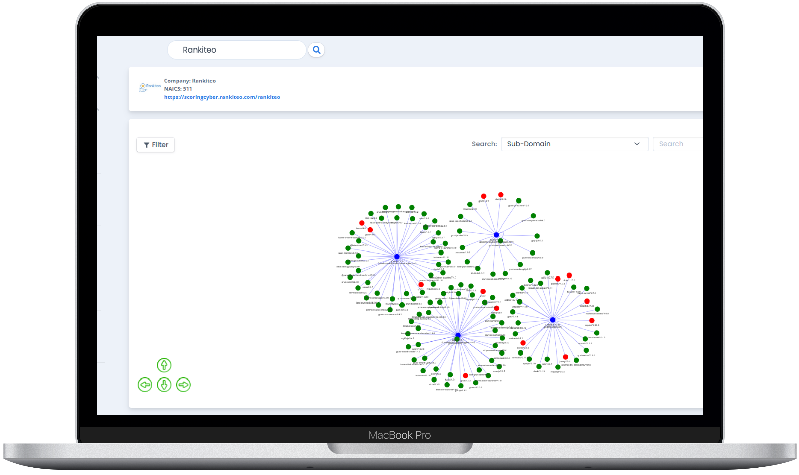
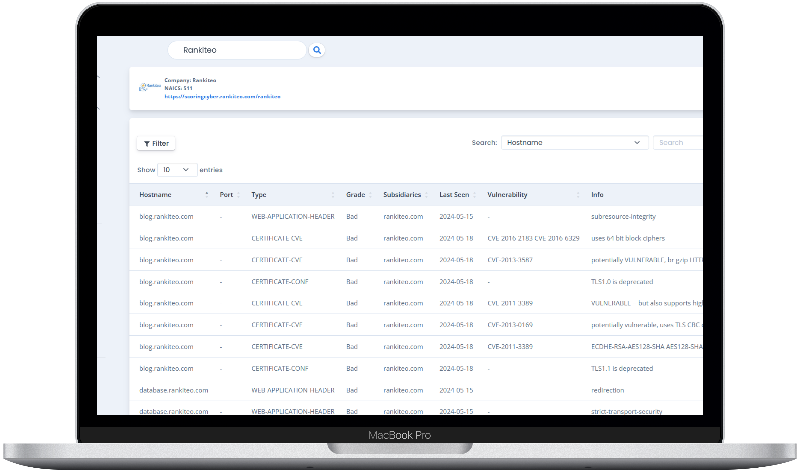
Identify exposed access points, detect misconfigured SSL certificates, and uncover vulnerabilities across the network infrastructure.
Gain visibility into the software components used within an organization to detect vulnerabilities, manage risk, and ensure supply chain security.
Monitor and manage all IT assets and their configurations to ensure accurate, real-time visibility across the company's technology environment.
Leverage real-time insights on active threats, malware campaigns, and emerging vulnerabilities to proactively defend against evolving cyberattacks.



 Conduent
 Salesforce




 Rapid
Rapid