






Apollo Hospitals
Company Details
Linkedin ID:
theapollohospitals
Website:
Employees number:
37,617
Number of followers:
937,837
NAICS:
62
Industry Type:
Homepage:
apollohospitals.com
IP Addresses:
0
Company ID:
APO_2230881
Scan Status:
In-progress


Apollo Hospitals Vendor Cyber Rating & Cyber Score
apollohospitals.comDriven by the vision of its Chairman, Dr. Prathap C. Reddy, the Apollo Hospitals Group pioneered corporate healthcare in India. Apollo revolutionized healthcare when Dr Prathap Reddy opened the first hospital in Chennai in 1983. Today Apollo is the world’s largest integrated healthcare platform with over 10,000 beds across 73 hospitals, over 6000 pharmacies and over 2500 clinics and diagnostic centers as well as 500+ telemedicine centers. Since its inception, Apollo has emerged as one of the world's premier cardiac centers, having conducted over 300,000+ angioplasties and 200,000+ surgeries. Apollo continues to invest in research to bring the most cutting-edge technologies, equipment and treatment protocols to ensure patients have the best available care in the world. Apollo’s 100,000 family members are dedicated to bringing you the best care and leaving the world better than we found it.
Company Details
theapollohospitals
37,617
937,837
62
apollohospitals.com
0
APO_2230881
In-progress
 Apollo Hospitals Risk Score (AI oriented)
Between 750 and 799
 Apollo Hospitals Global Score (TPRM)
XXXX
Description: Apollo Hospitals, one of India’s largest private healthcare chains, faced a 247% surge in cyberattacks in early 2025, with persistent threats targeting its hospital systems and patient portals. Cybercriminals exploited vulnerabilities in digital health records, leading to disruptions in critical services, including delayed surgeries, compromised diagnostic reports, and unauthorized access to patient data. The attack vector primarily involved DDoS overloads and phishing scams targeting employee accounts, crippling internal communication systems during peak operational hours. The breach resulted in leaked medical histories of high-profile patients, including politicians and business leaders, alongside the exposure of sensitive treatment details of cancer and cardiac patients. Emergency response systems experienced 12-hour outages, forcing manual record-keeping and postponing elective procedures. While no direct fatalities were reported, the incident triggered regulatory scrutiny and a mass patient lawsuit, alleging negligence in safeguarding health data. The hospital’s reputation suffered irreversible damage, with a 30% drop in outpatient visits in the following quarter. Recovery efforts involved complete overhauls of legacy IT infrastructure, costing an estimated ₹120 crore ($14.5M) in remediation and legal settlements.


No incidents recorded for Apollo Hospitals in 2026.
No incidents recorded for Apollo Hospitals in 2026.
No incidents recorded for Apollo Hospitals in 2026.
Apollo Hospitals cyber incidents detection timeline including parent company and subsidiaries

Driven by the vision of its Chairman, Dr. Prathap C. Reddy, the Apollo Hospitals Group pioneered corporate healthcare in India. Apollo revolutionized healthcare when Dr Prathap Reddy opened the first hospital in Chennai in 1983. Today Apollo is the world’s largest integrated healthcare platform with over 10,000 beds across 73 hospitals, over 6000 pharmacies and over 2500 clinics and diagnostic centers as well as 500+ telemedicine centers. Since its inception, Apollo has emerged as one of the world's premier cardiac centers, having conducted over 300,000+ angioplasties and 200,000+ surgeries. Apollo continues to invest in research to bring the most cutting-edge technologies, equipment and treatment protocols to ensure patients have the best available care in the world. Apollo’s 100,000 family members are dedicated to bringing you the best care and leaving the world better than we found it.

At Mercy Health, we understand that every family is a universe. A network of people who love, and support, and count on one other to be there. Everybody means the world to someone and we are committed to care for others so they can be there for the ones they love. With nearly 35,000 employees across

We are Erasmus MC. Our roots lie in Rotterdam, a city and port of international standing. We are the most innovative university medical center in the Netherlands and one of the world’s leading centers of scientific research. We are committed to achieving a healthy population and pursuing excellence
The International SOS Group of Companies has been in the business of saving lives for over 40 years. Protecting global workforces from health and security threats, we deliver customised health, security risk management and wellbeing solutions to fuel our clients’ growth and productivity. In the even

At NewYork-Presbyterian, we put patients first. It’s the kind of work that requires an unwavering commitment to excellence and a steady spirit of professionalism. And it’s a unique opportunity for you to collaborate with some of the brightest minds in health care, while building on our success as on

The University Medical Center Utrecht is one of the largest academic healthcare institutions in the Netherlands. We provide the best healthcare for today’s patients, and we also work towards a healthy society in the future. Our organization has three core tasks: care, research and education. Ca

Advocate Health is redefining how, when and where care is delivered to help people live well. We’re providing equitable care for all in our communities and using our combined strength and expertise to deliver better outcomes at a lower cost. Headquartered in Charlotte, North Carolina, we have a com
NMC Healthcare is one of the largest private healthcare networks in the United Arab Emirates. Since 1975, we have provided high quality, personalised, and compassionate care to our patients and are proud to have earned the trust of millions of people in the UAE and around the world. ---------------
Fortis Healthcare Group is a leading integrated healthcare provider operating across the Asia Pacific region. With more than 20,000 employees and growing, Fortis Helathcare is currently present in Australia, Canada, Hong Kong SAR, India, Mauritius, New Zealand, Singapore, Sri Lanka, UAE, and Vietnam
Whether you are searching for your next career opportunity or looking for care for yourself or a family member, you’ll find what you need at Scripps. Founded in 1924 by philanthropist Ellen Browning Scripps, Scripps is a non-profit integrated health care delivery system based in San Diego, Calif. W
.png)
New Delhi, March 9 Cybersecurity researchers have reported a sharp rise in cyber threats targeting US critical infrastructure following the...
New Delhi, March 9 IT industry's apex body Nasscom on Monday issued an advisory to member companies, urging heightened vigilance and...
New Delhi [India], March 9 : In light of the evolving geopolitical situation in the Middle East, Nasscom has issued another advisory to...
Cyber Security and Cyber Crime Investigation Course inaugurated in Pune to create skilled professionals amid rising cyber crime threats.
The cyberattack occurred in May 2025, when vendor ApolloMD's network was compromised. The full scope of the breach was reported to HHS on...
As executive vice chairperson, Preetha Reddy, the eldest daughter of Apollo Hospitals founder Prathap Reddy, is digitizing the family's $12.4 billion...
Indian healthcare in 2026 enters an era of digital accountability, driven by AI, interoperability, cybersecurity and responsible,...
India's influence on global patient safety and healthcare governance was showcased at the Apollo Hospitals International Health Dialogue...
The acting head of the US cyber defense agency uploaded sensitive contracting records to ChatGPT, triggering security alerts.

Explore insights on cybersecurity incidents, risk posture, and Rankiteo's assessments.
The official website of Apollo Hospitals is https://www.apollohospitals.com.
According to Rankiteo, Apollo Hospitals’s AI-generated cybersecurity score is 794, reflecting their Fair security posture.
According to Rankiteo, Apollo Hospitals currently holds 0 security badges, indicating that no recognized compliance certifications are currently verified for the organization.
According to Rankiteo, Apollo Hospitals has not been affected by any supply chain cyber incidents, and no incident IDs are currently listed for the organization.
According to Rankiteo, Apollo Hospitals is not certified under SOC 2 Type 1.
According to Rankiteo, Apollo Hospitals does not hold a SOC 2 Type 2 certification.
According to Rankiteo, Apollo Hospitals is not listed as GDPR compliant.
According to Rankiteo, Apollo Hospitals does not currently maintain PCI DSS compliance.
According to Rankiteo, Apollo Hospitals is not compliant with HIPAA regulations.
According to Rankiteo,Apollo Hospitals is not certified under ISO 27001, indicating the absence of a formally recognized information security management framework.
Apollo Hospitals operates primarily in the Hospitals and Health Care industry.
Apollo Hospitals employs approximately 37,617 people worldwide.
Apollo Hospitals presently has no subsidiaries across any sectors.
Apollo Hospitals’s official LinkedIn profile has approximately 937,837 followers.
Apollo Hospitals is classified under the NAICS code 62, which corresponds to Health Care and Social Assistance.
No, Apollo Hospitals does not have a profile on Crunchbase.
Yes, Apollo Hospitals maintains an official LinkedIn profile, which is actively utilized for branding and talent engagement, which can be accessed here: https://www.linkedin.com/company/theapollohospitals.
As of March 30, 2026, Rankiteo reports that Apollo Hospitals has experienced 1 cybersecurity incidents.
Apollo Hospitals has an estimated 32,295 peer or competitor companies worldwide.
Incident Types: The types of cybersecurity incidents that have occurred include Cyber Attack.
Detection and Response: The company detects and responds to cybersecurity incidents through an incident response plan activated with yes (ai-driven threat detection), and containment measures with ai-based attack blocking, containment measures with advanced threat detection, and enhanced monitoring with emphasized by experts..
Title: Surge in Cyberattacks Across India's Critical Sectors (January–June 2025)
Description: India witnessed a 15% rise in cyberattacks in 2025, with 4.26 billion attacks blocked across sectors like insurance, banking, healthcare, manufacturing, and e-commerce. DDoS, API exploits, and employee-targeted attacks surged, highlighting vulnerabilities in digital infrastructure. AI-driven defenses played a key role in mitigation, but experts emphasize the need for proactive monitoring, training, and international cooperation.
Date Detected: 2025-01-01
Date Publicly Disclosed: 2025-07-01
Type: Cyberattack Surge
Attack Vector: DDoSAPI VulnerabilitiesEmployee Credential TheftSystem ExploitsCloud Attacks
Vulnerability Exploited: Unpatched APIsWeak Employee CredentialsOutdated Factory Digital SystemsCloud Security Gaps
Motivation: Financial GainData TheftDisruption of ServicesEspionage (Potential)
Common Attack Types: The most common types of attacks the company has faced is Cyber Attack.
Identification of Attack Vectors: The company identifies the attack vectors used in incidents through Compromised Employee AccountsUnsecured APIsOutdated Systems.

Data Compromised: Customer data (insurance), Patient data (healthcare), Payment card information (retail), Employee credentials, Third-party api data
Systems Affected: Insurance PortalsBanking/FINTECH PlatformsHealthcare PortalsManufacturing Supply ChainsE-commerce WebsitesCloud Infrastructure
Operational Impact: Disrupted Financial TransactionsHospital Service OutagesSupply Chain InterruptionsE-commerce Fraud
Brand Reputation Impact: High (Erosion of Public Trust Across Sectors)
Identity Theft Risk: High (Credential Theft in Retail/E-commerce)
Payment Information Risk: High (Fraudulent Card Transactions in Retail)
Commonly Compromised Data Types: The types of data most commonly compromised in incidents are Customer Data, Patient Records, Payment Information, Employee Credentials and .
Entity Name: Indian Insurance Sector
Entity Type: Industry Sector
Industry: Insurance
Location: India
Entity Name: Indian Banking & Financial Services
Entity Type: Industry Sector
Industry: Banking/Finance
Location: India
Entity Name: Indian Healthcare Sector
Entity Type: Industry Sector
Industry: Healthcare
Location: India
Entity Name: Indian Manufacturing & Industrial Sector
Entity Type: Industry Sector
Industry: Manufacturing
Location: India
Entity Name: Indian Retail & E-commerce Sector
Entity Type: Industry Sector
Industry: Retail/E-commerce
Location: India
Entity Name: Indian Small Businesses
Entity Type: Industry Sector
Industry: Diverse (SMEs)
Location: India
Size: Small
Incident Response Plan Activated: Yes (AI-Driven Threat Detection)
Containment Measures: AI-Based Attack BlockingAdvanced Threat Detection
Enhanced Monitoring: Emphasized by Experts
Incident Response Plan: The company's incident response plan is described as Yes (AI-Driven Threat Detection).
Type of Data Compromised: Customer data, Patient records, Payment information, Employee credentials
Sensitivity of Data: High (PII, Financial, Health Data)
Personally Identifiable Information: Yes
Handling of PII Incidents: The company handles incidents involving personally identifiable information (PII) through by ai-based attack blocking, advanced threat detection and .
Lessons Learned: Cybersecurity is a national security and economic stability issue, not just a technical challenge., AI and advanced tools are critical but insufficient without proactive monitoring and trained staff., International cooperation is essential for a digitizing economy like India., Sectors must prioritize employee training, system updates, and robust cyber policies.
Recommendations: Implement continuous monitoring and real-time threat detection., Conduct regular employee cybersecurity training, especially for credential hygiene., Strengthen API security with zero-trust frameworks and encryption., Update and patch factory digital systems and supply chain infrastructures., Enhance cloud security measures for small businesses., Foster public-private partnerships for information sharing., Invest in adaptive behavioral WAFs and DDoS mitigation services., Develop sector-specific incident response plans with regulatory alignment.Implement continuous monitoring and real-time threat detection., Conduct regular employee cybersecurity training, especially for credential hygiene., Strengthen API security with zero-trust frameworks and encryption., Update and patch factory digital systems and supply chain infrastructures., Enhance cloud security measures for small businesses., Foster public-private partnerships for information sharing., Invest in adaptive behavioral WAFs and DDoS mitigation services., Develop sector-specific incident response plans with regulatory alignment.Implement continuous monitoring and real-time threat detection., Conduct regular employee cybersecurity training, especially for credential hygiene., Strengthen API security with zero-trust frameworks and encryption., Update and patch factory digital systems and supply chain infrastructures., Enhance cloud security measures for small businesses., Foster public-private partnerships for information sharing., Invest in adaptive behavioral WAFs and DDoS mitigation services., Develop sector-specific incident response plans with regulatory alignment.Implement continuous monitoring and real-time threat detection., Conduct regular employee cybersecurity training, especially for credential hygiene., Strengthen API security with zero-trust frameworks and encryption., Update and patch factory digital systems and supply chain infrastructures., Enhance cloud security measures for small businesses., Foster public-private partnerships for information sharing., Invest in adaptive behavioral WAFs and DDoS mitigation services., Develop sector-specific incident response plans with regulatory alignment.Implement continuous monitoring and real-time threat detection., Conduct regular employee cybersecurity training, especially for credential hygiene., Strengthen API security with zero-trust frameworks and encryption., Update and patch factory digital systems and supply chain infrastructures., Enhance cloud security measures for small businesses., Foster public-private partnerships for information sharing., Invest in adaptive behavioral WAFs and DDoS mitigation services., Develop sector-specific incident response plans with regulatory alignment.Implement continuous monitoring and real-time threat detection., Conduct regular employee cybersecurity training, especially for credential hygiene., Strengthen API security with zero-trust frameworks and encryption., Update and patch factory digital systems and supply chain infrastructures., Enhance cloud security measures for small businesses., Foster public-private partnerships for information sharing., Invest in adaptive behavioral WAFs and DDoS mitigation services., Develop sector-specific incident response plans with regulatory alignment.Implement continuous monitoring and real-time threat detection., Conduct regular employee cybersecurity training, especially for credential hygiene., Strengthen API security with zero-trust frameworks and encryption., Update and patch factory digital systems and supply chain infrastructures., Enhance cloud security measures for small businesses., Foster public-private partnerships for information sharing., Invest in adaptive behavioral WAFs and DDoS mitigation services., Develop sector-specific incident response plans with regulatory alignment.Implement continuous monitoring and real-time threat detection., Conduct regular employee cybersecurity training, especially for credential hygiene., Strengthen API security with zero-trust frameworks and encryption., Update and patch factory digital systems and supply chain infrastructures., Enhance cloud security measures for small businesses., Foster public-private partnerships for information sharing., Invest in adaptive behavioral WAFs and DDoS mitigation services., Develop sector-specific incident response plans with regulatory alignment.
Key Lessons Learned: The key lessons learned from past incidents are Cybersecurity is a national security and economic stability issue, not just a technical challenge.,AI and advanced tools are critical but insufficient without proactive monitoring and trained staff.,International cooperation is essential for a digitizing economy like India.,Sectors must prioritize employee training, system updates, and robust cyber policies.
Implemented Recommendations: The company has implemented the following recommendations to improve cybersecurity: Develop sector-specific incident response plans with regulatory alignment., Strengthen API security with zero-trust frameworks and encryption., Implement continuous monitoring and real-time threat detection., Conduct regular employee cybersecurity training, especially for credential hygiene., Enhance cloud security measures for small businesses., Update and patch factory digital systems and supply chain infrastructures., Invest in adaptive behavioral WAFs and DDoS mitigation services. and Foster public-private partnerships for information sharing..
Source: Cybersecurity Report (January–June 2025)
Source: Expert Insights by Prof. Triveni Singh (Former IPS Officer)
Additional Resources: Stakeholders can find additional resources on cybersecurity best practices at and Source: Cybersecurity Report (January–June 2025), and Source: Expert Insights by Prof. Triveni Singh (Former IPS Officer).
Investigation Status: Ongoing (Sector-Wide Analysis)
Stakeholder Advisories: Experts advise strategic collaboration, policy reforms, and resource allocation for cybersecurity.
Advisories Provided: The company provides the following advisories to stakeholders and customers following an incident: were Experts advise strategic collaboration, policy reforms and and resource allocation for cybersecurity..
Entry Point: Compromised Employee Accounts, Unsecured Apis, Outdated Systems,
High Value Targets: Financial Data, Patient Records, Supply Chain Systems,
Data Sold on Dark Web: Financial Data, Patient Records, Supply Chain Systems,
Root Causes: Rapid Digitization Without Proportional Security Scaling, Underinvestment In Employee Training And Api Security, Lagging Updates To Industrial And Cloud Systems, Insufficient International Cooperation For Threat Intelligence,
Corrective Actions: Mandate Cybersecurity Audits For Critical Sectors., Establish A National Cybersecurity Task Force With Industry Representation., Incentivize Smes To Adopt Baseline Security Measures., Integrate Ai-Driven Threat Intelligence Into National Defense Strategies.,
Post-Incident Analysis Process: The company's process for conducting post-incident analysis is described as Emphasized by Experts.
Corrective Actions Taken: The company has taken the following corrective actions based on post-incident analysis: Mandate Cybersecurity Audits For Critical Sectors., Establish A National Cybersecurity Task Force With Industry Representation., Incentivize Smes To Adopt Baseline Security Measures., Integrate Ai-Driven Threat Intelligence Into National Defense Strategies., .
Most Recent Incident Detected: The most recent incident detected was on 2025-01-01.
Most Recent Incident Publicly Disclosed: The most recent incident publicly disclosed was on 2025-07-01.
Most Significant Data Compromised: The most significant data compromised in an incident were Customer Data (Insurance), Patient Data (Healthcare), Payment Card Information (Retail), Employee Credentials, Third-Party API Data and .
Most Significant System Affected: The most significant system affected in an incident was Insurance PortalsBanking/FINTECH PlatformsHealthcare PortalsManufacturing Supply ChainsE-commerce WebsitesCloud Infrastructure.
Containment Measures in Most Recent Incident: The containment measures taken in the most recent incident was AI-Based Attack BlockingAdvanced Threat Detection.
Most Sensitive Data Compromised: The most sensitive data compromised in a breach were Patient Data (Healthcare), Payment Card Information (Retail), Customer Data (Insurance), Employee Credentials and Third-Party API Data.
Most Significant Lesson Learned: The most significant lesson learned from past incidents was Sectors must prioritize employee training, system updates, and robust cyber policies.
Most Significant Recommendation Implemented: The most significant recommendation implemented to improve cybersecurity was Develop sector-specific incident response plans with regulatory alignment., Strengthen API security with zero-trust frameworks and encryption., Implement continuous monitoring and real-time threat detection., Conduct regular employee cybersecurity training, especially for credential hygiene., Enhance cloud security measures for small businesses., Update and patch factory digital systems and supply chain infrastructures., Invest in adaptive behavioral WAFs and DDoS mitigation services. and Foster public-private partnerships for information sharing..
Most Recent Source: The most recent source of information about an incident are Expert Insights by Prof. Triveni Singh (Former IPS Officer) and Cybersecurity Report (January–June 2025).
Current Status of Most Recent Investigation: The current status of the most recent investigation is Ongoing (Sector-Wide Analysis).
Most Recent Stakeholder Advisory: The most recent stakeholder advisory issued was Experts advise strategic collaboration, policy reforms, and resource allocation for cybersecurity., .
.png)
A vulnerability was identified in Totolink A3300R 17.0.0cu.557_b20221024. This affects the function setLanCfg of the file /cgi-bin/cstecgi.cgi of the component Parameter Handler. The manipulation of the argument lanIp leads to command injection. Remote exploitation of the attack is possible. The exploit is publicly available and might be used.
Perl versions from 5.9.4 before 5.40.4-RC1, from 5.41.0 before 5.42.2-RC1, from 5.43.0 before 5.43.9 contain a vulnerable version of Compress::Raw::Zlib. Compress::Raw::Zlib is included in the Perl package as a dual-life core module, and is vulnerable to CVE-2026-3381 due to a vendored version of zlib which has several vulnerabilities, including CVE-2026-27171. The bundled Compress::Raw::Zlib was updated to version 2.221 in Perl blead commit c75ae9cc164205e1b6d6dbd57bd2c65c8593fe94.
Ghidra versions prior to 12.0.3 improperly process annotation directives embedded in automatically extracted binary data, resulting in arbitrary command execution when an analyst interacts with the UI. Specifically, the @execute annotation (which is intended for trusted, user-authored comments) is also parsed in comments generated during auto-analysis (such as CFStrings in Mach-O binaries). This allows a crafted binary to present seemingly benign clickable text which, when clicked, executes attacker-controlled commands on the analyst’s machine.
A critical security vulnerability in parisneo/lollms versions up to 2.2.0 allows any authenticated user to accept or reject friend requests belonging to other users. The `respond_request()` function in `backend/routers/friends.py` does not implement proper authorization checks, enabling Insecure Direct Object Reference (IDOR) attacks. Specifically, the `/api/friends/requests/{friendship_id}` endpoint fails to verify whether the authenticated user is part of the friendship or the intended recipient of the request. This vulnerability can lead to unauthorized access, privacy violations, and potential social engineering attacks. The issue has been addressed in version 2.2.0.
A Server-Side Request Forgery (SSRF) vulnerability exists in parisneo/lollms versions prior to 2.2.0, specifically in the `/api/files/export-content` endpoint. The `_download_image_to_temp()` function in `backend/routers/files.py` fails to validate user-controlled URLs, allowing attackers to make arbitrary HTTP requests to internal services and cloud metadata endpoints. This vulnerability can lead to internal network access, cloud metadata access, information disclosure, port scanning, and potentially remote code execution.

Get company history

Every week, Rankiteo analyzes billions of signals to give organizations a sharper, faster view of emerging risks. With deeper, more actionable intelligence at their fingertips, security teams can outpace threat actors, respond instantly to Zero-Day attacks, and dramatically shrink their risk exposure window.
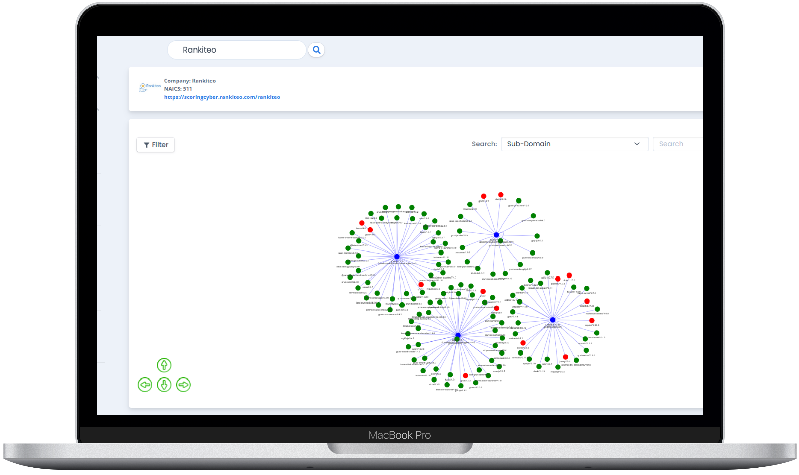
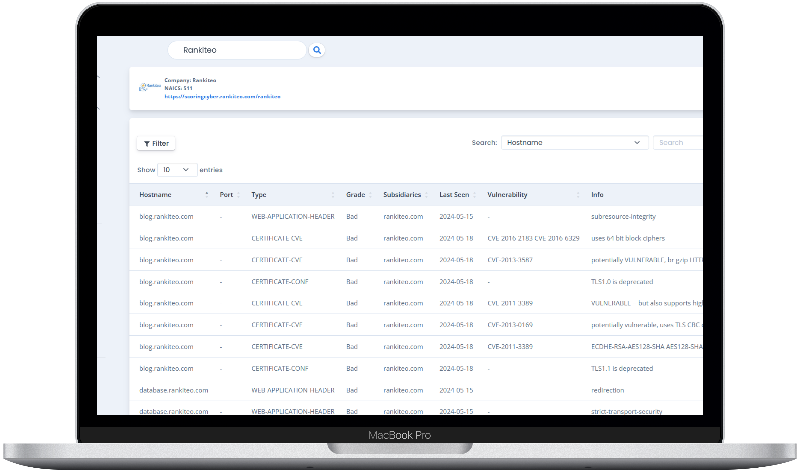
Identify exposed access points, detect misconfigured SSL certificates, and uncover vulnerabilities across the network infrastructure.
Gain visibility into the software components used within an organization to detect vulnerabilities, manage risk, and ensure supply chain security.
Monitor and manage all IT assets and their configurations to ensure accurate, real-time visibility across the company's technology environment.
Leverage real-time insights on active threats, malware campaigns, and emerging vulnerabilities to proactively defend against evolving cyberattacks.







 Rapid
Rapid