








Stryker
Company Details
Linkedin ID:
stryker
Website:
Employees number:
50,225
Number of followers:
1,694,532
NAICS:
3391
Industry Type:
Homepage:
stryker.com
IP Addresses:
310
Company ID:
STR_3135691
Scan Status:
Completed


Stryker Vendor Cyber Rating & Cyber Score
stryker.comStryker is a global leader in medical technologies and, together with our customers, we are driven to make healthcare better. We offer innovative products and services in MedSurg, Neurotechnology and Orthopaedics that help improve patient and healthcare outcomes. Alongside its customers around the world, Stryker impacts more than 150 million patients annually. More information is available at stryker.com and careers.stryker.com. Facts: ● 2024 Sales: $22.6 billion ● Industry: Medical Instruments & Supplies ● Employees: 53,000 worldwide ● 40 years of sales growth leading up to 2020 ● 44+ Manufacturing and R&D Locations Worldwide ● $1.5 billion spent on research and development in 2024 ● ~14,200 patents owned globally in 2024 ● Products sold in ~75 countries ● Fortune 500 Company ● 7 consecutive years as one of Fortune's World's Best Workplaces Stryker’s social media community guidelines: https://www.stryker.com/content/m/legal/social-media-community-guidelines/en/index.html Notice Regarding Employee Conduct on Facebook/LinkedIn Meta/LinkedIn does not permit employers to verify or validate “employees” in the (META: “Works at” LinkedIn: “Experience”) section of users’ profiles. Please be aware that the views expressed by individuals on their personal accounts and do not necessarily represent the views of our company. If you encounter any issues with a person claiming to be our employee, we recommend using the “Report Profile” feature. If you’d like to report concerns to our Ethics Hotline, you may do so at: https://app.convercent.com/en-us/LandingPage/b6bb4e84-9fcb-ea11-a974-000d3ab9f296
Company Details
stryker
50,225
1,694,532
3391
stryker.com
310
STR_3135691
Completed
 Stryker Risk Score (AI oriented)
Between 650 and 699
 Stryker Global Score (TPRM)
XXXX
Description: Iranian-Backed Hackers Breach FBI Director’s Personal Email, Leak Private Photos On March 27, 2026, the Iranian-linked hacktivist group Handala Hack Team claimed responsibility for accessing the personal emails of FBI Director Kash Patel, publishing alleged photos and documents as proof. The leaked images dated between 2010 and 2019 depict Patel in personal settings, including vacations and social gatherings. The U.S. Justice Department confirmed the breach, verifying the authenticity of the materials. Handala framed the attack as retaliation for the ongoing U.S.-Iran conflict and the FBI’s $10 million bounty for information on its members. The group boasted of bypassing the FBI’s security systems, though officials clarified that only Patel’s personal Gmail account not government systems was compromised. The incident highlights persistent risks tied to officials using personal emails for professional matters. About Handala Hack Team Active since 2023 and linked to Iran’s Ministry of Intelligence and Security, Handala specializes in disruptive cyberattacks, often targeting Israeli and Western entities. The group has previously breached Lockheed Martin and executed a 200,000-user data wipe at medical tech firm Stryker, leveraging malware designed to delete or expose sensitive data. The breach underscores vulnerabilities in personal email security, even among high-profile officials.
Description: Loblaw Faces Alleged Massive Data Breach as Threat Actor Demands Response A threat actor operating under the handle *"igotafeeling"* on the *DarkWeb Informer* forum has claimed to have breached Loblaw, Canada’s largest food and pharmacy retailer, which owns brands like *President’s Choice, No Frills, Shoppers Drug Mart, Real Canadian Superstore*, and the *PC Optimum* loyalty program. The actor alleges possession of over 1.8 billion records, including: - 75.1 million Salesforce customer records (names, emails, phone numbers, addresses, loyalty IDs, and health card numbers) - 724.9 million Shoppers Drug Mart records (passwords, tokens, loyalty IDs, payment details, and full credit card numbers with expiry dates) - 129.9 million pharmacy fill requests (prescription numbers and patient IDs) - 120.4 million e-commerce fraud-feed records (payment card BINs, last-four digits, and expiry dates) - 20.2 million Delivery Ops Portal records (orders, deliveries, and postal codes) - 3,014 GitLab projects containing Loblaw’s full source code - 19.3 million Oracle identity records (MFA device details and credentials) - 55.3 million marketing and email records across 673 tables The threat actor has given Loblaw until March 19 to respond, accusing the company of *"ghosting"* them and dismissing customer and investor concerns. They have also invited media organizations to verify the data’s authenticity. In response, Loblaw issued a March 12 press release, labeling the incident a *"low-level data breach"* and stating that only *"basic customer information"* (names, phone numbers, and emails) may have been accessed. The company explicitly denied evidence of financial or credit card data compromise directly contradicting the threat actor’s claims. While the breach remains unverified, the scale of the alleged exposure if confirmed would rank among the largest in Canadian history. The situation mirrors past high-profile breaches (e.g., *T-Mobile, Equifax, Capital One*), where initial corporate statements downplayed impact before later revelations proved otherwise. Loblaw customers with *PC Optimum accounts, Shoppers Drug Mart loyalty cards, or prescription histories* may be affected if the claims hold true. The deadline for Loblaw’s response is six days away.
Description: Stryker Hit by Global Cyberattack Disrupting Medical Technology Services On March 11, Stryker, a leading medical technology provider serving hospitals worldwide, confirmed a global cyberattack that disrupted its operations. The company reported that its Microsoft environment was compromised but found no evidence of ransomware or malware. Stryker stated the incident had been contained. John Riggi, the American Hospital Association’s (AHA) national advisor for cybersecurity and risk, acknowledged the attack, noting ongoing collaboration with hospitals and federal agencies to assess the threat’s scope. While no direct disruptions to U.S. hospital operations have been reported, Riggi warned that impacts could emerge as hospitals evaluate Stryker’s services, technology, and supply chain particularly if the disruption persists. The incident highlights the vulnerability of critical healthcare infrastructure to cyber threats, even in the absence of traditional ransomware tactics. Further details on the attack’s origin and full impact remain under investigation.
Description: Stryker Hit by Destructive Cyberattack Linked to Iranian-Backed Group A global medical technology firm, Stryker, suffered a devastating wiper cyberattack on Wednesday, suspected to be orchestrated by Handala Hack, a group with ties to the Iranian regime. The attack targeted the company’s Cork, Ireland headquarters, where up to 5,000 employees including 4,000 in Cork are based, crippling critical IT systems and manufacturing operations. The National Cyber Security Centre (NCSC) in Dublin is responding to the incident, which involved the permanent deletion of data from infected systems a hallmark of wiper attacks, typically politically motivated rather than financially driven. Devices connected to Stryker’s network, including employee phones with Outlook installed, were wiped, and login screens were defaced with the Handala logo, a symbol of Palestinian resistance. The attack has disrupted production of Stryker’s medical devices, with some manufacturing machines still operational but their long-term functionality uncertain. Staff were instructed to avoid connecting to the company’s network via any device, including mobile apps like Microsoft Teams and Outlook, while recovery efforts continue. Employees have been sent home, relying on WhatsApp groups for updates. Stryker, which operates six manufacturing sites and three innovation centers in Ireland, is one of the country’s largest medical tech employers. The company confirmed the incident in a staff memo, stating that security experts and law enforcement are involved in the response, emphasizing that sites and personnel remain safe while efforts focus on restoring systems. Handala Hack, linked to Iran’s cyber warfare campaigns, has recently targeted Israeli, Jordanian, and Saudi oil and gas facilities, as well as the Academy of the Hebrew Language, according to Israeli media. The Israeli National Cyber Directorate has warned of a surge in Iranian cyberattacks against civilian companies, suggesting Stryker may have been targeted due to its business ties with Israel. The attack underscores Iran’s expanding cyber-economic warfare, extending beyond regional conflicts to global operations. With Ireland serving as Stryker’s largest hub outside the U.S., the incident highlights the growing threat of state-backed cyber sabotage in critical industries.
Description: Iranian-Linked Pay2Key Ransomware Targets U.S. Healthcare Organization Amid Rising Cyber Conflict In late February, an unnamed U.S. healthcare organization fell victim to a ransomware attack by Pay2Key, a strain linked to Iranian state-affiliated cyber actors. The incident, investigated by Beazley Security and Halcyon Ransomware Research Center, revealed significant upgrades to the ransomware, making it harder to detect and more destructive. Unlike typical financially motivated attacks, this intrusion showed no evidence of data exfiltration a departure from previous Pay2Key operations, which U.S. intelligence agencies had tied to espionage. Researchers noted the group’s activity surged following recent U.S.-Iran military tensions, suggesting motivations beyond profit, including strategic disruption. The attackers compromised an administrative account days before deploying the ransomware, then attempted to erase logs to cover their tracks. Cynthia Kaiser, Halcyon’s senior vice president and former FBI Cyber Division official, questioned whether the attack was timed to exploit geopolitical chaos, emphasizing the group’s dual role as both a state-aligned actor and a ransomware-as-a-service (RaaS) operator. Pay2Key has undergone significant shifts in recent months. In mid-2025, the group marketed itself on Russian cybercriminal forums, briefly offering to sell its operations for 0.15 BTC while recruiting affiliates with an 80% ransom split up from 70%. Despite internal upheaval, the group remains active, with Morphisec tracking $4 million in ransom payments over four months and a total of $8 million from 170 victims since then. First identified in 2020, Pay2Key has targeted organizations in the U.S., Israel, Azerbaijan, and the UAE, with ransom payments traced to Excoino, an Iranian cryptocurrency exchange requiring national ID verification. A 2024 U.S. advisory highlighted its coordination with other ransomware gangs, reinforcing its ties to Iranian government operations. The healthcare attack preceded a high-profile wiper attack on Stryker, a U.S. medical device company, claimed by the Iranian group Handala, which wiped 200,000 devices. Kaiser warned that unreported Iranian cyberattacks are likely ongoing, with a mix of ransomware, wiper malware, and critical infrastructure targeting expected as tensions persist.
Description: Stryker Cyberattack Disrupts Global Medical Equipment Operations U.S.-based medical technology giant Stryker confirmed that a cyberattack disrupted its global networks, impacting operations across its systems. The incident, disclosed in recent reports, highlights growing cybersecurity threats targeting critical healthcare infrastructure. Stryker, a leading manufacturer of surgical equipment, implants, and medical devices, has not released details on the nature of the attack, its origin, or whether ransomware or data exfiltration was involved. The company has not specified the duration of the disruption or the extent of the operational impact, though such incidents often lead to delays in production, supply chain interruptions, and potential risks to patient care. The attack underscores the vulnerability of healthcare and medical device companies to cyber threats, which have increasingly become high-value targets for malicious actors. No further updates on recovery efforts or regulatory responses have been provided at this time.
Description: Stryker Hit by Suspected Iran-Linked Cyberattack, Causing Global Outages Medical technology giant Stryker suffered a global system outage on March 10, 2025, following a suspected cyberattack linked to an Iran-backed hacking group. The incident began shortly after midnight on the U.S. East Coast, disrupting operations across the company’s network. According to reports, remote devices running Microsoft Windows including laptops and mobile devices connected to Stryker’s systems were wiped, rendering them inoperable. Employees and contractors reported seeing the logo of Handala, a pro-Palestinian hacking group with alleged ties to Iran, on login screens, though Reuters could not independently verify the claim. The attack triggered a 3% drop in Stryker’s stock price after *The Wall Street Journal* first reported the breach. The company has not yet issued an official response to requests for comment. Stryker, a major supplier of medical equipment, operates globally, with facilities including a plant in Carrigtwohill, Ireland. The full extent of the disruption and potential data compromise remains unclear.
Description: Pro-Iranian Hackers Claim Breach of FBI Director’s Personal Account A pro-Iranian hacking group, Handala, announced on Friday that it had compromised an account belonging to FBI Director Kash Patel, releasing decades-old personal photographs, a resume, and other documents online. The group, which has ties to Iran and Palestine, posted a statement alongside the materials, taunting Patel and declaring him among their "successfully hacked victims." The leaked files including images of Patel with a vintage sports car and a cigar appear to date back over a decade, primarily involving personal travel and business records. The FBI confirmed awareness of the incident, stating that the exposed data was historical and contained no classified or government information. The bureau added that it had taken steps to mitigate risks from the breach. The timing of the hack remains unclear, though reports from December 2024 indicated Patel had been previously warned by the FBI about Iranian targeting efforts. Handala, which has escalated its cyber operations in recent months, recently claimed responsibility for disrupting systems at Stryker, a Michigan-based medical technology firm, in retaliation for alleged U.S. airstrikes linked to Iranian civilian casualties. The group has been a persistent threat, with the U.S. Justice Department seizing four web domains tied to its operations last week as part of efforts to counter Iranian cyber campaigns. The Trump administration has also offered a $10 million reward for information leading to the identification of Handala members. The incident underscores the growing role of proxy hacking groups in Iran’s broader cyber conflict with Western targets.
Description: The Vermont Office of the Attorney General reported that Stryker Corporation experienced a cybersecurity incident on June 10, 2024. The breach involved unauthorized access to Stryker internal systems between May 14, 2024, and June 10, 2024, affecting an unspecified number of individuals and potentially compromising personal information including names. A notification letter was included with the report.
Description: Iranian Threat Actor Handala Hack Launches Destructive Cyberattacks Across Israel, Albania, and the U.S. A cyber threat group linked to Iran’s Ministry of Intelligence and Security (MOIS), known as Handala Hack (also tracked as Void Manticore, Red Sandstorm, and Banished Kitten), has executed a series of data-destructive attacks targeting organizations in Israel, Albania, and the United States. Unlike traditional espionage-focused operations, the group’s campaigns are designed to permanently erase data, making recovery nearly impossible. Active since late 2023, Handala Hack operates under multiple public-facing personas, including Homeland Justice (used since mid-2022 against Albanian government and telecom sectors) and Karma (now largely replaced by Handala). Recent attacks expanded to the U.S., with medical technology firm Stryker among the confirmed victims. ### Attack Methods and Evolution Check Point researchers identified consistent yet evolving tactics in the group’s operations. While core techniques such as compromised VPN credentials, RDP exploitation, and simultaneous wiper deployments have remained stable since 2024, newer campaigns incorporate: - NetBird, a legitimate peer-to-peer networking tool, to tunnel traffic within victim networks. - An AI-assisted PowerShell script as part of its wiping toolkit. - A decline in operational security, with attacks traced directly to Iranian IP addresses instead of commercial VPNs. ### Multi-Layered Destruction Handala Hack’s destructive phase employs four simultaneous wiping techniques to maximize damage: 1. Handala Wiper – A custom tool distributed via Group Policy logon scripts (`handala.bat`), overwriting files and corrupting Master Boot Records (MBR). The executable runs remotely from domain controllers, evading detection. 2. AI-PowerShell Wiper – Deletes user directory files and floods drives with a propaganda image (`handala.gif`). 3. VeraCrypt Abuse – Legitimate encryption software is downloaded via the victim’s browser to lock drives and prevent recovery. 4. Manual Deletion – Attackers delete virtual machines and files over RDP, a tactic documented in leaked videos. ### Tactical Execution Intrusions typically begin with compromised VPN credentials, obtained through brute-force attacks or supply chain breaches. Once inside, operators use RDP to navigate manually, deploying multiple attacker-controlled machines within a single environment to accelerate destruction. The group’s lack of operational discipline including direct use of Iranian IPs has made attribution easier. The attacks reflect a shift from espionage to pure sabotage, with no financial or intelligence-gathering motives. Instead, the focus is on maximizing disruption across critical sectors.
Description: Stryker Hit by Cyberattack Claimed by Pro-Iran Hacking Group Handala Medical technology firm Stryker, a leading manufacturer of surgical tools and medical implants based in Kalamazoo, Michigan, confirmed a cyberattack on Wednesday that disrupted its global Microsoft environment. The company stated it had no evidence of ransomware or malware and believed the incident was contained, though it is still assessing the impact. Continuity measures remain in place to support customers and partners. The pro-Iran hacking group Handala claimed responsibility for the attack, alleging it wiped over 200,000 systems, servers, and mobile devices and exfiltrated 50 terabytes of critical data. The group cited retaliation for the ongoing regional conflict and a February 28 airstrike on a girls' elementary school in Minab, Iran, which killed 168 people, as motivations. While the attack’s origins remain unconfirmed, U.S. military operations were reported near the site. Stryker has not disclosed further details, and U.S. officials have not commented on the incident. The investigation is ongoing.
Description: Iran-Linked Hackers Leak FBI Director Kash Patel’s Personal Emails in Cyber Espionage Campaign On March 27, 2026, the Iran-backed hacking group Handala Hack Team publicly released a trove of personal emails belonging to FBI Director Kash Patel, marking a high-profile breach in a series of cyber operations attributed to Iranian state-linked actors. The leaked correspondence, spanning from 2010 to 2019, includes a mix of personal and professional communications tied to Patel’s Gmail account, which had been previously exposed in other data breaches. Western cybersecurity researchers identify Handala as one of several personas used by Iranian government cyberintelligence units, which have recently escalated attacks on Western targets. Earlier this year, the group claimed responsibility for hacking Stryker, a U.S. medical devices manufacturer, further demonstrating its focus on high-value entities. The hackers published photographs of Patel alongside the leaked documents, declaring him among their "successfully hacked victims." A U.S. Justice Department official confirmed the breach, stating that the released material appeared authentic. While the full extent of the compromise remains unclear, the incident underscores the persistent threat posed by state-sponsored cyber espionage, particularly from Iranian-linked groups targeting U.S. officials and critical infrastructure.


Stryker has 581.82% more incidents than the average of same-industry companies with at least one recorded incident.
Stryker has 417.24% more incidents than the average of all companies with at least one recorded incident.
Stryker reported 6 incidents this year: 5 cyber attacks, 0 ransomware, 0 vulnerabilities, 1 data breaches, compared to industry peers with at least 1 incident.
Stryker cyber incidents detection timeline including parent company and subsidiaries

Stryker is a global leader in medical technologies and, together with our customers, we are driven to make healthcare better. We offer innovative products and services in MedSurg, Neurotechnology and Orthopaedics that help improve patient and healthcare outcomes. Alongside its customers around the world, Stryker impacts more than 150 million patients annually. More information is available at stryker.com and careers.stryker.com. Facts: ● 2024 Sales: $22.6 billion ● Industry: Medical Instruments & Supplies ● Employees: 53,000 worldwide ● 40 years of sales growth leading up to 2020 ● 44+ Manufacturing and R&D Locations Worldwide ● $1.5 billion spent on research and development in 2024 ● ~14,200 patents owned globally in 2024 ● Products sold in ~75 countries ● Fortune 500 Company ● 7 consecutive years as one of Fortune's World's Best Workplaces Stryker’s social media community guidelines: https://www.stryker.com/content/m/legal/social-media-community-guidelines/en/index.html Notice Regarding Employee Conduct on Facebook/LinkedIn Meta/LinkedIn does not permit employers to verify or validate “employees” in the (META: “Works at” LinkedIn: “Experience”) section of users’ profiles. Please be aware that the views expressed by individuals on their personal accounts and do not necessarily represent the views of our company. If you encounter any issues with a person claiming to be our employee, we recommend using the “Report Profile” feature. If you’d like to report concerns to our Ethics Hotline, you may do so at: https://app.convercent.com/en-us/LandingPage/b6bb4e84-9fcb-ea11-a974-000d3ab9f296

Boston Scientific transforms lives through innovative medical technologies that improve the health of patients around the world. As a global medical technology leader for more than 40 years, we advance science for life by providing a broad range of high-performance solutions that address unmet patie

Medline is the largest provider of medical-surgical products and supply chain solutions serving all points of care. Through its unique offering of world-class products, supply chain resilience and clinical practice expertise, Medline delivers improved clinical, financial and operational outcomes. He

Edwards Lifesciences (NYSE: EW), is the leading global structural heart innovation company, driven by a passion to improve patient lives. Through breakthrough technologies, world-class evidence and partnerships with clinicians and healthcare stakeholders, our employees are inspired by our patient-fo

We are dedicated to transforming lives by improving the journey to a healthy, beautiful smile. Discover your straight path to a bright future at Align Technology. As a part of our smart, diverse and fast-moving global team, you'll make an impact on the market leader that's moving an industry forwa
BD is one of the largest global medical technology companies in the world and is advancing the world of health™ by improving medical discovery, diagnostics and the delivery of care. The company supports the heroes on the frontlines of health care by developing innovative technology, services and sol

As a leading medical technology company, B. Braun protects and improves the health of people around the world. For more than 185 years, the family-owned company has been accelerating progress in health care with pioneering spirit and groundbreaking contributions. This innovative strength continues t

For nearly a century, we have delivered on our commitment to saving and sustaining the lives of patients, working alongside clinicians and providers around the world. We believe every person — regardless of who they are or where they are from — deserves a chance to live a healthy life, free from ill

Olympus is passionate about creating customer-driven solutions for the medical industry. For more than 100 years, Olympus has focused on making people’s lives healthier, safer and more fulfilling by helping detect, prevent, and treat disease, furthering scientific research, and ensuring public safet
Henry Schein, Inc. (Nasdaq: HSIC) is a solutions company for health care professionals powered by a network of people and technology. With more than 25,000 Team Schein Members worldwide, the Company's network of trusted advisors provides more than 1 million customers globally with more than 300 valu
.png)
Medical device maker Stryker said on Thursday its operations were steadily improving towards full capacity, after a cyberattack caused...
Following its recent cybersecurity incident, medical technology giant Stryker said it found no indication of ransomware or malware.
It has been a busy month for those of us defending hospitals against cyber threats. The news cycle is relentless, so you may or may not have...
Major U.S. medical device firm Stryker has discovered the involvement of a malicious file in the recent cyberattack by Iran-linked...
PORTAGE, MI (WTVB) - Stryker Corporation is facing a wave of proposed class-action lawsuits following a massiv...
A cyberattack at Stryker has sparked multiple lawsuits, which include a current employee, alleging the company failed to adequately protect...
The medical device firm Stryker said it is ramping production lines back up two weeks after alleged Iranian cyber actors wiped more than...
Stryker ( (SYK) ) has provided an announcement. Stryker disclosed that a cybersecurity incident identified and reported to the U.S. SEC on...
PORTAGE, MI (WKZO AM/FM) - Portage-based Stryker Corporation says the cyberattack that hit them earlier this m...

Explore insights on cybersecurity incidents, risk posture, and Rankiteo's assessments.
The official website of Stryker is http://www.stryker.com.
According to Rankiteo, Stryker’s AI-generated cybersecurity score is 667, reflecting their Weak security posture.
According to Rankiteo, Stryker currently holds 0 security badges, indicating that no recognized compliance certifications are currently verified for the organization.
According to Rankiteo, Stryker has been affected by multiple supply chain cyber incidents. The affected supply chain sources and their corresponding incident IDs are:
According to Rankiteo, Stryker is not certified under SOC 2 Type 1.
According to Rankiteo, Stryker does not hold a SOC 2 Type 2 certification.
According to Rankiteo, Stryker is not listed as GDPR compliant.
According to Rankiteo, Stryker does not currently maintain PCI DSS compliance.
According to Rankiteo, Stryker is not compliant with HIPAA regulations.
According to Rankiteo,Stryker is not certified under ISO 27001, indicating the absence of a formally recognized information security management framework.
Stryker operates primarily in the Medical Equipment Manufacturing industry.
Stryker employs approximately 50,225 people worldwide.
Stryker presently has no subsidiaries across any sectors.
Stryker’s official LinkedIn profile has approximately 1,694,532 followers.
Stryker is classified under the NAICS code 3391, which corresponds to Medical Equipment and Supplies Manufacturing.
No, Stryker does not have a profile on Crunchbase.
Yes, Stryker maintains an official LinkedIn profile, which is actively utilized for branding and talent engagement, which can be accessed here: https://www.linkedin.com/company/stryker.
As of April 04, 2026, Rankiteo reports that Stryker has experienced 12 cybersecurity incidents.
Stryker has an estimated 5,750 peer or competitor companies worldwide.
Incident Types: The types of cybersecurity incidents that have occurred include Cyber Attack and Breach.
Detection and Response: The company detects and responds to cybersecurity incidents through an third party assistance with security experts, and and containment measures with employees instructed to avoid connecting to the company’s network via any device, and remediation measures with restoring systems, and communication strategy with staff memo, whatsapp groups for updates, and containment measures with incident believed to be contained, and recovery measures with continuity measures in place to support customers and partners, and containment measures with incident contained, and communication strategy with press release downplaying the breach and denying financial data compromise, and third party assistance with beazley security, third party assistance with halcyon ransomware research center, and law enforcement notified with u.s. justice department, and law enforcement notified with u.s. justice department confirmed the breach, and incident response plan activated with yes, and containment measures with steps taken to mitigate risks from the breach, and communication strategy with fbi issued a public statement..
Title: Stryker Corporation Cybersecurity Incident
Description: The Vermont Office of the Attorney General reported that Stryker Corporation experienced a cybersecurity incident on June 10, 2024. The breach involved unauthorized access to Stryker internal systems between May 14, 2024, and June 10, 2024, affecting an unspecified number of individuals and potentially compromising personal information including names. A notification letter was included with the report.
Date Detected: 2024-06-10
Type: Data Breach
Attack Vector: Unauthorized Access
Title: Stryker Hit by Destructive Cyberattack Linked to Iranian-Backed Group
Description: A global medical technology firm, Stryker, suffered a devastating wiper cyberattack suspected to be orchestrated by Handala Hack, a group with ties to the Iranian regime. The attack targeted the company’s Cork, Ireland headquarters, crippling critical IT systems and manufacturing operations. The attack involved the permanent deletion of data from infected systems, a hallmark of wiper attacks, and disrupted production of medical devices.
Date Detected: Wednesday
Type: Wiper Attack
Threat Actor: Handala Hack
Motivation: Politically motivated (suspected state-backed cyber sabotage)
Title: Stryker Hit by Suspected Iran-Linked Cyberattack, Causing Global Outages
Description: Medical technology giant Stryker suffered a global system outage on March 10, 2025, following a suspected cyberattack linked to an Iran-backed hacking group. The incident disrupted operations across the company’s network, with remote devices running Microsoft Windows being wiped and displaying the logo of Handala, a pro-Palestinian hacking group with alleged ties to Iran.
Date Detected: 2025-03-10T00:00:00Z
Date Publicly Disclosed: 2025-03-10
Type: Cyberattack
Attack Vector: Unknown
Threat Actor: Handala (suspected Iran-backed hacking group)
Motivation: Political (pro-Palestinian)
Title: Stryker Cyberattack Disrupts Global Medical Equipment Operations
Description: U.S.-based medical technology giant Stryker confirmed that a cyberattack disrupted its global networks, impacting operations across its systems. The incident highlights growing cybersecurity threats targeting critical healthcare infrastructure.
Type: cyberattack
Title: Stryker Hit by Cyberattack Claimed by Pro-Iran Hacking Group Handala
Description: Medical technology firm Stryker confirmed a cyberattack that disrupted its global Microsoft environment. The pro-Iran hacking group Handala claimed responsibility, alleging data exfiltration and system wipes in retaliation for regional conflict.
Date Detected: Wednesday
Type: Cyberattack
Threat Actor: Handala
Motivation: Retaliation for ongoing regional conflictFebruary 28 airstrike on a girls' elementary school in Minab, Iran
Title: Stryker Hit by Global Cyberattack Disrupting Medical Technology Services
Description: Stryker, a leading medical technology provider serving hospitals worldwide, confirmed a global cyberattack that disrupted its operations. The company reported that its Microsoft environment was compromised but found no evidence of ransomware or malware. The incident had been contained.
Date Detected: 2024-03-11
Date Publicly Disclosed: 2024-03-11
Type: Cyberattack
Title: Alleged Massive Data Breach at Loblaw
Description: A threat actor operating under the handle 'igotafeeling' on the DarkWeb Informer forum has claimed to have breached Loblaw, Canada’s largest food and pharmacy retailer. The actor alleges possession of over 1.8 billion records, including customer data, pharmacy records, payment details, and source code. Loblaw has labeled the incident a 'low-level data breach' and denied evidence of financial or credit card data compromise.
Date Publicly Disclosed: 2024-03-12
Type: Data Breach
Threat Actor: igotafeeling
Motivation: Extortion (response demanded by March 19)
Title: Iranian Threat Actor Handala Hack Launches Destructive Cyberattacks Across Israel, Albania, and the U.S.
Description: A cyber threat group linked to Iran’s Ministry of Intelligence and Security (MOIS), known as Handala Hack (also tracked as Void Manticore, Red Sandstorm, and Banished Kitten), has executed a series of data-destructive attacks targeting organizations in Israel, Albania, and the United States. The group’s campaigns are designed to permanently erase data, making recovery nearly impossible.
Date Detected: late 2023
Type: Data Destruction / Wiper Attack
Attack Vector: Compromised VPN credentialsRDP exploitationGroup Policy logon scriptsAI-assisted PowerShell scripts
Threat Actor: Handala Hack (Void Manticore, Red Sandstorm, Banished Kitten)
Motivation: Sabotage and disruption
Title: Iranian-Linked Pay2Key Ransomware Targets U.S. Healthcare Organization
Description: In late February, an unnamed U.S. healthcare organization fell victim to a ransomware attack by Pay2Key, a strain linked to Iranian state-affiliated cyber actors. The incident revealed significant upgrades to the ransomware, making it harder to detect and more destructive. The attack showed no evidence of data exfiltration, a departure from previous Pay2Key operations, and was potentially timed to exploit geopolitical tensions.
Date Detected: 2025-02
Type: Ransomware
Attack Vector: Compromised administrative account
Threat Actor: Pay2Key (Iranian state-affiliated cyber actors)
Motivation: Strategic disruptionGeopolitical tensions
Title: Iran-Linked Hackers Leak FBI Director Kash Patel’s Personal Emails in Cyber Espionage Campaign
Description: On March 27, 2026, the Iran-backed hacking group Handala Hack Team publicly released a trove of personal emails belonging to FBI Director Kash Patel, marking a high-profile breach in a series of cyber operations attributed to Iranian state-linked actors. The leaked correspondence, spanning from 2010 to 2019, includes a mix of personal and professional communications tied to Patel’s Gmail account, which had been previously exposed in other data breaches. The hackers published photographs of Patel alongside the leaked documents, declaring him among their 'successfully hacked victims.' A U.S. Justice Department official confirmed the breach, stating that the released material appeared authentic.
Date Detected: 2026-03-27
Date Publicly Disclosed: 2026-03-27
Type: Cyber Espionage
Attack Vector: Email Compromise
Vulnerability Exploited: Previously exposed data breach (Gmail account)
Threat Actor: Handala Hack Team (Iran-backed)
Motivation: Cyber Espionage, Intelligence Gathering
Title: Iranian-Backed Hackers Breach FBI Director’s Personal Email, Leak Private Photos
Description: On March 27, 2026, the Iranian-linked hacktivist group Handala Hack Team claimed responsibility for accessing the personal emails of FBI Director Kash Patel, publishing alleged photos and documents as proof. The leaked images dated between 2010 and 2019 depict Patel in personal settings, including vacations and social gatherings. The U.S. Justice Department confirmed the breach, verifying the authenticity of the materials. Handala framed the attack as retaliation for the ongoing U.S.-Iran conflict and the FBI’s $10 million bounty for information on its members. The group boasted of bypassing the FBI’s security systems, though officials clarified that only Patel’s personal Gmail account, not government systems, was compromised.
Date Detected: 2026-03-27
Date Publicly Disclosed: 2026-03-27
Type: Data Breach
Attack Vector: Personal Email Compromise
Threat Actor: Handala Hack Team
Motivation: Retaliation for U.S.-Iran conflictResponse to FBI's $10 million bounty
Title: Pro-Iranian Hackers Claim Breach of FBI Director’s Personal Account
Description: A pro-Iranian hacking group, Handala, announced it had compromised an account belonging to FBI Director Kash Patel, releasing decades-old personal photographs, a resume, and other documents online. The FBI confirmed awareness of the incident, stating the exposed data was historical and contained no classified or government information.
Date Publicly Disclosed: 2024-10-11
Type: Data Breach
Threat Actor: Handala
Motivation: Retaliation for alleged U.S. airstrikes linked to Iranian civilian casualties, cyber conflict with Western targets
Common Attack Types: The most common types of attacks the company has faced is Cyber Attack.
Identification of Attack Vectors: The company identifies the attack vectors used in incidents through Compromised VPN credentials, Compromised administrative account, Previously exposed Gmail account and Personal Gmail account.

Data Compromised: Names

Data Compromised: Permanent deletion of data from infected systems
Systems Affected: IT systems, manufacturing operations, employee devices (Outlook, Microsoft Teams)
Operational Impact: Disrupted production of medical devices, employees sent home, reliance on WhatsApp for updates
Systems Affected: Remote devices running Microsoft Windows (laptops, mobile devices)
Downtime: Global system outage
Operational Impact: Disrupted operations across the company’s network
Brand Reputation Impact: 3% drop in stock price
Systems Affected: global networks
Operational Impact: delays in production, supply chain interruptions, potential risks to patient care
Data Compromised: 50 terabytes
Systems Affected: 200,000 systems, servers, and mobile devices
Operational Impact: Disrupted global Microsoft environment
Systems Affected: Microsoft environment
Operational Impact: Disrupted operations
Data Compromised: Over 1.8 billion records allegedly exposed
Systems Affected: SalesforceShoppers Drug Mart systemsGitLab projectsOracle identity systemsE-commerce platforms
Brand Reputation Impact: Potential significant impact if claims are verified
Identity Theft Risk: High (health card numbers, prescription IDs, PII)
Payment Information Risk: High (full credit card numbers with expiry dates)
Data Compromised: Permanent data erasure
Systems Affected: Master Boot Records (MBR)User directoriesVirtual machinesEncrypted drives
Operational Impact: Severe disruption across critical sectors

Operational Impact: Disruption of healthcare services

Data Compromised: Personal and professional emails (2010-2019)
Systems Affected: Personal email account (Gmail)
Brand Reputation Impact: High (FBI Director)
Identity Theft Risk: High
Data Compromised: Personal photos and documents
Systems Affected: Personal Gmail account
Brand Reputation Impact: High (FBI Director's personal data exposed)
Identity Theft Risk: High (personal photos and documents exposed)
Data Compromised: Personal photographs, resume, and other personal documents
Brand Reputation Impact: Potential reputational harm to FBI Director
Identity Theft Risk: Possible risk due to exposure of personal documents
Commonly Compromised Data Types: The types of data most commonly compromised in incidents are Personal Information, , System data (permanently deleted), Critical data, Customer Records (Names, Emails, Phone Numbers, Addresses, Loyalty Ids), Health Card Numbers, Pharmacy Fill Requests (Prescription Numbers, Patient Ids), Payment Details (Full Credit Card Numbers With Expiry Dates, Bins, Last-Four Digits), Source Code (Gitlab Projects), Mfa Device Details And Credentials (Oracle Identity Records), Marketing And Email Records, , Permanently erased data, Emails, Personal Photographs, Personal photos and documents, Personal photographs, resume and personal documents.
Entity Name: Stryker Corporation
Entity Type: Corporation
Industry: Medical Devices
Entity Name: Stryker
Entity Type: Medical Technology Firm
Industry: Medical Devices
Location: Cork, Ireland
Size: 5,000 employees (4,000 in Cork)
Entity Name: Stryker
Entity Type: Corporation
Industry: Medical Technology
Location: Global (facilities including Carrigtwohill, Ireland)
Entity Name: Stryker
Entity Type: medical technology company
Industry: healthcare, medical devices
Location: U.S.
Entity Name: Stryker
Entity Type: Medical technology firm
Industry: Medical devices and surgical tools
Location: Kalamazoo, Michigan, USA
Entity Name: Stryker
Entity Type: Corporation
Industry: Medical Technology
Location: Global
Customers Affected: Hospitals worldwide
Entity Name: Loblaw Companies Limited
Entity Type: Retailer / Pharmacy
Industry: Retail, Grocery, Pharmacy, Loyalty Programs
Location: Canada
Size: Large (Canada’s largest food and pharmacy retailer)
Customers Affected: Potentially millions (PC Optimum, Shoppers Drug Mart, prescription users)
Entity Name: Stryker
Entity Type: Medical Technology Firm
Industry: Healthcare/Medical Devices
Location: United States
Entity Type: Government and Telecom
Industry: Government/Telecommunications
Location: Albania
Entity Type: Various organizations
Location: Israel
Entity Name: Unnamed U.S. healthcare organization
Entity Type: Healthcare
Industry: Healthcare
Location: United States
Entity Name: Kash Patel (FBI Director)
Entity Type: Individual (Government Official)
Industry: Government/Law Enforcement
Location: United States
Entity Name: Kash Patel (FBI Director)
Entity Type: Individual
Industry: Government
Location: United States
Entity Name: Kash Patel (FBI Director)
Entity Type: Individual
Industry: Government
Location: United States
Incident Response Plan Activated: True
Third Party Assistance: Security experts
Containment Measures: Employees instructed to avoid connecting to the company’s network via any device
Remediation Measures: Restoring systems
Communication Strategy: Staff memo, WhatsApp groups for updates
Containment Measures: Incident believed to be contained
Recovery Measures: Continuity measures in place to support customers and partners
Containment Measures: Incident contained
Communication Strategy: Press release downplaying the breach and denying financial data compromise
Third Party Assistance: Beazley Security, Halcyon Ransomware Research Center.
Law Enforcement Notified: U.S. Justice Department
Law Enforcement Notified: U.S. Justice Department confirmed the breach
Incident Response Plan Activated: Yes
Containment Measures: Steps taken to mitigate risks from the breach
Communication Strategy: FBI issued a public statement
Incident Response Plan: The company's incident response plan is described as Yes.
Third-Party Assistance: The company involves third-party assistance in incident response through Security experts, Beazley Security, Halcyon Ransomware Research Center, .
Type of Data Compromised: Personal information
Personally Identifiable Information: Names
Type of Data Compromised: System data (permanently deleted)
Type of Data Compromised: Critical data
Data Exfiltration: 50 terabytes
Type of Data Compromised: Customer records (names, emails, phone numbers, addresses, loyalty ids), Health card numbers, Pharmacy fill requests (prescription numbers, patient ids), Payment details (full credit card numbers with expiry dates, bins, last-four digits), Source code (gitlab projects), Mfa device details and credentials (oracle identity records), Marketing and email records
Number of Records Exposed: 1.8 billion (alleged)
Sensitivity of Data: High (PII, financial data, health information, source code)
Data Exfiltration: Alleged (data sold on dark web if claims are true)
Personally Identifiable Information: Yes (names, emails, phone numbers, addresses, health card numbers, prescription IDs)
Type of Data Compromised: Permanently erased data
Data Encryption: VeraCrypt abuse for drive encryption
Data Exfiltration: No evidence of data exfiltration
Data Encryption: Yes
Type of Data Compromised: Emails, Personal Photographs
Sensitivity of Data: High (Personal and Professional Communications)
Data Exfiltration: Yes
File Types Exposed: EmailsImages
Personally Identifiable Information: Yes
Type of Data Compromised: Personal photos and documents
Sensitivity of Data: High (personal and potentially sensitive images)
Data Exfiltration: Yes (leaked publicly)
File Types Exposed: ImagesDocuments
Personally Identifiable Information: Yes (personal photos, potential metadata)
Type of Data Compromised: Personal photographs, resume, personal documents
Sensitivity of Data: Low (historical, no classified or government information)
Data Exfiltration: Yes
File Types Exposed: ImagesDocuments
Personally Identifiable Information: Yes
Prevention of Data Exfiltration: The company takes the following measures to prevent data exfiltration: Restoring systems.
Handling of PII Incidents: The company handles incidents involving personally identifiable information (PII) through by employees instructed to avoid connecting to the company’s network via any device, incident believed to be contained, incident contained and steps taken to mitigate risks from the breach.
Data Encryption: No evidence of data encryption
Data Exfiltration: Alleged
Data Encryption: VeraCrypt abuse for drive encryption
Ransomware Strain: Pay2Key
Data Encryption: Yes
Data Exfiltration: No evidence of data exfiltration
Data Recovery from Ransomware: The company recovers data encrypted by ransomware through Continuity measures in place to support customers and partners.
Regulatory Notifications: National Cyber Security Centre (NCSC) in Dublin
Lessons Learned: The attack highlights the dual role of state-aligned ransomware groups in both financial extortion and geopolitical disruption. Organizations must account for evolving tactics, including log erasure and timing attacks to exploit chaos.
Lessons Learned: Highlights risks of high-profile officials using personal emails for professional matters and the need for enhanced personal email security.
Recommendations: Enhance monitoring for administrative account compromises, Prepare for ransomware attacks with no data exfiltration but destructive encryption, Account for geopolitical risks in cybersecurity planning, Collaborate with third-party threat intelligence providersEnhance monitoring for administrative account compromises, Prepare for ransomware attacks with no data exfiltration but destructive encryption, Account for geopolitical risks in cybersecurity planning, Collaborate with third-party threat intelligence providersEnhance monitoring for administrative account compromises, Prepare for ransomware attacks with no data exfiltration but destructive encryption, Account for geopolitical risks in cybersecurity planning, Collaborate with third-party threat intelligence providersEnhance monitoring for administrative account compromises, Prepare for ransomware attacks with no data exfiltration but destructive encryption, Account for geopolitical risks in cybersecurity planning, Collaborate with third-party threat intelligence providers
Recommendations: Implement stricter personal email security protocols for government officials, including multi-factor authentication and regular security audits.
Key Lessons Learned: The key lessons learned from past incidents are The attack highlights the dual role of state-aligned ransomware groups in both financial extortion and geopolitical disruption. Organizations must account for evolving tactics, including log erasure and timing attacks to exploit chaos.Highlights risks of high-profile officials using personal emails for professional matters and the need for enhanced personal email security.
Implemented Recommendations: The company has implemented the following recommendations to improve cybersecurity: Implement stricter personal email security protocols for government officials and including multi-factor authentication and regular security audits..
Source: Vermont Office of the Attorney General
Source: Israeli media, National Cyber Security Centre (NCSC) Dublin, Stryker staff memo
Source: Cyber incident report
Source: American Hospital Association (AHA)
Source: DarkWeb Informer forum (threat actor 'igotafeeling')
Source: Loblaw Press Release (March 12)
Source: Check Point Research
Source: Beazley Security and Halcyon Ransomware Research Center
Source: Morphisec
Source: U.S. intelligence agencies
Source: 2024 U.S. advisory on Pay2Key
Source: Cybersecurity Researchers
Additional Resources: Stakeholders can find additional resources on cybersecurity best practices at and Source: Vermont Office of the Attorney General, and Source: Israeli media, National Cyber Security Centre (NCSC) Dublin, Stryker staff memo, and Source: The Wall Street JournalDate Accessed: 2025-03-10, and Source: ReutersDate Accessed: 2025-03-10, and Source: Cyber incident report, and Source: American Hospital Association (AHA), and Source: DarkWeb Informer forum (threat actor 'igotafeeling'), and Source: Loblaw Press Release (March 12), and Source: Check Point Research, and Source: Beazley Security and Halcyon Ransomware Research Center, and Source: Morphisec, and Source: U.S. intelligence agencies, and Source: 2024 U.S. advisory on Pay2Key, and Source: Cybersecurity Researchers, and Source: Cyber Incident ReportDate Accessed: 2026-03-27, and Source: FBI StatementDate Accessed: 2024-10-11, and Source: U.S. Justice DepartmentDate Accessed: 2024-10-11.
Investigation Status: Ongoing
Investigation Status: Ongoing
Investigation Status: Ongoing
Investigation Status: Ongoing
Investigation Status: Unverified (allegations under scrutiny)
Investigation Status: Ongoing
Investigation Status: Ongoing
Investigation Status: Confirmed by U.S. Justice Department
Investigation Status: Ongoing
Communication of Investigation Status: The company communicates the status of incident investigations to stakeholders through Staff memo, WhatsApp groups for updates, Press release downplaying the breach and denying financial data compromise and FBI issued a public statement.
Stakeholder Advisories: Sites and personnel remain safe; focus on restoring systems
Stakeholder Advisories: Collaboration with hospitals and federal agencies to assess the threat’s scope
Customer Advisories: Loblaw customers with PC Optimum accounts, Shoppers Drug Mart loyalty cards, or prescription histories advised to monitor for potential fraud
Stakeholder Advisories: Cynthia Kaiser (Halcyon) warned of unreported Iranian cyberattacks and the mix of ransomware, wiper malware, and critical infrastructure targeting.
Advisories Provided: The company provides the following advisories to stakeholders and customers following an incident: were Sites and personnel remain safe; focus on restoring systems, Collaboration with hospitals and federal agencies to assess the threat’s scope, Loblaw customers with PC Optimum accounts, Shoppers Drug Mart loyalty cards, or prescription histories advised to monitor for potential fraud, Cynthia Kaiser (Halcyon) warned of unreported Iranian cyberattacks and the mix of ransomware, wiper malware and and critical infrastructure targeting..
Entry Point: Compromised VPN credentials
Entry Point: Compromised administrative account
Reconnaissance Period: Days before ransomware deployment
Entry Point: Previously exposed Gmail account
High Value Targets: FBI Director
Data Sold on Dark Web: FBI Director
Entry Point: Personal Gmail account
High Value Targets: FBI Director
Data Sold on Dark Web: FBI Director
High Value Targets: FBI Director
Data Sold on Dark Web: FBI Director
Root Causes: Compromised Vpn Credentials, Rdp Exploitation, Lack Of Operational Security (Direct Use Of Iranian Ips),
Root Causes: Compromised Administrative Account, Lack Of Detection For Upgraded Ransomware Strain, Geopolitical Timing To Exploit Chaos,
Corrective Actions: Improve Administrative Account Security, Enhance Detection For Ransomware Upgrades, Monitor For Geopolitically Motivated Attacks,
Root Causes: Exploitation of previously breached data
Root Causes: Lack of robust personal email security for high-profile officials
Corrective Actions: Enhance personal email security measures for government officials
Post-Incident Analysis Process: The company's process for conducting post-incident analysis is described as Security experts, Beazley Security, Halcyon Ransomware Research Center, .
Corrective Actions Taken: The company has taken the following corrective actions based on post-incident analysis: Improve Administrative Account Security, Enhance Detection For Ransomware Upgrades, Monitor For Geopolitically Motivated Attacks, , Enhance personal email security measures for government officials.
Last Attacking Group: The attacking group in the last incident were an Handala Hack, Handala (suspected Iran-backed hacking group), Handala, igotafeeling, Handala Hack (Void Manticore, Red Sandstorm, Banished Kitten), Pay2Key (Iranian state-affiliated cyber actors), Handala Hack Team (Iran-backed), Handala Hack Team and Handala.
Most Recent Incident Detected: The most recent incident detected was on 2024-06-10.
Most Recent Incident Publicly Disclosed: The most recent incident publicly disclosed was on 2024-10-11.
Most Significant Data Compromised: The most significant data compromised in an incident were Names, , Permanent deletion of data from infected systems, 50 terabytes, Over 1.8 billion records allegedly exposed, Permanent data erasure, Personal and professional emails (2010-2019), Personal photos and documents, Personal photographs, resume and and other personal documents.
Most Significant System Affected: The most significant system affected in an incident was SalesforceShoppers Drug Mart systemsGitLab projectsOracle identity systemsE-commerce platforms and Master Boot Records (MBR)User directoriesVirtual machinesEncrypted drives and and .
Third-Party Assistance in Most Recent Incident: The third-party assistance involved in the most recent incident was Security experts, beazley security, halcyon ransomware research center, .
Containment Measures in Most Recent Incident: The containment measures taken in the most recent incident were Employees instructed to avoid connecting to the company’s network via any device, Incident believed to be contained, Incident contained and Steps taken to mitigate risks from the breach.
Most Sensitive Data Compromised: The most sensitive data compromised in a breach were Personal photos and documents, Permanent data erasure, Personal photographs, resume, and other personal documents, Over 1.8 billion records allegedly exposed, Permanent deletion of data from infected systems, 50 terabytes, Names and Personal and professional emails (2010-2019).
Number of Records Exposed in Most Significant Breach: The number of records exposed in the most significant breach was 1.8B.
Most Significant Lesson Learned: The most significant lesson learned from past incidents was The attack highlights the dual role of state-aligned ransomware groups in both financial extortion and geopolitical disruption. Organizations must account for evolving tactics, including log erasure and timing attacks to exploit chaos., Highlights risks of high-profile officials using personal emails for professional matters and the need for enhanced personal email security.
Most Significant Recommendation Implemented: The most significant recommendation implemented to improve cybersecurity was Collaborate with third-party threat intelligence providers, Prepare for ransomware attacks with no data exfiltration but destructive encryption, Enhance monitoring for administrative account compromises, Implement stricter personal email security protocols for government officials, including multi-factor authentication and regular security audits. and Account for geopolitical risks in cybersecurity planning.
Most Recent Source: The most recent source of information about an incident are Check Point Research, Cyber incident report, Cyber Incident Report, Israeli media, National Cyber Security Centre (NCSC) Dublin, Stryker staff memo, Morphisec, FBI Statement, American Hospital Association (AHA), The Wall Street Journal, U.S. Justice Department, Loblaw Press Release (March 12), 2024 U.S. advisory on Pay2Key, Reuters, Cybersecurity Researchers, Vermont Office of the Attorney General, U.S. intelligence agencies, Beazley Security and Halcyon Ransomware Research Center and DarkWeb Informer forum (threat actor 'igotafeeling').
Current Status of Most Recent Investigation: The current status of the most recent investigation is Ongoing.
Most Recent Stakeholder Advisory: The most recent stakeholder advisory issued was Sites and personnel remain safe; focus on restoring systems, Collaboration with hospitals and federal agencies to assess the threat’s scope, Cynthia Kaiser (Halcyon) warned of unreported Iranian cyberattacks and the mix of ransomware, wiper malware, and critical infrastructure targeting., .
Most Recent Customer Advisory: The most recent customer advisory issued were an Loblaw customers with PC Optimum accounts, Shoppers Drug Mart loyalty cards and or prescription histories advised to monitor for potential fraud.
Most Recent Entry Point: The most recent entry point used by an initial access broker were an Compromised VPN credentials, Personal Gmail account, Previously exposed Gmail account and Compromised administrative account.
Most Recent Reconnaissance Period: The most recent reconnaissance period for an incident was Days before ransomware deployment.
Most Significant Root Cause: The most significant root cause identified in post-incident analysis was Compromised VPN credentialsRDP exploitationLack of operational security (direct use of Iranian IPs), Compromised administrative accountLack of detection for upgraded ransomware strainGeopolitical timing to exploit chaos, Exploitation of previously breached data, Lack of robust personal email security for high-profile officials.
Most Significant Corrective Action: The most significant corrective action taken based on post-incident analysis was Improve administrative account securityEnhance detection for ransomware upgradesMonitor for geopolitically motivated attacks, Enhance personal email security measures for government officials.
.png)
nimiq/core-rs-albatross is a Rust implementation of the Nimiq Proof-of-Stake protocol based on the Albatross consensus algorithm. Prior to version 1.3.0, two peer-facing consensus request handlers assume that the history index is always available and call blockchain.history_store.history_index().unwrap() directly. That assumption is false by construction. HistoryStoreProxy::history_index() explicitly returns None for the valid HistoryStoreProxy::WithoutIndex state. when a full node is syncing or otherwise running without the history index, a remote peer can send RequestTransactionsProof or RequestTransactionReceiptsByAddress and trigger an Option::unwrap() panic on the request path. This issue has been patched in version 1.3.0.
PraisonAI is a multi-agent teams system. Prior to version 1.5.95, FileTools.download_file() in praisonaiagents validates the destination path but performs no validation on the url parameter, passing it directly to httpx.stream() with follow_redirects=True. An attacker who controls the URL can reach any host accessible from the server including cloud metadata services and internal network services. This issue has been patched in version 1.5.95.
PraisonAI is a multi-agent teams system. Prior to version 4.5.97, OAuthManager.validate_token() returns True for any token not found in its internal store, which is empty by default. Any HTTP request to the MCP server with an arbitrary Bearer token is treated as authenticated, granting full access to all registered tools and agent capabilities. This issue has been patched in version 4.5.97.
PraisonAI is a multi-agent teams system. Prior to version 4.5.97, the PraisonAI Gateway server accepts WebSocket connections at /ws and serves agent topology at /info with no authentication. Any network client can connect, enumerate registered agents, and send arbitrary messages to agents and their tool sets. This issue has been patched in version 4.5.97.
PraisonAI is a multi-agent teams system. Prior to version 4.5.90, MCPToolIndex.search_tools() compiles a caller-supplied string directly as a Python regular expression with no validation, sanitization, or timeout. A crafted regex causes catastrophic backtracking in the re engine, blocking the Python thread for hundreds of seconds and causing a complete service outage. This issue has been patched in version 4.5.90.

Get company history

Every week, Rankiteo analyzes billions of signals to give organizations a sharper, faster view of emerging risks. With deeper, more actionable intelligence at their fingertips, security teams can outpace threat actors, respond instantly to Zero-Day attacks, and dramatically shrink their risk exposure window.
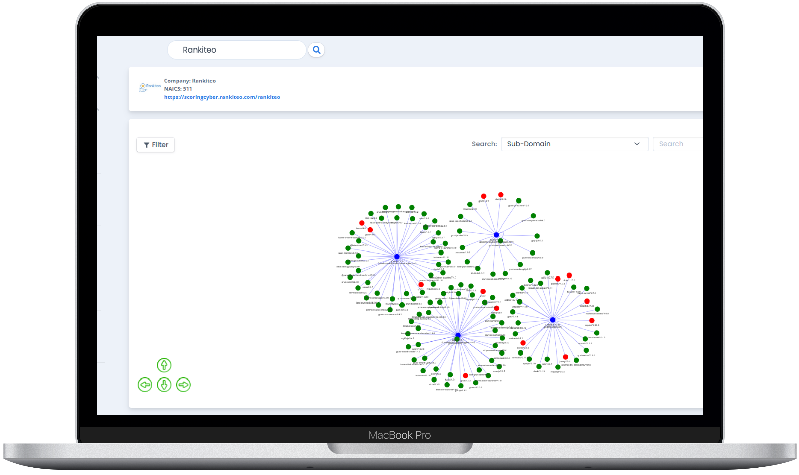
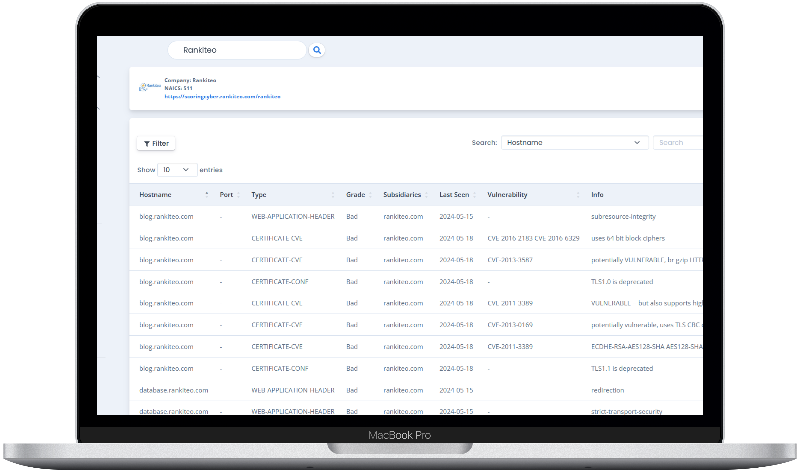
Identify exposed access points, detect misconfigured SSL certificates, and uncover vulnerabilities across the network infrastructure.
Gain visibility into the software components used within an organization to detect vulnerabilities, manage risk, and ensure supply chain security.
Monitor and manage all IT assets and their configurations to ensure accurate, real-time visibility across the company's technology environment.
Leverage real-time insights on active threats, malware campaigns, and emerging vulnerabilities to proactively defend against evolving cyberattacks.



 Oracle
 Microsoft
 Microsoft Security



 Rapid
Rapid