













LSEG
Company Details
Linkedin ID:
london-stock-exchange-group
Website:
Employees number:
24,270
Number of followers:
547,817
NAICS:
52
Industry Type:
Homepage:
lseg.com
IP Addresses:
73
Company ID:
LSE_2736575
Scan Status:
Completed


LSEG Vendor Cyber Rating & Cyber Score
lseg.comLSEG (London Stock Exchange Group) is a diversified international markets infrastructure business —earning our clients’ trust for over 300 years. That legacy of customer-focused excellence ensures that you can rely on our expertise in capital formation, intellectual property and risk and balance sheet management. As global leaders in financial indexing, benchmarking and analytic services, we offer unrivalled access to international capital markets. Our high-performance technology solutions enable companies worldwide to access funds for growth and development. And with our Data & Analytics, Capital Markets and Post Trade divisions, we provide a comprehensive, integrated suite of trusted financial market infrastructure services that help our customers pursue—and achieve—their ambitions. You can count on our open access model for unparalleled partnership, flexibility, stability, and support across all of our businesses. That’s how we make a difference— ensuring people can meet their potential—worldwide.
Company Details
london-stock-exchange-group
24,270
547,817
52
lseg.com
73
LSE_2736575
Completed
 LSEG Risk Score (AI oriented)
Between 650 and 699
 LSEG Global Score (TPRM)
XXXX
Description: Brussels Airport experienced a cyberattack on Friday evening that crippled its passenger and baggage check-in systems, forcing manual processing and causing significant operational disruptions. The attack, which also affected other European airports, targeted a third-party service provider’s systems. As of Saturday, nine flights were cancelled, and 15 departed with delays, with no immediate resolution expected. Passengers were advised to confirm flight statuses before arriving, as the outage led to processing bottlenecks and potential further cancellations. An investigation is underway to assess the full extent of the damage, but the incident has already resulted in financial losses (e.g., compensation, operational costs), reputational harm due to publicized delays, and potential long-term trust erosion among travelers and partners. The attack disrupted critical infrastructure, highlighting vulnerabilities in supply chain cybersecurity and the cascading effects of third-party breaches on large-scale operations.
Description: Collins Aerospace, a critical supplier in the aerospace and defense industry, fell victim to a ransomware attack that disrupted European airports by targeting its digital supply chain dependencies. The incident, highlighted in ENISA’s *Threat Landscape 2025* report, exemplifies how cyber-attacks on high-value vendors can cascade into broader operational failures. While specific details on data compromise were not disclosed, the attack caused significant service outages, delaying flights and grounding operations across multiple airports reliant on Collins’ systems. The disruption underscored vulnerabilities in interconnected OT (operational technology) and supply chain networks, where a single breach can paralyze downstream services. ENISA warned that such attacks exploit critical dependency points, amplifying impact beyond the initial target. The incident aligns with a rising trend of threat actors leveraging ransomware to cripple essential infrastructure, with financial and reputational fallout extending to airlines, passengers, and regulatory bodies. No direct mention of data theft was made, but the operational halt suggests severe financial losses, reputational damage, and potential regulatory scrutiny for failing to secure supply chain resilience.


No incidents recorded for LSEG in 2026.
No incidents recorded for LSEG in 2026.
No incidents recorded for LSEG in 2026.
LSEG cyber incidents detection timeline including parent company and subsidiaries

LSEG (London Stock Exchange Group) is a diversified international markets infrastructure business —earning our clients’ trust for over 300 years. That legacy of customer-focused excellence ensures that you can rely on our expertise in capital formation, intellectual property and risk and balance sheet management. As global leaders in financial indexing, benchmarking and analytic services, we offer unrivalled access to international capital markets. Our high-performance technology solutions enable companies worldwide to access funds for growth and development. And with our Data & Analytics, Capital Markets and Post Trade divisions, we provide a comprehensive, integrated suite of trusted financial market infrastructure services that help our customers pursue—and achieve—their ambitions. You can count on our open access model for unparalleled partnership, flexibility, stability, and support across all of our businesses. That’s how we make a difference— ensuring people can meet their potential—worldwide.


At Empower, we’ve always been guided by strong values with a focus on helping people achieve the financial freedom they deserve. It’s been an incredible journey so far, but our story is just getting started. From the very beginning, we’ve prided ourselves on putting our customers first in every

In a changing world, we aim at anticipating transformation and driving your company for success. We are convinced to have the expertise and networks you need to develop your business. BNP Paribas Corporate and Institutional Banking is a leading global financial partner, offering you a wide range of
Manappuram Finance Ltd. is one of India’s largest and most trusted gold loan companies, with 4,199 branches across the length and breadth of the country. It currently has nearly Rs. 157.65 billion worth assets under management (AUM), and 20,185 employees. Promoted by Shri. V.P. Nandakumar, the curr

Wells Fargo & Company (NYSE: WFC) is a diversified, community-based financial services company with approximately $1.9 trillion in assets. Wells Fargo’s vision is to satisfy our customers’ financial needs and help them succeed financially. Founded in 1852 and headquartered in San Francisco, Wells Fa
Truist Financial Corporation is a purpose-driven financial services company committed to inspiring and building better lives and communities. As a leading U.S. commercial bank, Truist has leading market share in many of the high-growth markets across the country. Truist offers a wide range of produc

O Sicoob é o maior sistema financeiro cooperativo do país, com mais de 9 milhões de cooperados e mais de 4,6 mil pontos de atendimento distribuídos em todo o Brasil. Somos uma cooperativa financeira que oferece aos cooperados serviços de conta corrente, crédito, investimento, cartões, previdência, c
People are living longer, and we are excited about the possibilities this brings. We see longevity, aging, and changing life patterns as an opportunity for our customers, our employees, and society as a whole. And we want to support everyone in building the financial means to explore the possibiliti

Somos el grupo financiero líder en el Perú con una vasta experiencia en el mercado peruano. Contamos con una sólida plataforma de Banca Comercial reforzada por una importante presencia en Banca de Inversión en Latinoamérica destinada a desarrollar el potencial de la región y acompañar a nuestros cli

NN Group is an international financial services company, active in 10 countries, with a strong presence in a number of European countries and Japan. We are rooted in the Netherlands and have a rich history spanning 180 years. With our 16,000 colleagues, NN Group provides retirement services, pensio
.png)
Founder and CEO George Kurtz made a compelling argument that we agree with, so why can't the rest of the market get behind him?
Source: Sharecast. At 1215 GMT, NCC Group shares were down 4.1%, LSEG and Sage Group were both 1.9% lower, France's Atos was off 2.8%, SAP was 2.2% lower...
Mastercard will roll out new tools to help small businesses defend themselves against cyber threats.
Palo Alto Networks topped Wall Street's fiscal second-quarter estimates. The cybersecurity company's fiscal third-quarter earnings forecast...
We're awaiting earnings from Palo Alto Networks and Texas Roadhouse.
AI is transforming everything. What's the deal for M&A? AI investments and megadeals create a K-shaped M&A market.
Hi, it's Elffie Chew in Singapore, where investment banking fees are on the up and likely to continue heading that way.
The tech layoff wave is still kicking in 2025. Last year saw more than 150,000 job cuts across 549 companies, according to independent...
BlackBerry on Thursday raised the lower end of its fiscal 2026 revenue forecast, signalling strong demand for its cybersecurity software as...

Explore insights on cybersecurity incidents, risk posture, and Rankiteo's assessments.
The official website of LSEG is http://www.lseg.com.
According to Rankiteo, LSEG’s AI-generated cybersecurity score is 697, reflecting their Weak security posture.
According to Rankiteo, LSEG currently holds 0 security badges, indicating that no recognized compliance certifications are currently verified for the organization.
According to Rankiteo, LSEG has been affected by multiple supply chain cyber incidents. The affected supply chain sources and their corresponding incident IDs are:
According to Rankiteo, LSEG is not certified under SOC 2 Type 1.
According to Rankiteo, LSEG does not hold a SOC 2 Type 2 certification.
According to Rankiteo, LSEG is not listed as GDPR compliant.
According to Rankiteo, LSEG does not currently maintain PCI DSS compliance.
According to Rankiteo, LSEG is not compliant with HIPAA regulations.
According to Rankiteo,LSEG is not certified under ISO 27001, indicating the absence of a formally recognized information security management framework.
LSEG operates primarily in the Financial Services industry.
LSEG employs approximately 24,270 people worldwide.
LSEG presently has no subsidiaries across any sectors.
LSEG’s official LinkedIn profile has approximately 547,817 followers.
LSEG is classified under the NAICS code 52, which corresponds to Finance and Insurance.
No, LSEG does not have a profile on Crunchbase.
Yes, LSEG maintains an official LinkedIn profile, which is actively utilized for branding and talent engagement, which can be accessed here: https://www.linkedin.com/company/london-stock-exchange-group.
As of April 02, 2026, Rankiteo reports that LSEG has experienced 2 cybersecurity incidents.
LSEG has an estimated 31,537 peer or competitor companies worldwide.
Incident Types: The types of cybersecurity incidents that have occurred include Ransomware and Cyber Attack.
Detection and Response: The company detects and responds to cybersecurity incidents through an incident response plan activated with yes (in-depth investigation underway), and recovery measures with manual passenger processing, and communication strategy with public statement, communication strategy with advisories to travelers to confirm flight status before arriving..
Title: Cyberattack on Brussels Airport Disrupts Passenger and Baggage Check-in Systems
Description: Brussels Airport was hit by a cyberattack on Friday evening, disabling its passenger and baggage check-in systems. The attack also affected other European airports. Passenger processing is being carried out manually, leading to delays and flight cancellations. The cyberattack targeted systems of a service provider, and an in-depth investigation is underway to assess the damage. Nine flights have been cancelled, and 15 have departed with delays. No immediate solution is expected in the coming hours.
Date Detected: 2024-02-23T18:00:00Z
Date Publicly Disclosed: 2024-02-23T18:00:00Z
Type: cyberattack
Title: ENISA Threat Landscape 2025: Phishing and Vulnerability Exploitation Dominate EU Cyber Incidents (July 2024 - June 2025)
Description: Phishing and vulnerability exploitation accounted for the majority of initial access in cyber-attacks against EU organizations over the past year, according to ENISA. The report analyzed 4,875 incidents, with phishing (60%) and vulnerability exploitation (21%) as the top attack vectors. DDoS attacks dominated in volume (77% of incidents), though only 2% caused service disruption. Hacktivists, led by Russian actor NoName057(16), were the primary threat actors (79% of attacks), often targeting public administration (38%) and leveraging geopolitical tensions. Ransomware was deemed the most impactful threat, while AI-powered phishing surged to 80% of social engineering activity. Outdated mobile/OT systems and supply chain dependencies were flagged as high-risk targets.
Date Detected: 2024-07-01
Date Publicly Disclosed: 2025-07-01
Type: Phishing
Attack Vector: Phishing (60%)Vulnerability Exploitation (21%)Botnets (10%)Malicious Applications (8%)DDoS (77% of incidents)AI-Powered Phishing (80% of social engineering)Supply Chain Compromise
Threat Actor: Name: NoName057(16), Type: Hacktivist (Russian-aligned), Motivation: Geopolitical (anti-EU/EU-aligned causes), Tools: ['DDoSia platform'], Name: Unspecified State-Sponsored Actors, Type: State-Sponsored (blended with hacktivism), Motivation: ['Cyber-Espionage (7%)', 'Geopolitical Influence'], Tactics: ['Faketivism (posing as hacktivists)'], Name: Financially Motivated Actors, Type: Cybercriminal, Motivation: Financial Gain (13%), Methods: ['Ransomware', 'Data Theft'].
Motivation: Geopolitical (79%, e.g., elections, EU support for opposition groups)Financial (13%)Cyber-Espionage (7%)
Common Attack Types: The most common types of attacks the company has faced is Cyber Attack.
Identification of Attack Vectors: The company identifies the attack vectors used in incidents through Phishing (60%)Vulnerability Exploitation (21%)Botnets (10%)Malicious Applications (8%).

Systems Affected: passenger check-in systemsbaggage check-in systems
Downtime: ongoing (as of 2024-02-24, no solution expected in the coming hours)
Operational Impact: manual passenger processingflight delaysflight cancellations
Brand Reputation Impact: potential negative impact due to service disruptions

Systems Affected: Outdated Mobile DevicesOperational Technology (OT) SystemsPublic Administration (38% of attacks)Critical Supply Chain Dependencies (e.g., Collins Aerospace)European Airports (disruption example)
Downtime: Limited (2% of DDoS attacks caused disruption)
Operational Impact: Supply Chain Ripple EffectsAirport Disruptions (via Collins Aerospace ransomware)Public Sector Targeting (38%)
Brand Reputation Impact: Erosion of trust in public administrationSupply chain vulnerability exposure
Entity Name: Brussels Airport
Entity Type: airport
Industry: aviation/transportation
Location: Brussels, Belgium
Customers Affected: passengers (exact number unspecified, but delays and cancellations reported)
Entity Name: Unnamed service provider
Entity Type: third-party service provider
Industry: IT/aviation services
Entity Name: Other European airports (unspecified)
Entity Type: airports
Industry: aviation/transportation
Location: Europe
Entity Name: European Union Organizations (General)
Entity Type: Multinational
Industry: Cross-Sector (Public Administration, Critical Infrastructure, Supply Chain)
Location: European Union
Entity Name: Collins Aerospace
Entity Type: Corporation
Industry: Aerospace/Defense
Location: Global (impacted European airports)
Entity Name: Public Administration (EU)
Entity Type: Government
Industry: Public Sector
Location: European Union
Incident Response Plan Activated: yes (in-depth investigation underway)
Recovery Measures: manual passenger processing
Communication Strategy: public statementadvisories to travelers to confirm flight status before arriving
Data Encryption: Likely (most impactful threat)
Data Recovery from Ransomware: The company recovers data encrypted by ransomware through manual passenger processing, .
Lessons Learned: AI amplification of phishing (80% of social engineering by 2025) requires adaptive defenses., Supply chain dependencies create systemic risks (e.g., Collins Aerospace airport disruptions)., Convergence of hacktivism and state-sponsored TTPs complicates attribution., Outdated OT/mobile systems remain high-value targets., DDoS volume (77% of incidents) masks low disruption rate (2%), but still strains resources.
Recommendations: Prioritize patching for OT and mobile systems to reduce vulnerability exploitation., Enhance supply chain cybersecurity resilience (e.g., third-party risk assessments)., Deploy AI-driven phishing detection to counter AI-powered attacks., Improve attribution capabilities to distinguish hacktivism from state-sponsored faketivism., Public administration should harden defenses against geopolitically motivated DDoS., Collaborate on EU-wide incident response (e.g., ENISA’s €36m scheme).Prioritize patching for OT and mobile systems to reduce vulnerability exploitation., Enhance supply chain cybersecurity resilience (e.g., third-party risk assessments)., Deploy AI-driven phishing detection to counter AI-powered attacks., Improve attribution capabilities to distinguish hacktivism from state-sponsored faketivism., Public administration should harden defenses against geopolitically motivated DDoS., Collaborate on EU-wide incident response (e.g., ENISA’s €36m scheme).Prioritize patching for OT and mobile systems to reduce vulnerability exploitation., Enhance supply chain cybersecurity resilience (e.g., third-party risk assessments)., Deploy AI-driven phishing detection to counter AI-powered attacks., Improve attribution capabilities to distinguish hacktivism from state-sponsored faketivism., Public administration should harden defenses against geopolitically motivated DDoS., Collaborate on EU-wide incident response (e.g., ENISA’s €36m scheme).Prioritize patching for OT and mobile systems to reduce vulnerability exploitation., Enhance supply chain cybersecurity resilience (e.g., third-party risk assessments)., Deploy AI-driven phishing detection to counter AI-powered attacks., Improve attribution capabilities to distinguish hacktivism from state-sponsored faketivism., Public administration should harden defenses against geopolitically motivated DDoS., Collaborate on EU-wide incident response (e.g., ENISA’s €36m scheme).Prioritize patching for OT and mobile systems to reduce vulnerability exploitation., Enhance supply chain cybersecurity resilience (e.g., third-party risk assessments)., Deploy AI-driven phishing detection to counter AI-powered attacks., Improve attribution capabilities to distinguish hacktivism from state-sponsored faketivism., Public administration should harden defenses against geopolitically motivated DDoS., Collaborate on EU-wide incident response (e.g., ENISA’s €36m scheme).Prioritize patching for OT and mobile systems to reduce vulnerability exploitation., Enhance supply chain cybersecurity resilience (e.g., third-party risk assessments)., Deploy AI-driven phishing detection to counter AI-powered attacks., Improve attribution capabilities to distinguish hacktivism from state-sponsored faketivism., Public administration should harden defenses against geopolitically motivated DDoS., Collaborate on EU-wide incident response (e.g., ENISA’s €36m scheme).
Key Lessons Learned: The key lessons learned from past incidents are AI amplification of phishing (80% of social engineering by 2025) requires adaptive defenses.,Supply chain dependencies create systemic risks (e.g., Collins Aerospace airport disruptions).,Convergence of hacktivism and state-sponsored TTPs complicates attribution.,Outdated OT/mobile systems remain high-value targets.,DDoS volume (77% of incidents) masks low disruption rate (2%), but still strains resources.
Source: Brussels Airport public statement (via local media)
Date Accessed: 2024-02-24
Source: ENISA Threat Landscape 2025 Report
Date Accessed: 2025-07-01
Source: Infosecurity Magazine: ENISA to Coordinate €36m EU-Wide Incident Response Scheme
Additional Resources: Stakeholders can find additional resources on cybersecurity best practices at and Source: Brussels Airport public statement (via local media)Date Accessed: 2024-02-24, and Source: ENISA Threat Landscape 2025 ReportDate Accessed: 2025-07-01, and Source: Infosecurity Magazine: ENISA to Coordinate €36m EU-Wide Incident Response Scheme.
Investigation Status: ongoing (in-depth investigation underway to assess damage)
Investigation Status: Completed (report published)
Communication of Investigation Status: The company communicates the status of incident investigations to stakeholders through Public Statement and Advisories To Travelers To Confirm Flight Status Before Arriving.
Stakeholder Advisories: Travelers Advised To Confirm Flight Status Before Arriving At The Airport.
Customer Advisories: expect delays and cancellations; manual check-in procedures in place
Advisories Provided: The company provides the following advisories to stakeholders and customers following an incident: were Travelers Advised To Confirm Flight Status Before Arriving At The Airport, Expect Delays And Cancellations; Manual Check-In Procedures In Place and .
Entry Point: Phishing (60%), Vulnerability Exploitation (21%), Botnets (10%), Malicious Applications (8%),
Backdoors Established: Likely (68% of intrusions led to malware deployment)
High Value Targets: Outdated Mobile Devices, Operational Technology (Ot) Systems, Critical Supply Chain Nodes,
Data Sold on Dark Web: Outdated Mobile Devices, Operational Technology (Ot) Systems, Critical Supply Chain Nodes,
Root Causes: Overreliance On Outdated Ot/Mobile Systems With Unpatched Vulnerabilities., Insufficient Supply Chain Cybersecurity Controls (E.G., Collins Aerospace Case)., Lack Of Adaptive Defenses Against Ai-Enhanced Phishing., Geopolitical Tensions Exploited By Hacktivist/State-Sponsored Actors., Difficulty In Attributing Blended Hacktivism/State-Sponsored Attacks.,
Corrective Actions: Eu-Wide Coordination (E.G., Enisa’S €36M Incident Response Scheme)., Mandatory Ot/Mobile System Updates In Critical Sectors., Supply Chain Cybersecurity Frameworks (E.G., Third-Party Audits)., Public-Private Collaboration To Counter Ddos/Hacktivism., Investment In Ai-Driven Threat Detection And Attribution Tools.,
Corrective Actions Taken: The company has taken the following corrective actions based on post-incident analysis: Eu-Wide Coordination (E.G., Enisa’S €36M Incident Response Scheme)., Mandatory Ot/Mobile System Updates In Critical Sectors., Supply Chain Cybersecurity Frameworks (E.G., Third-Party Audits)., Public-Private Collaboration To Counter Ddos/Hacktivism., Investment In Ai-Driven Threat Detection And Attribution Tools., .
Last Attacking Group: The attacking group in the last incident were an Name: NoName057(16)Type: Hacktivist (Russian-aligned)Motivation: Geopolitical (anti-EU/EU-aligned causes)Tools: DDoSia platform, Name: Unspecified State-Sponsored ActorsType: State-Sponsored (blended with hacktivism)Motivation: Cyber-Espionage (7%), Motivation: Geopolitical Influence, Tactics: Faketivism (posing as hacktivists), Name: Financially Motivated ActorsType: CybercriminalMotivation: Financial Gain (13%)Methods: Ransomware, Methods: Data Theft and .
Most Recent Incident Detected: The most recent incident detected was on 2024-02-23T18:00:00Z.
Most Recent Incident Publicly Disclosed: The most recent incident publicly disclosed was on 2025-07-01.
Most Significant System Affected: The most significant system affected in an incident were passenger check-in systemsbaggage check-in systems and Outdated Mobile DevicesOperational Technology (OT) SystemsPublic Administration (38% of attacks)Critical Supply Chain Dependencies (e.g., Collins Aerospace)European Airports (disruption example).
Most Significant Lesson Learned: The most significant lesson learned from past incidents was DDoS volume (77% of incidents) masks low disruption rate (2%), but still strains resources.
Most Significant Recommendation Implemented: The most significant recommendation implemented to improve cybersecurity was Prioritize patching for OT and mobile systems to reduce vulnerability exploitation., Public administration should harden defenses against geopolitically motivated DDoS., Improve attribution capabilities to distinguish hacktivism from state-sponsored faketivism., Collaborate on EU-wide incident response (e.g., ENISA’s €36m scheme)., Enhance supply chain cybersecurity resilience (e.g., third-party risk assessments). and Deploy AI-driven phishing detection to counter AI-powered attacks..
Most Recent Source: The most recent source of information about an incident are ENISA Threat Landscape 2025 Report, Infosecurity Magazine: ENISA to Coordinate €36m EU-Wide Incident Response Scheme and Brussels Airport public statement (via local media).
Current Status of Most Recent Investigation: The current status of the most recent investigation is ongoing (in-depth investigation underway to assess damage).
Most Recent Stakeholder Advisory: The most recent stakeholder advisory issued was travelers advised to confirm flight status before arriving at the airport, .
Most Recent Customer Advisory: The most recent customer advisory issued was an expect delays and cancellations; manual check-in procedures in place.
.png)
A vulnerability was found in Nothings stb up to 1.26. Impacted is the function stbtt_InitFont_internal in the library stb_truetype.h of the component TTF File Handler. Performing a manipulation results in out-of-bounds read. Remote exploitation of the attack is possible. The exploit has been made public and could be used. The vendor was contacted early about this disclosure but did not respond in any way.
V-SFT versions 6.2.10.0 and prior contain an out-of-bounds read in VS6ComFile!get_macro_mem_COM. Opening a crafted V7 file may lead to information disclosure from the affected product.
V-SFT versions 6.2.10.0 and prior contain a stack-based buffer overflow in VS6ComFile!CSaveData::_conv_AnimationItem. Opening a crafted V7 file may lead to arbitrary code execution on the affected product.
V-SFT versions 6.2.10.0 and prior contain an out-of-bounds read vulnerability in VS6MemInIF!set_temp_type_default. Opening a crafted V7 file may lead to information disclosure from the affected product.
V-SFT versions 6.2.10.0 and prior contain an out-of-bounds read vulnerability in VS6ComFile!load_link_inf. Opening a crafted V7 file may lead to information disclosure from the affected product.

Get company history

Every week, Rankiteo analyzes billions of signals to give organizations a sharper, faster view of emerging risks. With deeper, more actionable intelligence at their fingertips, security teams can outpace threat actors, respond instantly to Zero-Day attacks, and dramatically shrink their risk exposure window.
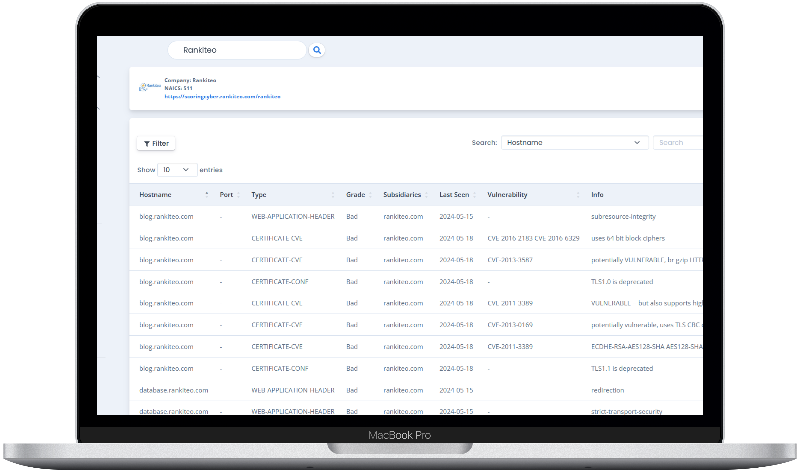
Identify exposed access points, detect misconfigured SSL certificates, and uncover vulnerabilities across the network infrastructure.
Gain visibility into the software components used within an organization to detect vulnerabilities, manage risk, and ensure supply chain security.
Monitor and manage all IT assets and their configurations to ensure accurate, real-time visibility across the company's technology environment.
Leverage real-time insights on active threats, malware campaigns, and emerging vulnerabilities to proactively defend against evolving cyberattacks.



 Collins Aerospace


 Rapid
Rapid