











Facebook
Company Details
Linkedin ID:
Website:
Employees number:
24,784
Number of followers:
406,260
NAICS:
5112
Industry Type:
Homepage:
meta.com
IP Addresses:
0
Company ID:
FAC_5156420
Scan Status:
In-progress


Facebook Vendor Cyber Rating & Cyber Score
meta.comThe Facebook company is now Meta. Meta builds technologies that help people connect, find communities, and grow businesses. When Facebook launched in 2004, it changed the way people connect. Apps like Messenger, Instagram and WhatsApp further empowered billions around the world. Now, Meta is moving beyond 2D screens toward immersive experiences like augmented and virtual reality to help build the next evolution in social technology. We want to give people the power to build community and bring the world closer together. To do that, we ask that you help create a safe and respectful online space. These community values encourage constructive conversations on this page: • Start with an open mind. Whether you agree or disagree, engage with empathy. • Comments violating our Community Standards will be removed or hidden. So please treat everybody with respect. • Keep it constructive. Use your interactions here to learn about and grow your understanding of others. • Our moderators are here to uphold these guidelines for the benefit of everyone, every day. • If you are seeking support for issues related to your Facebook account, please reference our Help Center (https://www.facebook.com/help) or Help Community (https://www.facebook.com/help/community). For a full listing of our jobs, visit http://www.facebookcareers.com
Company Details
24,784
406,260
5112
meta.com
0
FAC_5156420
In-progress
 Facebook Risk Score (AI oriented)
Between 650 and 699
 Facebook Global Score (TPRM)
XXXX
Description: The FileFix attack impersonated a Facebook security alert, tricking users into executing malicious commands disguised as a PDF file appeal process. Victims unknowingly ran a multi-stage payload that dropped the StealC infostealer, a malware capable of harvesting credentials from browsers (Chrome, Firefox, Opera, etc.), cryptocurrency wallets (20+ types), messaging apps (Telegram, Discord, Thunderbird), VPNs (OpenVPN, Proton VPN), cloud services (AWS, Azure), and gaming platforms (Ubisoft, Battle.net). The attack leveraged AI-generated decoy images (e.g., houses, doors) embedded with PowerShell scripts and encrypted executables, evading detection by mimicking benign user actions (downloading a JPG). The malware also checked for virtual machines (VMs) to avoid sandbox analysis. While the article does not confirm direct financial losses or data breaches at Facebook, the campaign’s global reach (US, Germany, China, etc.) and sophisticated evasion techniques suggest high-risk exposure for users’ personal, financial, and corporate credentials. The attack’s rapid evolution (from a July 2023 PoC to a 517% surge in 6 months) highlights its effectiveness in bypassing traditional phishing defenses, posing reputational harm to Facebook’s platform security and potential downstream fraud for affected users.
Description: Meta has been fined €265 million ($275.5 million) by the Irish data protection commission (DPC) for the data leak suffered by Facebook. It exposed the data belonging to millions of Facebook users. The Data Protection Commission is also imposing a range of corrective measures on Meta. On April 3rd, 2021, a user leaked the phone numbers and personal data of 533 million Facebook users in a hacking forum for free online. Leaked data included users’ phone numbers, Facebook IDs, full names, locations, birthdates, bios, and for some accounts the associated email addresses.
Description: A threat actor published the phone numbers and account details of about 533 million Facebook users. The leaked data included information that users posted on their profiles including Facebook ID numbers, profile names, email addresses, location information, gender details, and job data. The database also contained phone numbers for all users, information that is not always public for most profiles.
Description: Facebook is charged with another fine. This time the social network is handing over CAD$9 million (US$6.5 million / £5.3 million) to Canada as part of a settlement. Facebook “made false or misleading claims about the privacy of Canadians’ personal information on Facebook and Messenger” and improperly shared data with third-party developers. Facebook gave the impression that users could control who could see and access their personal information on the Facebook platform when using privacy features. Facebook also allowed certain third-party developers to access the personal information of users’ friends after they installed certain third-party applications.
Description: Russian court fines social media company Facebook $63,000 over data law breach. Facebook failed to comply with a Russian data law. The Tagansky District Court in Moscow fined Facebook for its refusal to put its server holding data about Russian citizens on Russian territory.
Description: Data from millions of Facebook users who used a popular personality app was left exposed online for anyone to access. Academics at the University of Cambridge distributed the data from the personality quiz app myPersonality to hundreds of researchers via a website with insufficient security provisions. It led to it being left vulnerable to access for four years & gaining access illicitly was relatively easy. The data was highly sensitive, revealing personal details of Facebook users, such as the results of psychological tests. Facebook suspended myPersonality from its platform saying the app may have violated its policies due to the language used in the app and on its website to describe how data is shared. More than 6 million people completed the tests on the myPersonality app and nearly half agreed to share data from their Facebook profiles with the project. All of this data was then scooped up and the names removed before it was put on a website to share with other researchers.
Description: A Las Vegas man called Spam King had faced federal fraud charges for allegedly luring Facebook users to third-party websites and collecting personal data for spam list. He used to trick people into revealing their login details which he then used to access half a million accounts and used this to send spam to other Facebook users. He also used to target the users with bogus "friend requests" for distributing spam.


No incidents recorded for Facebook in 2026.
No incidents recorded for Facebook in 2026.
No incidents recorded for Facebook in 2026.
Facebook cyber incidents detection timeline including parent company and subsidiaries

The Facebook company is now Meta. Meta builds technologies that help people connect, find communities, and grow businesses. When Facebook launched in 2004, it changed the way people connect. Apps like Messenger, Instagram and WhatsApp further empowered billions around the world. Now, Meta is moving beyond 2D screens toward immersive experiences like augmented and virtual reality to help build the next evolution in social technology. We want to give people the power to build community and bring the world closer together. To do that, we ask that you help create a safe and respectful online space. These community values encourage constructive conversations on this page: • Start with an open mind. Whether you agree or disagree, engage with empathy. • Comments violating our Community Standards will be removed or hidden. So please treat everybody with respect. • Keep it constructive. Use your interactions here to learn about and grow your understanding of others. • Our moderators are here to uphold these guidelines for the benefit of everyone, every day. • If you are seeking support for issues related to your Facebook account, please reference our Help Center (https://www.facebook.com/help) or Help Community (https://www.facebook.com/help/community). For a full listing of our jobs, visit http://www.facebookcareers.com


We're championing possibilities for all by making money fast, easy, and more enjoyable. Our hope is to unlock opportunities for people in their everyday lives and empower the millions of people and businesses around the world who trust, rely, and use PayPal every day. For support, visit the PayPal
At Bolt, we're building a future where people don’t need to own personal cars to move around safely and conveniently. A future where people have the freedom to use transport on demand, choosing whatever vehicle's best for each occasion — be it a car, scooter, or e-bike. We're helping over 200 mill
Upwork is the world’s work marketplace that connects businesses with independent talent from across the globe. We serve everyone from one-person startups to large, Fortune 100 enterprises with a powerful, trust-driven platform that enables companies and talent to work together in new ways that unloc

Adhering to the ‘Retail + Technology’ strategy, Meituan commits to its mission that 'We help people eat better, live better'. Since its establishment in March 2010, Meituan has advanced the digital upgrading of services and goods retail on both supply and demand sides. Together with our partners we

GlobalLogic, a Hitachi Group company, is a trusted partner in design, data, and digital engineering for the world’s largest and most innovative companies. Since our inception in 2000, we have been at the forefront of the digital revolution, helping to create some of the most widely used digital prod
Founded in 2015, Daraz is the leading e-commerce platform in South Asia with operations in Pakistan, Bangladesh, Sri Lanka, Nepal, and Myanmar. It provides sellers and consumers with cutting-edge marketplace technology, targeting a rapidly growing region of over 500 million people. By building an in

HubSpot is a leading CRM platform that provides software and support to help businesses grow better. Our platform includes marketing, sales, service, and website management products that start free and scale to meet our customers’ needs at any stage of growth. Today, thousands of customers around th
Adobe is the global leader in digital media and digital marketing solutions. Our creative, marketing and document solutions empower everyone – from emerging artists to global brands – to bring digital creations to life and deliver immersive, compelling experiences to the right person at the right mo
PhonePe Group is India’s leading fintech company, proudly recognized as India’s #1 Trusted Digital Payments* Brand for three consecutive years. Our flagship product, the PhonePe app was launched in August 2016, has rapidly become the preferred consumer payments app in India. In just eight years, Pho
.png)
Meta introduced anti-scam tools across WhatsApp, Facebook, and Messenger using AI and alerts to combat online scams.
Buying and selling used goods online is a great way to make or save a few bucks, but is Facebook Marketplace safe? It pays to be careful.
By Khanh Vu HANOI (Reuters) - Facebook has violated Vietnam's new cybersecurity law by allowing users to post anti-government comments on the platform,...
Shares of cybersecurity software companies tumbled Friday after Anthropic PBC introduced a new security feature into its Claude AI model.
Malicious Chrome extension steals Facebook Business Manager 2FA codes and analytics data, targeting Meta Business admins and risking account...
Following the alleged hijacking of the Wood County Sheriff's Office Facebook account by hackers, it may be time to review how secure social media accounts...
Cybersecurity researcher reveals that a massive 96 GB database was compromised. He also revealed that financial service accounts,...
Gmail passwords have been uncovered in a data leak along with other mailbox providers Yahoo and Outlook and social media sites including...
ClickFix campaign steals Facebook session tokens via fake verification pages, using social engineering to target creators.

Explore insights on cybersecurity incidents, risk posture, and Rankiteo's assessments.
The official website of Facebook is https://www.meta.com.
According to Rankiteo, Facebook’s AI-generated cybersecurity score is 670, reflecting their Weak security posture.
According to Rankiteo, Facebook currently holds 0 security badges, indicating that no recognized compliance certifications are currently verified for the organization.
According to Rankiteo, Facebook has not been affected by any supply chain cyber incidents, and no incident IDs are currently listed for the organization.
According to Rankiteo, Facebook is not certified under SOC 2 Type 1.
According to Rankiteo, Facebook does not hold a SOC 2 Type 2 certification.
According to Rankiteo, Facebook is not listed as GDPR compliant.
According to Rankiteo, Facebook does not currently maintain PCI DSS compliance.
According to Rankiteo, Facebook is not compliant with HIPAA regulations.
According to Rankiteo,Facebook is not certified under ISO 27001, indicating the absence of a formally recognized information security management framework.
Facebook operates primarily in the Software Development industry.
Facebook employs approximately 24,784 people worldwide.
Facebook presently has no subsidiaries across any sectors.
Facebook’s official LinkedIn profile has approximately 406,260 followers.
Facebook is classified under the NAICS code 5112, which corresponds to Software Publishers.
No, Facebook does not have a profile on Crunchbase.
Yes, Facebook maintains an official LinkedIn profile, which is actively utilized for branding and talent engagement, which can be accessed here: https://www.linkedin.com/company/facebook.
As of April 02, 2026, Rankiteo reports that Facebook has experienced 7 cybersecurity incidents.
Facebook has an estimated 29,306 peer or competitor companies worldwide.
Incident Types: The types of cybersecurity incidents that have occurred include Data Leak, Cyber Attack and Breach.
Total Financial Loss: The total financial loss from these incidents is estimated to be $9.06 million.
Detection and Response: The company detects and responds to cybersecurity incidents through an third party assistance with acronis threat research unit, and communication strategy with public disclosure via the register, communication strategy with research report by acronis..
Title: Spam King Cyber Incident
Description: A Las Vegas man called Spam King faced federal fraud charges for allegedly luring Facebook users to third-party websites and collecting personal data for spam list. He tricked people into revealing their login details which he then used to access half a million accounts and used this to send spam to other Facebook users. He also targeted the users with bogus 'friend requests' for distributing spam.
Type: Phishing, Unauthorized Access, Spam Distribution
Attack Vector: PhishingFriend Requests
Vulnerability Exploited: Social Engineering
Threat Actor: Spam King
Motivation: Financial Gain, Data Collection
Title: Data Breach of myPersonality App on Facebook
Description: Data from millions of Facebook users who used the myPersonality app was left exposed online for anyone to access due to insufficient security provisions.
Type: Data Breach
Attack Vector: Insufficient Security Provisions
Vulnerability Exploited: Inadequate data protection measures
Title: Facebook Data Leak
Description: A threat actor published the phone numbers and account details of about 533 million Facebook users. The leaked data included information that users posted on their profiles including Facebook ID numbers, profile names, email addresses, location information, gender details, and job data. The database also contained phone numbers for all users, information that is not always public for most profiles.
Type: Data Breach
Title: Facebook Data Leak
Description: A user leaked the phone numbers and personal data of 533 million Facebook users in a hacking forum for free online.
Date Detected: 2021-04-03
Type: Data Leak
Attack Vector: Hacking Forum
Threat Actor: Unknown
Title: Russian Court Fines Facebook for Data Law Breach
Description: Russian court fines social media company Facebook $63,000 over data law breach. Facebook failed to comply with a Russian data law by refusing to put its server holding data about Russian citizens on Russian territory.
Type: Data Law Breach
Title: Facebook Fined for Privacy Violations in Canada
Description: Facebook is charged with another fine. This time the social network is handing over CAD$9 million (US$6.5 million / £5.3 million) to Canada as part of a settlement. Facebook made false or misleading claims about the privacy of Canadians’ personal information on Facebook and Messenger and improperly shared data with third-party developers. Facebook gave the impression that users could control who could see and access their personal information on the Facebook platform when using privacy features. Facebook also allowed certain third-party developers to access the personal information of users’ friends after they installed certain third-party applications.
Type: Data Breach
Attack Vector: Improper Access Control
Vulnerability Exploited: Privacy Controls
Threat Actor: Third-party Developers
Motivation: Data Access
Title: FileFix Attack Dropping StealC Infostealer via Fake Facebook Security Alerts
Description: An attack called FileFix masquerades as a Facebook security alert, tricking victims into executing malicious commands that ultimately drop the StealC infostealer and malware downloader. The attack is a variation of ClickFix, a social-engineering technique that surged by 517% in the past six months. Victims are deceived into copying and pasting a command into a file upload window or File Explorer, which executes the payload. The attack uses AI-generated images (e.g., a bucolic house, intricate doors) embedded with PowerShell scripts and encrypted executables to evade detection. The final payload includes a Go-written loader that checks for VM environments before deploying StealC v2, which targets browsers, cryptocurrency wallets, messaging apps, VPNs, and cloud service credentials (Azure, AWS). The campaign has global reach, with submissions from multiple countries, and leverages BitBucket for hosting malicious images to avoid domain-based detection.
Date Detected: 2024-08-late
Date Publicly Disclosed: 2024-08-late
Type: Malware
Attack Vector: Fake Facebook Security AlertUser-Executed Command via File ExplorerAI-Generated Image PayloadsPowerShell Script Embedding
Vulnerability Exploited: Human Trust (Social Engineering)
Motivation: Data TheftCredential HarvestingFinancial Gain (Potential Ransomware/Fraud)
Common Attack Types: The most common types of attacks the company has faced is Breach.
Identification of Attack Vectors: The company identifies the attack vectors used in incidents through Phishing, Friend Requests and Fake Facebook Security Alert PDFUser-Executed Command in File Explorer.

Data Compromised: Personal Data, Login Details
Systems Affected: Facebook Accounts
Identity Theft Risk: High

Data Compromised: Personal details, Psychological test results
Data Compromised: Facebook id numbers, Profile names, Email addresses, Location information, Gender details, Job data, Phone numbers

Data Compromised: Phone numbers, Facebook ids, Full names, Locations, Birthdates, Bios, Email addresses
Financial Loss: CAD$9 million (US$6.5 million / £5.3 million)
Data Compromised: Personal Information
Data Compromised: Browser credentials, Cryptocurrency wallet data, Messaging app data (telegram, discord, etc.), Vpn credentials, Cloud service keys (azure, aws), Game launcher credentials
Systems Affected: Windows (User Devices)Potential Enterprise Systems via Stolen Credentials
Brand Reputation Impact: Potential Reputation Damage for Facebook (Abused Brand Trust)
Identity Theft Risk: High (Stolen PII, Credentials, Financial Data)
Payment Information Risk: High (Cryptocurrency Wallets, Payment App Data)
Average Financial Loss: The average financial loss per incident is $1.29 million.
Commonly Compromised Data Types: The types of data most commonly compromised in incidents are Personal Data, Login Details, Personal Details, Psychological Test Results, , Personal Information, , Phone Numbers, Facebook Ids, Full Names, Locations, Birthdates, Bios, Email Addresses, , Personal Information, Credentials, Session Cookies, Cryptocurrency Wallet Data, Messaging App Data, Vpn Configurations, Cloud Service Keys, Pii (Potential) and .
Entity Name: Facebook
Entity Type: Social Media Platform
Industry: Technology
Location: Global
Size: Large
Customers Affected: 500,000
Entity Name: Facebook
Entity Type: Social Media Platform
Industry: Technology
Customers Affected: 6000000
Entity Name: Facebook
Entity Type: Company
Industry: Social Media
Customers Affected: 533 million
Entity Name: Meta
Entity Type: Company
Industry: Technology
Location: Global
Customers Affected: 533 million
Entity Name: Facebook
Entity Type: Social Media Company
Industry: Technology
Entity Name: Facebook
Entity Type: Social Network
Industry: Technology
Location: Global
Size: Large
Entity Name: Facebook (Brand Abused)
Entity Type: Social Media Platform
Industry: Technology
Location: Global
Customers Affected: Users Worldwide (US, Bangladesh, Philippines, Tunisia, Nepal, Dominican Republic, Serbia, Peru, China, Germany, etc.)
Entity Name: Individual Victims
Entity Type: End Users
Location: Global (Multi-Country)
Third Party Assistance: Acronis Threat Research Unit.
Communication Strategy: Public Disclosure via The RegisterResearch Report by Acronis
Third-Party Assistance: The company involves third-party assistance in incident response through Acronis Threat Research Unit, .
Type of Data Compromised: Personal Data, Login Details
Number of Records Exposed: 500,000
Sensitivity of Data: High
Personally Identifiable Information: Yes
Type of Data Compromised: Personal details, Psychological test results
Number of Records Exposed: 6000000
Sensitivity of Data: High
Type of Data Compromised: Personal information
Number of Records Exposed: 533 million
Personally Identifiable Information: Facebook ID numbersprofile namesemail addresseslocation informationgender detailsjob dataphone numbers
Type of Data Compromised: Phone numbers, Facebook ids, Full names, Locations, Birthdates, Bios, Email addresses
Number of Records Exposed: 533 million
Type of Data Compromised: Personal Information
Type of Data Compromised: Credentials, Session cookies, Cryptocurrency wallet data, Messaging app data, Vpn configurations, Cloud service keys, Pii (potential)
Sensitivity of Data: High
Data Exfiltration: Likely (StealC Capabilities)
Data Encryption: Partial (Payload Encrypted in Images)
File Types Exposed: JPG (Malicious Images)PowerShell ScriptsExecutables
Personally Identifiable Information: Potential (Browser Autofill, Saved Logins)
Legal Actions: Federal Fraud Charges
Fines Imposed: €265 million ($275.5 million)
Regulations Violated: Russian Data Law,
Fines Imposed: $63,000
Fines Imposed: CAD$9 million (US$6.5 million / £5.3 million)
Ensuring Regulatory Compliance: The company ensures compliance with regulatory requirements through Federal Fraud Charges.
Lessons Learned: Evolution of social engineering tactics beyond traditional phishing (e.g., user-executed commands via fake file prompts)., Effectiveness of AI-generated imagery in evading detection and luring victims., Rapid weaponization of proof-of-concept (PoC) attacks (75 days from PoC to global campaign)., Need for updated anti-phishing training to address 'Fix'-type attacks (ClickFix/FileFix)., Shift from malicious domains to legitimate platforms (e.g., BitBucket) for payload hosting.
Recommendations: Educate users on 'Fix'-style attacks (e.g., fake CAPTCHAs, file upload prompts)., Monitor for unusual PowerShell activity originating from image files., Block execution of scripts from temporary directories (e.g., %Temp%)., Implement behavioral detection for malware using image steganography., Enhance email/phishing filters to detect fake social media alerts., Restrict access to file-sharing platforms (e.g., BitBucket) for untrusted sources., Deploy endpoint detection for StealC indicators (e.g., targeted app data exfiltration).Educate users on 'Fix'-style attacks (e.g., fake CAPTCHAs, file upload prompts)., Monitor for unusual PowerShell activity originating from image files., Block execution of scripts from temporary directories (e.g., %Temp%)., Implement behavioral detection for malware using image steganography., Enhance email/phishing filters to detect fake social media alerts., Restrict access to file-sharing platforms (e.g., BitBucket) for untrusted sources., Deploy endpoint detection for StealC indicators (e.g., targeted app data exfiltration).Educate users on 'Fix'-style attacks (e.g., fake CAPTCHAs, file upload prompts)., Monitor for unusual PowerShell activity originating from image files., Block execution of scripts from temporary directories (e.g., %Temp%)., Implement behavioral detection for malware using image steganography., Enhance email/phishing filters to detect fake social media alerts., Restrict access to file-sharing platforms (e.g., BitBucket) for untrusted sources., Deploy endpoint detection for StealC indicators (e.g., targeted app data exfiltration).Educate users on 'Fix'-style attacks (e.g., fake CAPTCHAs, file upload prompts)., Monitor for unusual PowerShell activity originating from image files., Block execution of scripts from temporary directories (e.g., %Temp%)., Implement behavioral detection for malware using image steganography., Enhance email/phishing filters to detect fake social media alerts., Restrict access to file-sharing platforms (e.g., BitBucket) for untrusted sources., Deploy endpoint detection for StealC indicators (e.g., targeted app data exfiltration).Educate users on 'Fix'-style attacks (e.g., fake CAPTCHAs, file upload prompts)., Monitor for unusual PowerShell activity originating from image files., Block execution of scripts from temporary directories (e.g., %Temp%)., Implement behavioral detection for malware using image steganography., Enhance email/phishing filters to detect fake social media alerts., Restrict access to file-sharing platforms (e.g., BitBucket) for untrusted sources., Deploy endpoint detection for StealC indicators (e.g., targeted app data exfiltration).Educate users on 'Fix'-style attacks (e.g., fake CAPTCHAs, file upload prompts)., Monitor for unusual PowerShell activity originating from image files., Block execution of scripts from temporary directories (e.g., %Temp%)., Implement behavioral detection for malware using image steganography., Enhance email/phishing filters to detect fake social media alerts., Restrict access to file-sharing platforms (e.g., BitBucket) for untrusted sources., Deploy endpoint detection for StealC indicators (e.g., targeted app data exfiltration).Educate users on 'Fix'-style attacks (e.g., fake CAPTCHAs, file upload prompts)., Monitor for unusual PowerShell activity originating from image files., Block execution of scripts from temporary directories (e.g., %Temp%)., Implement behavioral detection for malware using image steganography., Enhance email/phishing filters to detect fake social media alerts., Restrict access to file-sharing platforms (e.g., BitBucket) for untrusted sources., Deploy endpoint detection for StealC indicators (e.g., targeted app data exfiltration).
Key Lessons Learned: The key lessons learned from past incidents are Evolution of social engineering tactics beyond traditional phishing (e.g., user-executed commands via fake file prompts).,Effectiveness of AI-generated imagery in evading detection and luring victims.,Rapid weaponization of proof-of-concept (PoC) attacks (75 days from PoC to global campaign).,Need for updated anti-phishing training to address 'Fix'-type attacks (ClickFix/FileFix).,Shift from malicious domains to legitimate platforms (e.g., BitBucket) for payload hosting.
Source: The Register
Source: Acronis Threat Research Report
Source: ESET Research (ClickFix/FileFix Surge Data)
Additional Resources: Stakeholders can find additional resources on cybersecurity best practices at and Source: The Register, and Source: Acronis Threat Research Report, and Source: ESET Research (ClickFix/FileFix Surge Data), and Source: VirusTotal SubmissionsUrl: https://www.virustotal.com.
Investigation Status: Ongoing (Active Campaign)
Communication of Investigation Status: The company communicates the status of incident investigations to stakeholders through Public Disclosure Via The Register and Research Report By Acronis.
Customer Advisories: Acronis Blog/Report (Expected)Potential Facebook Security Notices
Advisories Provided: The company provides the following advisories to stakeholders and customers following an incident: were Acronis Blog/Report (Expected), Potential Facebook Security Notices and .
Entry Point: Phishing, Friend Requests
Entry Point: Fake Facebook Security Alert Pdf, User-Executed Command In File Explorer,
Backdoors Established: Potential (StealC's Secondary Payload Capabilities)
High Value Targets: Cryptocurrency Wallets, Cloud Service Credentials, Enterprise Vpn Access,
Data Sold on Dark Web: Cryptocurrency Wallets, Cloud Service Credentials, Enterprise Vpn Access,
Root Causes: Social Engineering
Root Causes: Lack Of User Awareness About 'Fix'-Type Social Engineering., Over-Reliance On Domain Reputation For Detection (Attackers Used Bitbucket)., Effective Evasion Via Image Steganography And Ai-Generated Lures., Rapid Iteration Of Attack Infrastructure (New Variants Deployed Frequently).,
Post-Incident Analysis Process: The company's process for conducting post-incident analysis is described as Acronis Threat Research Unit, .
Last Attacking Group: The attacking group in the last incident were an Spam King, Unknown and Third-party Developers.
Most Recent Incident Detected: The most recent incident detected was on 2021-04-03.
Most Recent Incident Publicly Disclosed: The most recent incident publicly disclosed was on 2024-08-late.
Highest Financial Loss: The highest financial loss from an incident was $63,000.
Most Significant Data Compromised: The most significant data compromised in an incident were Personal Data, Login Details, Personal details, Psychological test results, , Facebook ID numbers, profile names, email addresses, location information, gender details, job data, phone numbers, , phone numbers, Facebook IDs, full names, locations, birthdates, bios, email addresses, , Personal Information, Browser Credentials, Cryptocurrency Wallet Data, Messaging App Data (Telegram, Discord, etc.), VPN Credentials, Cloud Service Keys (Azure, AWS), Game Launcher Credentials and .
Most Significant System Affected: The most significant system affected in an incident was Windows (User Devices)Potential Enterprise Systems via Stolen Credentials.
Third-Party Assistance in Most Recent Incident: The third-party assistance involved in the most recent incident was acronis threat research unit, .
Most Sensitive Data Compromised: The most sensitive data compromised in a breach were Personal details, gender details, job data, Cryptocurrency Wallet Data, Personal Information, Browser Credentials, full names, Facebook ID numbers, Messaging App Data (Telegram, Discord, etc.), Cloud Service Keys (Azure, AWS), Psychological test results, VPN Credentials, email addresses, birthdates, location information, Personal Data, Login Details, Game Launcher Credentials, phone numbers, locations, Facebook IDs, profile names and bios.
Number of Records Exposed in Most Significant Breach: The number of records exposed in the most significant breach was 1.1B.
Highest Fine Imposed: The highest fine imposed for a regulatory violation was €265 million ($275.5 million), $63,000, CAD$9 million (US$6.5 million / £5.3 million).
Most Significant Legal Action: The most significant legal action taken for a regulatory violation was Federal Fraud Charges.
Most Significant Lesson Learned: The most significant lesson learned from past incidents was Shift from malicious domains to legitimate platforms (e.g., BitBucket) for payload hosting.
Most Significant Recommendation Implemented: The most significant recommendation implemented to improve cybersecurity was Enhance email/phishing filters to detect fake social media alerts., Monitor for unusual PowerShell activity originating from image files., Implement behavioral detection for malware using image steganography., Block execution of scripts from temporary directories (e.g., %Temp%)., Deploy endpoint detection for StealC indicators (e.g., targeted app data exfiltration)., Restrict access to file-sharing platforms (e.g., BitBucket) for untrusted sources., Educate users on 'Fix'-style attacks (e.g., fake CAPTCHAs and file upload prompts)..
Most Recent Source: The most recent source of information about an incident are VirusTotal Submissions, The Register, Acronis Threat Research Report and ESET Research (ClickFix/FileFix Surge Data).
Most Recent URL for Additional Resources: The most recent URL for additional resources on cybersecurity best practices is https://www.virustotal.com .
Current Status of Most Recent Investigation: The current status of the most recent investigation is Ongoing (Active Campaign).
Most Recent Customer Advisory: The most recent customer advisory issued was an Acronis Blog/Report (Expected)Potential Facebook Security Notices.
Most Recent Entry Point: The most recent entry point used by an initial access broker were an Phishing and Friend Requests.
Most Significant Root Cause: The most significant root cause identified in post-incident analysis was Social Engineering, Lack of user awareness about 'Fix'-type social engineering.Over-reliance on domain reputation for detection (attackers used BitBucket).Effective evasion via image steganography and AI-generated lures.Rapid iteration of attack infrastructure (new variants deployed frequently)..
.png)
A security flaw has been discovered in itsourcecode Payroll Management System 1.0. Affected by this vulnerability is an unknown functionality of the file /manage_user.php of the component Parameter Handler. Performing a manipulation of the argument ID results in sql injection. The attack is possible to be carried out remotely. The exploit has been released to the public and may be used for attacks.
A vulnerability was identified in Axiomatic Bento4 up to 1.6.0-641. Affected is the function AP4_BitReader::SkipBits of the file Ap4Dac4Atom.cpp of the component DSI v1 Parser. Such manipulation of the argument n_presentations leads to heap-based buffer overflow. The attack needs to be performed locally. The exploit is publicly available and might be used. The project was informed of the problem early through an issue report but has not responded yet.
A vulnerability was determined in Axiomatic Bento4 up to 1.6.0-641. This impacts the function AP4_BitReader::ReadCache of the file Ap4Dac4Atom.cpp of the component MP4 File Parser. This manipulation causes heap-based buffer overflow. The attack needs to be launched locally. The exploit has been publicly disclosed and may be utilized. The project was informed of the problem early through an issue report but has not responded yet.
iccDEV provides a set of libraries and tools for working with ICC color management profiles. Prior to version 2.3.1.6, there is a heap-buffer-overflow (HBO) in icAnsiToUtf8() in the XML conversion path. The issue is triggered by a crafted ICC profile which causes icAnsiToUtf8(std::string&, char const*) to treat an input buffer as a C-string and call operations that rely on strlen()/null-termination. AddressSanitizer reports an out-of-bounds READ of size 115 past a 114-byte heap allocation, with the failure observed while running the iccToXml tool. This issue has been patched in version 2.3.1.6.
iccDEV provides a set of libraries and tools for working with ICC color management profiles. Prior to version 2.3.1.6, there is a stack-buffer-overflow (SBO) in CIccTagFixedNum<>::GetValues() and a related bug chain. The primary crash is an AddressSanitizer-reported WRITE of size 4 that overflows a 4-byte stack variable (rv) via the call chain CIccTagFixedNum::GetValues() -> CIccTagStruct::GetElemNumberValue(). This issue has been patched in version 2.3.1.6.

Get company history

Every week, Rankiteo analyzes billions of signals to give organizations a sharper, faster view of emerging risks. With deeper, more actionable intelligence at their fingertips, security teams can outpace threat actors, respond instantly to Zero-Day attacks, and dramatically shrink their risk exposure window.
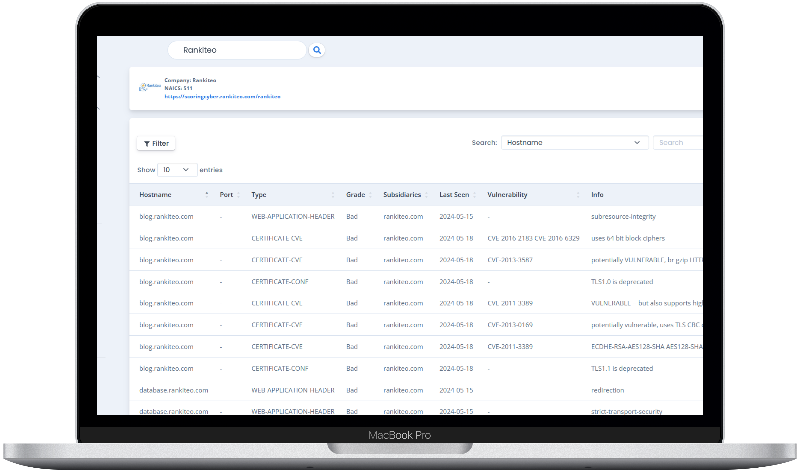
Identify exposed access points, detect misconfigured SSL certificates, and uncover vulnerabilities across the network infrastructure.
Gain visibility into the software components used within an organization to detect vulnerabilities, manage risk, and ensure supply chain security.
Monitor and manage all IT assets and their configurations to ensure accurate, real-time visibility across the company's technology environment.
Leverage real-time insights on active threats, malware campaigns, and emerging vulnerabilities to proactively defend against evolving cyberattacks.










 Rapid
Rapid