







UCLA Health
Company Details
Linkedin ID:
ucla-health
Website:
Employees number:
17,415
Number of followers:
143,829
NAICS:
62
Industry Type:
Homepage:
uclahealth.org
IP Addresses:
1152
Company ID:
UCL_1317132
Scan Status:
Completed


UCLA Health Vendor Cyber Rating & Cyber Score
uclahealth.orgFor more than half a century, UCLA Health has provided the best in healthcare and the latest in medical technology to the people of Los Angeles and throughout the world. Comprised of Ronald Reagan UCLA Medical Center, UCLA Medical Center Santa Monica, Resnick Neuropsychiatric Hospital at UCLA, UCLA Mattel Children's Hospital, UCLA West Valley Medical Center and the UCLA Medical Group with its wide-reaching system of primary-care and specialty-care offices throughout the region, UCLA Health is among the most comprehensive and advanced healthcare systems in the world. Our physicians are world leaders in the diagnosis and treatment of complex illnesses, and our hospitals are among the best in the country. Consistently ranked one of the top ten hospitals in the nation and the best medical center in the western United States by U.S. News & World Report, Ronald Reagan UCLA Medical Center is at the cutting edge of biomedical research, and our doctors and scientists are leaders in performing pioneering work across an astounding range of disciplines, from organ transplantation and cardiac surgery to neurosurgery and cancer treatment, and bringing the latest discoveries to virtually every field of medicine.
Company Details
ucla-health
17,415
143,829
62
uclahealth.org
1152
UCL_1317132
Completed
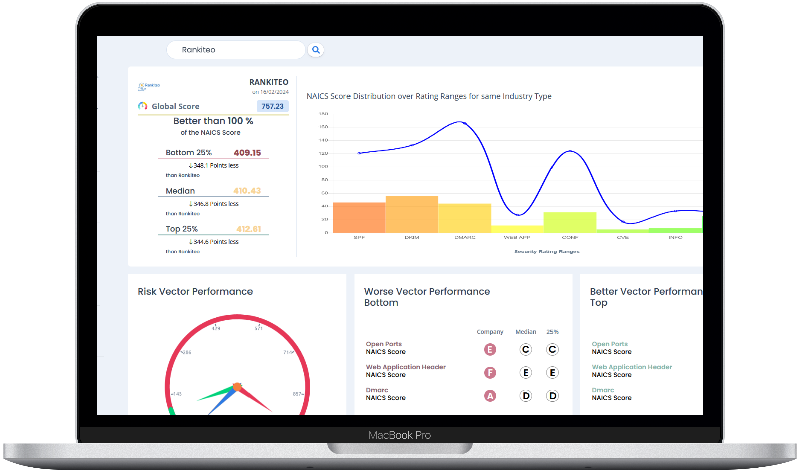
 UCLA Health Risk Score (AI oriented)
Between 700 and 749
 UCLA Health Global Score (TPRM)
XXXX
Description: UC Regents Settles $5.8 Million Class Action Over 2020-2021 Data Breach The University of California (UC) Regents has finalized a $5.8 million settlement in *Erazo v. The Regents of the University of California*, resolving a class action lawsuit stemming from a 2020-2021 data breach. The incident, which exposed sensitive information of over 350,000 UC students and employees, occurred between mid-December 2020 and January 2021 due to a compromised file transfer application licensed by Accellion, Inc. The breach allegedly exposed data from the 2020 UC Undergraduate Experience Survey and medical records. While the UC Regents denied wrongdoing as part of the settlement, they agreed to distribute payments to affected individuals, cover litigation costs, and implement enhanced cybersecurity measures for at least two years. These measures include retiring the vulnerable Accellion FTA system, migrating to a secure file transfer product, increasing system monitoring, and providing security training for relevant employees. Payments to the 353,265-member settlement class have begun, with eligible claimants notified via email. The settlement fund will also cover administrative expenses and attorneys' fees. The case was settled on May 29, 2025.
Description: The University of California San Francisco suffered a significant ransomware attack at the hands of the NetWalker group, which resulted in the loss of access to critical data. In order to recover the encrypted files, UCSF was compelled to pay a substantial ransom of $1.14 million. This incident stressed the vulnerability of major institutions to sophisticated cyber threats, particularly during sensitive times such as the COVID-19 pandemic when reliance on digital infrastructure is at its peak. The attack not only financially impacted the university but also highlighted the potential risks to privacy and the continuation of essential services.
Description: The California Office of the Attorney General reported that UC San Diego Health experienced a data breach due to a phishing attack, which occurred between January 9 and January 22, 2024. The breach involved unauthorized access to employee email accounts, potentially exposing personal information such as names and Social Security numbers, affecting an unspecified number of individuals. The breach was reported on March 8, 2024.
Description: UC San Diego Health experienced a ransomware attack threatening critical healthcare operations. As the medical industry increases reliance on technology, such attacks can have dire consequences on patient care and outcomes. The attack's costliness, with an average of $11 million according to IBM, poses risks to smaller healthcare systems' existence, potentially leading to their permanent closure. Patients in remote areas would be most affected due to the scarcity of nearby medical facilities. In response, federal funding has been allocated to develop better preventative and mitigative measures, focusing on cybersecurity in healthcare.
Description: The five new MOVEit assaults victims revealed on the dark web leak site for the Clop ransomware organization include the industrial behemoths Siemens Energy, Schneider Electric, werum.com, UCLA (http://ucla.edu), Abbie (http://abbvie.com), and Abbie. Worldwide, vital national infrastructures use Industrial Control Systems (ICS) from Siemens Energy and Schneider Electric. Threat actors claim they were able to compromise 100 different firms utilizing the most recently revealed MOVEit Transfer vulnerability CVE-2023-34362. The US government offers rewards for information that leads to the arrest, indictment, or location of dangerous actors.
Description: The University of California, San Francisco (UCSF) experienced a data breach on February 9, 2023, disclosed on April 26, 2023, due to a phishing attack targeting UCSF email accounts. The breach exposed sensitive personal information of individuals, including First Name, Last Name, Date of Birth, Medical Record Number (MRN), and Date of Service. The exact number of affected individuals remains undetermined, but the compromised data poses risks of identity theft, medical fraud, or targeted scams. The attack exploited human vulnerability through phishing, leading to unauthorized access to employee email accounts, which likely contained or facilitated access to patient records. While no ransomware was involved, the exposure of protected health information (PHI) particularly MRNs and service dates heightens concerns over compliance violations (e.g., HIPAA) and potential misuse of medical data. The breach underscores the persistent threat of social engineering attacks in healthcare institutions, where employee credentials serve as gateways to highly sensitive systems.
Description: UC San Diego Health suffered a data breach via its third-party vendor, Solv Health, between September 13 and December 22, 2022. The incident exposed sensitive personal information of individuals who used Solv Health’s scheduling websites. Compromised data may include names, dates of birth, email addresses, and insurance details, though the exact number of affected individuals remains undisclosed. The breach stems from a vulnerability or security lapse within Solv Health’s systems, indirectly impacting UC San Diego Health’s patients. While no financial or medical records appear to have been stolen, the exposure of personally identifiable information (PII) raises concerns over potential identity theft, phishing, or fraudulent activities targeting the victims. The breach underscores risks associated with third-party vendor dependencies in healthcare data management, where even non-direct attacks can erode trust and necessitate regulatory disclosures under laws like HIPAA or CCPA. UC San Diego Health likely faced reputational damage and operational disruptions in addressing the fallout, including notifications, credit monitoring offers, and system audits to prevent future incidents.
Description: UCLA health experienced a data breach incident that 94,000 patients personal information and health data to third parties. UCLA Health promptly disabled the use of the tools and launched an investigation. The compromised information includes patients’ URL/website addresses, provider names, specialty, ad campaign names, page views, IP addresses, third-party cookies, and hashed values of certain fields on the appointment request form, such as patient names, email addresses, mailing addresses, phone numbers, and genders. UCLA Health website and the UCLA Health mobile app were affected. The UCLA Health patient portal was not impacted.
Description: UC San Diego Health suffered from a data breach that exposed number of patients, employees and others connected to UC San Diego Health potentially. It was found that the breach occurred via unauthorized access to some employee email accounts, but it did not affect the continuity of care for their patients. A UCSD Health spokesperson said Tuesday that ransomware, software often used to extort money from an organization, was not involved. The compromised information includes full names, addresses, dates of birth, email addresses, fax numbers, claims information including dates and costs of care received, laboratory results, medical diagnoses and conditions, medical record numbers, prescription information, treatment information, Social Security numbers, government identification numbers, financial account numbers, student identification numbers, usernames and passwords. They notified people, and the letters each person receives precisely reflect the information that would have been impacted for that particular person.
Description: The California Office of the Attorney General reported a data breach at the University of California on May 13, 2021. The breach occurred on December 24, 2020, when an unauthorized third party accessed files containing personal information of UC community members, including Social Security numbers and financial information. Approximately 100 organizations were similarly attacked, but the number of affected individuals specific to UC is unknown.
Description: The California Office of the Attorney General reported that UC San Diego Health experienced a data breach involving unauthorized access to employee email accounts. The incident occurred between December 2, 2020, and April 8, 2021, affecting personal information including Social Security numbers and medical details. The breach was reported on September 9, 2021.
Description: The California Office of the Attorney General reported a data breach involving the University of California San Francisco (UCSF) on November 13, 2020. The breach occurred on June 1, 2020, due to a cybersecurity attack that resulted in unauthorized access to personal information, including names and social security numbers, affecting an unspecified number of individuals. UCSF paid the attacker to recover encrypted data and has offered credit monitoring services to impacted individuals.
Description: The California Office of the Attorney General reported a data breach at UC San Diego Health that occurred between November 20, 2017, and December 9, 2017, with notification issued on June 14, 2019. An unauthorized third party accessed a medical transcription platform, potentially compromising patient data such as names, dates of birth, and clinical information, but did not access Social Security numbers or financial account information. The number of individuals affected is currently unknown.
Description: The California Office of the Attorney General reported that UC San Diego School of Medicine experienced a data breach on August 3, 2016. The breach involved personal information including names and social security numbers of trainees. The incident was reported on September 22, 2016.
Description: UCLA Health experienced a data breach incident in September 2015 after one of its laptop got stolen. The stolen laptop contained the personal information of approximately 1,242 patient of the organization including names and medical record numbers. UCLA Health notified all affected patient and retraining those involved with the incident.
Description: An employee of UC Irvine Medical Center unethically viewed thousands of patient records over a four-year period. The incident compromised the personal health information including names, dates of birth, gender, medical record numbers, height, weight, medical center account numbers, allergy information, home address, medical documentation, diagnoses, test orders and results, of 4,859 patients . The center investigated the incident with the help of external security experts and notifies the affected patients.
Description: The University of California, Irvine experienced a data breach reported on May 14, 2014, involving unauthorized access to its systems. The breach occurred due to computers being infected with a keystroke logger between February 14 and March 27, 2014, which potentially compromised personal and unencrypted medical data of individuals. The exact number of affected individuals remains unknown, raising concerns about the exposure of sensitive health information. The attack method suggests a targeted intrusion aimed at harvesting confidential data, likely through malicious software designed to capture keystrokes including login credentials, medical records, or other personally identifiable information (PII). The breach underscores vulnerabilities in the university’s cybersecurity defenses, particularly in protecting high-risk data like medical records, which are subject to strict regulatory protections (e.g., HIPAA). The incident highlights the risks of unauthorized data access in academic institutions handling sensitive information, with potential long-term repercussions for trust, legal compliance, and individual privacy.
Description: The California Office of the Attorney General reported a data breach involving the University of California San Francisco (UCSF) on November 21, 2013. The breach occurred on September 25, 2013, when an unencrypted personal laptop containing identifiable health information was stolen from a physician's locked vehicle. The stolen laptop contained sensitive health information, which could potentially compromise the privacy and security of the affected individuals.
Description: In June 2015, the California Office of the Attorney General disclosed a data breach at the University of California Irvine Medical Center, where an employee improperly accessed patient records over an extended period from June 2011 to March 2015. The unauthorized access exposed personal health information (PHI) of an unknown number of patients, though investigations found no evidence of sensitive data being stolen or misused. The breach stemmed from internal misconduct, highlighting vulnerabilities in employee access controls and monitoring protocols. While the exposed data included patient details, the lack of confirmed theft or external exploitation mitigated some risks. However, the prolonged duration of the breach (nearly four years) raised concerns about compliance with healthcare privacy regulations (e.g., HIPAA) and the potential for reputational damage due to the mishandling of confidential medical records. The incident underscored the need for stricter audit trails, access restrictions, and employee training to prevent similar internal breaches in healthcare institutions.


No incidents recorded for UCLA Health in 2026.
No incidents recorded for UCLA Health in 2026.
No incidents recorded for UCLA Health in 2026.
UCLA Health cyber incidents detection timeline including parent company and subsidiaries

For more than half a century, UCLA Health has provided the best in healthcare and the latest in medical technology to the people of Los Angeles and throughout the world. Comprised of Ronald Reagan UCLA Medical Center, UCLA Medical Center Santa Monica, Resnick Neuropsychiatric Hospital at UCLA, UCLA Mattel Children's Hospital, UCLA West Valley Medical Center and the UCLA Medical Group with its wide-reaching system of primary-care and specialty-care offices throughout the region, UCLA Health is among the most comprehensive and advanced healthcare systems in the world. Our physicians are world leaders in the diagnosis and treatment of complex illnesses, and our hospitals are among the best in the country. Consistently ranked one of the top ten hospitals in the nation and the best medical center in the western United States by U.S. News & World Report, Ronald Reagan UCLA Medical Center is at the cutting edge of biomedical research, and our doctors and scientists are leaders in performing pioneering work across an astounding range of disciplines, from organ transplantation and cardiac surgery to neurosurgery and cancer treatment, and bringing the latest discoveries to virtually every field of medicine.

Siemens Healthineers is a leading medtech company with over 125 years of experience. We pioneer breakthroughs in healthcare. For everyone. Everywhere. Sustainably. Our portfolio, spanning in vitro and in vivo diagnostics to image-guided therapy and cancer care, is crucial for clinical decision-makin
Northside Hospital — a certified Great Place To Work® — is one of Georgia’s top health systems. We have acute-care hospitals in Atlanta, Canton, Cumming, Duluth and Lawrenceville and hundreds of outpatient locations across the state. Northside Hospital leads the U.S. in newborn deliveries and is amo
Molina Healthcare is a FORTUNE 500 company that is focused exclusively on government-sponsored health care programs for families and individuals who qualify for government sponsored health care. Molina Healthcare contracts with state governments and serves as a health plan providing a wide range o

Since its beginning in 1902, Cedars-Sinai has evolved to meet the healthcare needs of one of the most diverse regions in the nation, continually setting new standards for quality and innovation in patient care, research, teaching and community service. Today, Cedars-Sinai is widely known for its na

Abbott is a global healthcare leader that helps people live more fully at all stages of life. Our portfolio of life-changing technologies spans the spectrum of healthcare, with leading businesses and products in diagnostics, medical devices, nutritional and branded generic medicines. Our 114,000 col

Advocate Health is redefining how, when and where care is delivered to help people live well. We’re providing equitable care for all in our communities and using our combined strength and expertise to deliver better outcomes at a lower cost. Headquartered in Charlotte, North Carolina, we have a com

As a nationally ranked academic medical center and one of Alabama’s largest employers, UAB Medicine is about teamwork, support, mentorship, and collaboration. Employees are empowered to lead, learn, and innovate as they deliver world-class care to every patient, every family, every time. When you ar
Headquartered in Arizona, Banner Health is one of the largest nonprofit health care systems in the country. The system owns and operates 33 acute-care hospitals, Banner Health Network, Banner – University Medicine, academic and employed physician groups, long-term care centers, outpatient surgery ce

Our purpose is to provide safe, high quality health and personal social services to the population of Ireland. Our vision is a healthier Ireland with a high quality health service valued by all. Our Workforce The health service is the largest employer in the state with over 110,000 whole time equ
.png)
On Wednesday afternoon at UCLA Health Medical Center, two unexpected visitors cut through the IV machines and nurses' footsteps.
The gift expands mental and behavioral health services at the Stewart and Lynda Resnick Neuropsychiatric Hospital.
UCLA Health today announced the single largest gift to advance mental health care in its history – $100 million from global philanthropists...
The donation is the largest single gift ever given to UCLA Health, where a neuropsychiatric hospital is already named after the Resnicks.
Lynda and Stewart Resnick, the billionaire co-owners of agricultural giant the Wonderful Company, are giving $100 million to UCLA Health to...
The U.S. Justice Department said on Wednesday it was joining a lawsuit that alleges the use of race as a factor in admissions at the...
Cisco announced that hackers linked to China are exploiting a zero-day vulnerability in its AsyncOS software across Cisco Secure Email...
Cisco said it discovered a Chinese hacking campaign targeting its customers by exploiting a zero-day in some of the company's most popular...
Artificial intelligence (AI) tools designed to automatically document patient visits show promise in reducing the time physicians spend on...

Explore insights on cybersecurity incidents, risk posture, and Rankiteo's assessments.
The official website of UCLA Health is https://uclahealth.org.
According to Rankiteo, UCLA Health’s AI-generated cybersecurity score is 748, reflecting their Moderate security posture.
According to Rankiteo, UCLA Health currently holds 0 security badges, indicating that no recognized compliance certifications are currently verified for the organization.
According to Rankiteo, UCLA Health has been affected by a supply chain cyber incident involving Kiteworks, with the incident ID UCOKIT1774240010.
According to Rankiteo, UCLA Health is not certified under SOC 2 Type 1.
According to Rankiteo, UCLA Health does not hold a SOC 2 Type 2 certification.
According to Rankiteo, UCLA Health is not listed as GDPR compliant.
According to Rankiteo, UCLA Health does not currently maintain PCI DSS compliance.
According to Rankiteo, UCLA Health is not compliant with HIPAA regulations.
According to Rankiteo,UCLA Health is not certified under ISO 27001, indicating the absence of a formally recognized information security management framework.
UCLA Health operates primarily in the Hospitals and Health Care industry.
UCLA Health employs approximately 17,415 people worldwide.
UCLA Health presently has no subsidiaries across any sectors.
UCLA Health’s official LinkedIn profile has approximately 143,829 followers.
UCLA Health is classified under the NAICS code 62, which corresponds to Health Care and Social Assistance.
Yes, UCLA Health has an official profile on Crunchbase, which can be accessed here: https://www.crunchbase.com/organization/ucla-health-system.
Yes, UCLA Health maintains an official LinkedIn profile, which is actively utilized for branding and talent engagement, which can be accessed here: https://www.linkedin.com/company/ucla-health.
As of March 29, 2026, Rankiteo reports that UCLA Health has experienced 19 cybersecurity incidents.
UCLA Health has an estimated 32,295 peer or competitor companies worldwide.
Incident Types: The types of cybersecurity incidents that have occurred include Ransomware, Data Leak and Breach.
Total Financial Loss: The total financial loss from these incidents is estimated to be $17.94 million.
Detection and Response: The company detects and responds to cybersecurity incidents through an remediation measures with retraining involved personnel, remediation measures with notifying affected patients, and third party assistance with external security experts, and communication strategy with notifies the affected patients, and communication strategy with individuals were notified, and the letters each person receives precisely reflect the information that would have been impacted for that particular person., and containment measures with disabled the use of the tools, and communication strategy with public disclosure via california office of the attorney general, and communication strategy with public disclosure via california office of the attorney general, and containment measures with retired the vulnerable accellion fta system, and remediation measures with migrated to a secure file transfer product, increased system monitoring, provided security training for relevant employees, and communication strategy with notified eligible claimants via email, and enhanced monitoring with increased system monitoring..
Title: UCLA Health Data Breach
Description: UCLA Health experienced a data breach incident in September 2015 after one of its laptops got stolen. The stolen laptop contained the personal information of approximately 1,242 patients of the organization including names and medical record numbers. UCLA Health notified all affected patients and retrained those involved with the incident.
Date Detected: 2015-09
Type: Data Breach
Attack Vector: Theft of Laptop
Title: Unauthorized Access to Patient Records at UC Irvine Medical Center
Description: An employee of UC Irvine Medical Center unethically viewed thousands of patient records over a four-year period. The incident compromised the personal health information including names, dates of birth, gender, medical record numbers, height, weight, medical center account numbers, allergy information, home address, medical documentation, diagnoses, test orders and results, of 4,859 patients.
Type: Data Breach
Attack Vector: Unauthorized Access
Vulnerability Exploited: Insider Threat
Threat Actor: Employee
Motivation: Unethical Behavior
Title: UC San Diego Health Data Breach
Description: UC San Diego Health suffered from a data breach that exposed the information of patients, employees, and others connected to UC San Diego Health potentially.
Type: Data Breach
Attack Vector: Unauthorized access to employee email accounts
Title: UCLA Health Data Breach
Description: UCLA Health experienced a data breach incident affecting 94,000 patients' personal information and health data to third parties.
Type: Data Breach
Title: MOVEit Transfer Vulnerability Exploitation by Clop Ransomware Group
Description: The Clop ransomware group exploited the MOVEit Transfer vulnerability CVE-2023-34362 to compromise multiple organizations, including Siemens Energy, Schneider Electric, Werum, UCLA, and AbbVie.
Type: Data Breach and Ransomware Attack
Attack Vector: Vulnerability Exploitation
Vulnerability Exploited: CVE-2023-34362
Threat Actor: Clop Ransomware Group
Motivation: Financial Gain
Title: UC San Diego Health Ransomware Attack
Description: UC San Diego Health experienced a ransomware attack threatening critical healthcare operations. As the medical industry increases reliance on technology, such attacks can have dire consequences on patient care and outcomes. The attack's costliness, with an average of $11 million according to IBM, poses risks to smaller healthcare systems' existence, potentially leading to their permanent closure. Patients in remote areas would be most affected due to the scarcity of nearby medical facilities. In response, federal funding has been allocated to develop better preventative and mitigative measures, focusing on cybersecurity in healthcare.
Type: Ransomware
Motivation: Financial Gain
Title: UCSF Ransomware Attack
Description: The University of California San Francisco suffered a significant ransomware attack at the hands of the NetWalker group, which resulted in the loss of access to critical data. In order to recover the encrypted files, UCSF was compelled to pay a substantial ransom of $1.14 million. This incident stressed the vulnerability of major institutions to sophisticated cyber threats, particularly during sensitive times such as the COVID-19 pandemic when reliance on digital infrastructure is at its peak. The attack not only financially impacted the university but also highlighted the potential risks to privacy and the continuation of essential services.
Type: Ransomware
Threat Actor: NetWalker group
Motivation: Financial Gain
Title: UC San Diego Health Data Breach
Description: The California Office of the Attorney General reported that UC San Diego Health experienced a data breach due to a phishing attack, which occurred between January 9 and January 22, 2024. The breach involved unauthorized access to employee email accounts, potentially exposing personal information such as names and Social Security numbers, affecting an unspecified number of individuals. The breach was reported on March 8, 2024.
Date Detected: 2024-03-08
Date Publicly Disclosed: 2024-03-08
Type: Data Breach
Attack Vector: Phishing
Vulnerability Exploited: Human
Title: Data Breach at University of California San Francisco
Description: The California Office of the Attorney General reported a data breach involving the University of California San Francisco (UCSF) on November 13, 2020. The breach occurred on June 1, 2020, due to a cybersecurity attack that resulted in unauthorized access to personal information, including names and social security numbers, affecting an unspecified number of individuals. UCSF paid the attacker to recover encrypted data and has offered credit monitoring services to impacted individuals.
Date Detected: 2020-06-01
Date Publicly Disclosed: 2020-11-13
Type: Data Breach
Title: Data Breach at UC San Diego Health
Description: An unauthorized third party accessed a medical transcription platform, potentially compromising patient data such as names, dates of birth, and clinical information, but did not access Social Security numbers or financial account information.
Date Publicly Disclosed: 2019-06-14
Type: Data Breach
Attack Vector: Unauthorized Access
Threat Actor: Unauthorized Third Party
Title: Data Breach at University of California San Francisco (UCSF)
Description: A data breach occurred when an unencrypted personal laptop containing identifiable health information was stolen from a physician's locked vehicle.
Date Detected: 2013-09-25
Date Publicly Disclosed: 2013-11-21
Type: Data Breach
Attack Vector: Physical Theft
Vulnerability Exploited: Unencrypted Data
Threat Actor: Unknown
Motivation: Unknown
Title: UC San Diego School of Medicine Data Breach
Description: The California Office of the Attorney General reported that UC San Diego School of Medicine experienced a data breach involving personal information including names and social security numbers of trainees.
Date Detected: 2016-08-03
Date Publicly Disclosed: 2016-09-22
Type: Data Breach
Title: Data Breach at University of California
Description: The California Office of the Attorney General reported a data breach at the University of California on May 13, 2021. The breach occurred on December 24, 2020, when an unauthorized third party accessed files containing personal information of UC community members, including Social Security numbers and financial information. Approximately 100 organizations were similarly attacked, but the number of affected individuals specific to UC is unknown.
Date Detected: 2021-05-13
Date Publicly Disclosed: 2021-05-13
Type: Data Breach
Attack Vector: Unauthorized Access
Threat Actor: Unauthorized Third Party
Title: UC San Diego Health Data Breach
Description: Unauthorized access to employee email accounts compromising personal information including Social Security numbers and medical details.
Date Detected: April 8, 2021
Date Publicly Disclosed: September 9, 2021
Type: Data Breach
Attack Vector: Email Compromise
Title: Data Breach at University of California, San Francisco (UCSF) via Phishing Attack
Description: The California Office of the Attorney General reported a data breach involving the University of California, San Francisco (UCSF) on April 26, 2023. The breach occurred on February 9, 2023, due to a phishing attack that compromised some UCSF email accounts, potentially exposing individuals' First Name, Last Name, Date of Birth, MRN (Medical Record Number), and Date of Service. The number of individuals affected is currently unknown.
Date Detected: 2023-02-09
Date Publicly Disclosed: 2023-04-26
Type: Data Breach
Attack Vector: Phishing
Title: UC San Diego Health Data Breach via Vendor Solv Health
Description: The California Office of the Attorney General reported that UC San Diego Health experienced a data breach involving its vendor, Solv Health, between September 13 and December 22, 2022. The breach may have compromised personal information such as names, dates of birth, email addresses, and insurance types for individuals who used scheduling websites, affecting an unknown number of individuals.
Type: Data Breach
Title: University of California Irvine Medical Center Data Breach (2011-2015)
Description: An employee improperly accessed patient records between June 2011 and March 2015 at the University of California Irvine Medical Center. The breach potentially affected an unknown number of patients, exposing various personal health information, but no evidence was found of sensitive information being removed.
Date Detected: 2015-03-01
Date Publicly Disclosed: 2015-06-17
Type: Data Breach (Insider Threat)
Attack Vector: Insider Access Abuse
Threat Actor: Internal Employee
Motivation: Unknown (Potentially Unauthorized Curiosity or Malicious Intent)
Title: University of California, Irvine Data Breach (2014)
Description: The California Office of the Attorney General reported a data breach by the University of California, Irvine on May 14, 2014. The breach involved unauthorized access to computers infected with a keystroke logger between February 14 and March 27, 2014, potentially affecting personal information for individuals, including unencrypted medical data. The number of individuals affected is unknown.
Date Detected: 2014-03-27
Date Publicly Disclosed: 2014-05-14
Type: Data Breach
Attack Vector: Keystroke Logger (Malware)
Title: UC Regents Settles $5.8 Million Class Action Over 2020-2021 Data Breach
Description: The University of California (UC) Regents has finalized a $5.8 million settlement in *Erazo v. The Regents of the University of California*, resolving a class action lawsuit stemming from a 2020-2021 data breach. The incident exposed sensitive information of over 350,000 UC students and employees due to a compromised file transfer application licensed by Accellion, Inc.
Date Detected: 2021-01
Date Resolved: 2025-05-29
Type: Data Breach
Attack Vector: Compromised file transfer application (Accellion FTA)
Vulnerability Exploited: Vulnerability in Accellion FTA system
Common Attack Types: The most common types of attacks the company has faced is Breach.
Identification of Attack Vectors: The company identifies the attack vectors used in incidents through Employee email accounts, Phishing email, Email Compromise and Phishing (compromised email accounts).

Data Compromised: Names, Medical record numbers
Data Compromised: Names, Dates of birth, Gender, Medical record numbers, Height, Weight, Medical center account numbers, Allergy information, Home address, Medical documentation, Diagnoses, Test orders and results
Data Compromised: Full names, Addresses, Dates of birth, Email addresses, Fax numbers, Claims information including dates and costs of care received, Laboratory results, Medical diagnoses and conditions, Medical record numbers, Prescription information, Treatment information, Social security numbers, Government identification numbers, Financial account numbers, Student identification numbers, Usernames and passwords
Data Compromised: Url/website addresses, Provider names, Specialty, Ad campaign names, Page views, Ip addresses, Third-party cookies, Hashed values of certain fields on the appointment request form, such as patient names, email addresses, mailing addresses, phone numbers, and genders
Systems Affected: UCLA Health websiteUCLA Health mobile app

Financial Loss: Average of $11 million
Systems Affected: Critical healthcare operations
Operational Impact: Threat to patient care and outcomes
Financial Loss: $1.14 million
Systems Affected: Critical data systems
Operational Impact: Loss of access to critical data
Data Compromised: Names, Social security numbers
Systems Affected: Employee email accounts
Data Compromised: Names, Social security numbers
Data Compromised: Names, Dates of birth, Clinical information
Systems Affected: Medical Transcription Platform
Data Compromised: Identifiable Health Information
Systems Affected: Personal Laptop
Data Compromised: Names, Social security numbers
Data Compromised: Social security numbers, Financial information
Data Compromised: Social security numbers, Medical details
Data Compromised: First name, Last name, Date of birth, Mrn, Date of service
Systems Affected: Email Accounts
Identity Theft Risk: Potential (PII exposed)
Data Compromised: Names, Dates of birth, Email addresses, Insurance types
Systems Affected: scheduling websites
Identity Theft Risk: Potential
Data Compromised: Personal health information (phi)
Brand Reputation Impact: Potential Reputational Harm (Healthcare Trust Erosion)
Identity Theft Risk: Low (No Evidence of Data Exfiltration)
Data Compromised: Personal information, Unencrypted medical data
Systems Affected: Computers
Identity Theft Risk: Potential
Financial Loss: $5.8 million settlement
Data Compromised: Sensitive information of over 350,000 individuals
Systems Affected: File transfer application (Accellion FTA)
Operational Impact: Enhanced cybersecurity measures implemented for at least two years
Legal Liabilities: Class action lawsuit settlement
Identity Theft Risk: Exposure of sensitive information (e.g., medical records, survey data)
Average Financial Loss: The average financial loss per incident is $944.21 thousand.
Commonly Compromised Data Types: The types of data most commonly compromised in incidents are Personal Information, , Names, Dates Of Birth, Gender, Medical Record Numbers, Height, Weight, Medical Center Account Numbers, Allergy Information, Home Address, Medical Documentation, Diagnoses, Test Orders And Results, , Full Names, Addresses, Dates Of Birth, Email Addresses, Fax Numbers, Claims Information Including Dates And Costs Of Care Received, Laboratory Results, Medical Diagnoses And Conditions, Medical Record Numbers, Prescription Information, Treatment Information, Social Security Numbers, Government Identification Numbers, Financial Account Numbers, Student Identification Numbers, Usernames And Passwords, , Personal Information, Health Data, , Names, Social Security Numbers, , Names, Social Security Numbers, , Names, Dates Of Birth, Clinical Information, , Identifiable Health Information, Names, Social Security Numbers, , Social Security Numbers, Financial Information, , Social Security Numbers, Medical Details, , Personally Identifiable Information (Pii), Protected Health Information (Phi), , Personal Information, , Personal Health Information (PHI), Personal Information, Medical Data, , Medical Records, 2020 Uc Undergraduate Experience Survey Data and .
Entity Name: UCLA Health
Entity Type: Healthcare Provider
Industry: Healthcare
Customers Affected: 1,242
Entity Name: UC Irvine Medical Center
Entity Type: Hospital
Industry: Healthcare
Location: Irvine, CA
Customers Affected: 4,859 patients
Entity Name: UC San Diego Health
Entity Type: Healthcare
Industry: Healthcare
Location: San Diego, CA
Entity Name: UCLA Health
Entity Type: Healthcare Provider
Industry: Healthcare
Location: Los Angeles, California
Customers Affected: 94,000
Entity Name: Siemens Energy
Entity Type: Industrial Control Systems Provider
Industry: Energy
Entity Name: Schneider Electric
Entity Type: Industrial Control Systems Provider
Industry: Energy Management and Automation
Entity Name: Werum
Entity Type: Software Company
Industry: Pharmaceuticals and Biotech
Entity Name: UCLA
Entity Type: University
Industry: Education
Location: Los Angeles, CA
Entity Name: AbbVie
Entity Type: Pharmaceutical Company
Industry: Pharmaceuticals
Entity Name: UC San Diego Health
Entity Type: Healthcare Provider
Industry: Healthcare
Location: San Diego, California
Entity Name: University of California San Francisco
Entity Type: Educational Institution
Industry: Education
Location: San Francisco, CA
Entity Name: UC San Diego Health
Entity Type: Healthcare
Industry: Healthcare
Location: San Diego, California
Entity Name: University of California San Francisco
Entity Type: Educational Institution
Industry: Education
Location: San Francisco, California
Entity Name: UC San Diego Health
Entity Type: Healthcare
Industry: Healthcare
Location: San Diego, California
Entity Name: University of California San Francisco (UCSF)
Entity Type: Educational Institution
Industry: Healthcare
Location: San Francisco, California
Entity Name: UC San Diego School of Medicine
Entity Type: Educational Institution
Industry: Education
Location: San Diego, California
Entity Name: University of California
Entity Type: Educational Institution
Industry: Education
Location: California
Entity Name: UC San Diego Health
Entity Type: Healthcare
Industry: Healthcare
Location: San Diego, California
Entity Name: University of California, San Francisco (UCSF)
Entity Type: Educational Institution / Healthcare Provider
Industry: Education, Healthcare
Location: San Francisco, California, USA
Customers Affected: Unknown
Entity Name: UC San Diego Health
Entity Type: Healthcare Provider
Industry: Healthcare
Location: California, USA
Customers Affected: Unknown
Entity Name: Solv Health
Entity Type: Vendor
Industry: Healthcare Technology
Customers Affected: Unknown
Entity Name: University of California Irvine Medical Center
Entity Type: Healthcare Provider / Academic Medical Center
Industry: Healthcare
Location: Orange, California, USA
Customers Affected: Unknown (Patients)
Entity Name: University of California, Irvine
Entity Type: Educational Institution
Industry: Higher Education
Location: Irvine, California, USA
Customers Affected: Unknown
Entity Name: University of California (UC) Regents
Entity Type: Educational Institution
Industry: Education/Higher Education
Location: California, USA
Customers Affected: 353,265 students and employees
Remediation Measures: Retraining involved personnelNotifying affected patients
Third Party Assistance: external security experts
Communication Strategy: notifies the affected patients
Communication Strategy: Individuals were notified, and the letters each person receives precisely reflect the information that would have been impacted for that particular person.
Containment Measures: Disabled the use of the tools
Communication Strategy: Public disclosure via California Office of the Attorney General
Communication Strategy: Public Disclosure via California Office of the Attorney General
Containment Measures: Retired the vulnerable Accellion FTA system
Remediation Measures: Migrated to a secure file transfer product, increased system monitoring, provided security training for relevant employees
Communication Strategy: Notified eligible claimants via email
Enhanced Monitoring: Increased system monitoring
Third-Party Assistance: The company involves third-party assistance in incident response through external security experts.
Type of Data Compromised: Personal information
Number of Records Exposed: 1,242
Sensitivity of Data: High
Personally Identifiable Information: NamesMedical Record Numbers
Type of Data Compromised: Names, Dates of birth, Gender, Medical record numbers, Height, Weight, Medical center account numbers, Allergy information, Home address, Medical documentation, Diagnoses, Test orders and results
Number of Records Exposed: 4,859
Sensitivity of Data: High
Personally Identifiable Information: namesdates of birthgendermedical record numbersheightweightmedical center account numbersallergy informationhome address
Type of Data Compromised: Full names, Addresses, Dates of birth, Email addresses, Fax numbers, Claims information including dates and costs of care received, Laboratory results, Medical diagnoses and conditions, Medical record numbers, Prescription information, Treatment information, Social security numbers, Government identification numbers, Financial account numbers, Student identification numbers, Usernames and passwords
Sensitivity of Data: High
Type of Data Compromised: Personal information, Health data
Number of Records Exposed: 94,000
Sensitivity of Data: High
Personally Identifiable Information: Patient namesEmail addressesMailing addressesPhone numbersGenders
Type of Data Compromised: Names, Social security numbers
Sensitivity of Data: High
Type of Data Compromised: Names, Social security numbers
Type of Data Compromised: Names, Dates of birth, Clinical information
Sensitivity of Data: High
Personally Identifiable Information: NamesDates of Birth
Type of Data Compromised: Identifiable Health Information
Sensitivity of Data: High
Data Encryption: No
Personally Identifiable Information: Yes
Type of Data Compromised: Names, Social security numbers
Sensitivity of Data: High
Type of Data Compromised: Social security numbers, Financial information
Sensitivity of Data: High
Personally Identifiable Information: Social Security numbers
Type of Data Compromised: Social security numbers, Medical details
Sensitivity of Data: High
Type of Data Compromised: Personally identifiable information (pii), Protected health information (phi)
Number of Records Exposed: Unknown
Sensitivity of Data: High (includes MRN and PHI)
Personally Identifiable Information: First NameLast NameDate of BirthMRNDate of Service
Type of Data Compromised: Personal information
Number of Records Exposed: Unknown
Sensitivity of Data: Moderate (PII)
Data Exfiltration: Likely
Personally Identifiable Information: namesdates of birthemail addresses
Type of Data Compromised: Personal Health Information (PHI)
Number of Records Exposed: Unknown
Sensitivity of Data: High (Health Records)
Data Exfiltration: No Evidence
Personally Identifiable Information: Likely (PHI includes PII elements)
Type of Data Compromised: Personal information, Medical data
Number of Records Exposed: Unknown
Sensitivity of Data: High (Unencrypted Medical Data)
Data Exfiltration: Potential
Data Encryption: No (Data was unencrypted)
Personally Identifiable Information: Yes
Type of Data Compromised: Medical records, 2020 uc undergraduate experience survey data
Number of Records Exposed: 353,265
Sensitivity of Data: High (personally identifiable information, medical records)
Personally Identifiable Information: Yes
Prevention of Data Exfiltration: The company takes the following measures to prevent data exfiltration: Retraining involved personnel, Notifying affected patients, , Migrated to a secure file transfer product, increased system monitoring, provided security training for relevant employees.
Handling of PII Incidents: The company handles incidents involving personally identifiable information (PII) through by disabled the use of the tools and retired the vulnerable accellion fta system.
Ransomware Strain: Clop
Ransom Demanded: $1.14 million
Ransom Paid: $1.14 million
Ransomware Strain: NetWalker
Data Encryption: Yes
Data Encryption: True
Regulations Violated: Potentially HIPAA (Health Insurance Portability and Accountability Act), California Consumer Privacy Act (CCPA),
Regulatory Notifications: California Office of the Attorney General
Regulatory Notifications: California Office of the Attorney General
Regulations Violated: HIPAA (Potential Violation), California Data Breach Notification Law,
Regulatory Notifications: California Office of the Attorney General
Regulatory Notifications: California Office of the Attorney General
Legal Actions: Class action lawsuit (*Erazo v. The Regents of the University of California*)
Ensuring Regulatory Compliance: The company ensures compliance with regulatory requirements through Class action lawsuit (*Erazo v. The Regents of the University of California*).
Recommendations: Federal funding allocated to develop better preventative and mitigative measures, focusing on cybersecurity in healthcare.
Recommendations: Retire vulnerable systems, migrate to secure alternatives, enhance monitoring, and provide security training
Implemented Recommendations: The company has implemented the following recommendations to improve cybersecurity: Federal funding allocated to develop better preventative and mitigative measures, focusing on cybersecurity in healthcare., Retire vulnerable systems, migrate to secure alternatives, enhance monitoring and and provide security training.
Source: UCLA Health
Source: California Office of the Attorney General
Date Accessed: 2024-03-08
Source: California Office of the Attorney General
Date Accessed: 2020-11-13
Source: California Office of the Attorney General
Source: California Office of the Attorney General
Source: California Office of the Attorney General
Source: California Office of the Attorney General
Date Accessed: 2021-05-13
Source: California Office of the Attorney General
Date Accessed: September 9, 2021
Source: California Office of the Attorney General
Date Accessed: 2023-04-26
Source: California Office of the Attorney General
Source: California Office of the Attorney General
Date Accessed: 2015-06-17
Source: California Office of the Attorney General
Source: Class action settlement notice
Additional Resources: Stakeholders can find additional resources on cybersecurity best practices at and Source: UCLA Health, and Source: UCLAUrl: http://ucla.edu, and Source: AbbVieUrl: http://abbvie.com, and Source: California Office of the Attorney GeneralDate Accessed: 2024-03-08, and Source: California Office of the Attorney GeneralDate Accessed: 2020-11-13, and Source: California Office of the Attorney General, and Source: California Office of the Attorney General, and Source: California Office of the Attorney General, and Source: California Office of the Attorney GeneralDate Accessed: 2021-05-13, and Source: California Office of the Attorney GeneralDate Accessed: September 9, 2021, and Source: California Office of the Attorney GeneralDate Accessed: 2023-04-26, and Source: California Office of the Attorney General, and Source: California Office of the Attorney GeneralDate Accessed: 2015-06-17, and Source: California Office of the Attorney General, and Source: Class action settlement notice.
Investigation Status: Ongoing
Investigation Status: Completed (No Evidence of Data Theft)
Investigation Status: Settled
Communication of Investigation Status: The company communicates the status of incident investigations to stakeholders through notifies the affected patients, Individuals were notified, and the letters each person receives precisely reflect the information that would have been impacted for that particular person., Public disclosure via California Office of the Attorney General, Public Disclosure via California Office of the Attorney General and Notified eligible claimants via email.
Customer Advisories: Eligible claimants notified via email
Advisories Provided: The company provides the following advisories to stakeholders and customers following an incident: was Eligible claimants notified via email.
Entry Point: Employee email accounts
Entry Point: Phishing email
Entry Point: Email Compromise
Entry Point: Phishing (compromised email accounts)
Root Causes: Lack of Access Controls / Monitoring for Insider Threats
Root Causes: Vulnerability in Accellion FTA system
Corrective Actions: Retired Accellion FTA, migrated to secure file transfer product, increased monitoring, security training
Post-Incident Analysis Process: The company's process for conducting post-incident analysis is described as external security experts, Increased system monitoring.
Corrective Actions Taken: The company has taken the following corrective actions based on post-incident analysis: Retired Accellion FTA, migrated to secure file transfer product, increased monitoring, security training.
Ransom Payment History: The company has Paid ransoms in the past.
Last Ransom Demanded: The amount of the last ransom demanded was $1.14 million.
Last Attacking Group: The attacking group in the last incident were an Employee, Clop Ransomware Group, NetWalker group, Unauthorized Third Party, Unknown, Unauthorized Third Party and Internal Employee.
Most Recent Incident Detected: The most recent incident detected was on 2015-09.
Most Recent Incident Publicly Disclosed: The most recent incident publicly disclosed was on 2014-05-14.
Most Recent Incident Resolved: The most recent incident resolved was on 2025-05-29.
Highest Financial Loss: The highest financial loss from an incident was $1.14 million.
Most Significant Data Compromised: The most significant data compromised in an incident were Names, Medical Record Numbers, , names, dates of birth, gender, medical record numbers, height, weight, medical center account numbers, allergy information, home address, medical documentation, diagnoses, test orders and results, , full names, addresses, dates of birth, email addresses, fax numbers, claims information including dates and costs of care received, laboratory results, medical diagnoses and conditions, medical record numbers, prescription information, treatment information, Social Security numbers, government identification numbers, financial account numbers, student identification numbers, usernames and passwords, , URL/website addresses, Provider names, Specialty, Ad campaign names, Page views, IP addresses, Third-party cookies, Hashed values of certain fields on the appointment request form, such as patient names, email addresses, mailing addresses, phone numbers, and genders, , Names, Social Security numbers, , names, social security numbers, , Names, Dates of Birth, Clinical Information, , Identifiable Health Information, names, social security numbers, , Social Security numbers, Financial information, , Social Security numbers, medical details, , First Name, Last Name, Date of Birth, MRN, Date of Service, , names, dates of birth, email addresses, insurance types, , Personal Health Information (PHI), , Personal Information, Unencrypted Medical Data, , Sensitive information of over 350 and000 individuals.
Most Significant System Affected: The most significant system affected in an incident was UCLA Health websiteUCLA Health mobile app and and and Employee email accounts and Medical Transcription Platform and and Email Accounts and scheduling websites and Computers and .
Third-Party Assistance in Most Recent Incident: The third-party assistance involved in the most recent incident was external security experts.
Containment Measures in Most Recent Incident: The containment measures taken in the most recent incident were Disabled the use of the tools and Retired the vulnerable Accellion FTA system.
Most Sensitive Data Compromised: The most sensitive data compromised in a breach were prescription information, laboratory results, financial account numbers, government identification numbers, Provider names, Date of Birth, gender, usernames and passwords, IP addresses, Personal Information, names, Personal Health Information (PHI), Last Name, full names, treatment information, MRN, Clinical Information, addresses, insurance types, medical details, medical diagnoses and conditions, URL/website addresses, diagnoses, social security numbers, claims information including dates and costs of care received, First Name, email addresses, allergy information, home address, Ad campaign names, weight, Page views, Medical Record Numbers, medical center account numbers, dates of birth, medical documentation, height, Names, Social Security numbers, test orders and results, medical record numbers, fax numbers, student identification numbers, Dates of Birth, Financial information, Third-party cookies, Date of Service, Sensitive information of over 350,000 individuals, Specialty, Hashed values of certain fields on the appointment request form, such as patient names, email addresses, mailing addresses, phone numbers, and genders, Identifiable Health Information and Unencrypted Medical Data.
Number of Records Exposed in Most Significant Breach: The number of records exposed in the most significant breach was 453.4K.
Highest Ransom Demanded: The highest ransom demanded in a ransomware incident was $1.14 million.
Highest Ransom Paid: The highest ransom paid in a ransomware incident was $1.14 million.
Most Significant Legal Action: The most significant legal action taken for a regulatory violation was Class action lawsuit (*Erazo v. The Regents of the University of California*).
Most Significant Recommendation Implemented: The most significant recommendation implemented to improve cybersecurity was Federal funding allocated to develop better preventative and mitigative measures, focusing on cybersecurity in healthcare., Retire vulnerable systems, migrate to secure alternatives, enhance monitoring and and provide security training.
Most Recent Source: The most recent source of information about an incident are Class action settlement notice, UCLA, UCLA Health, California Office of the Attorney General and AbbVie.
Most Recent URL for Additional Resources: The most recent URL for additional resources on cybersecurity best practices is http://ucla.edu, http://abbvie.com .
Current Status of Most Recent Investigation: The current status of the most recent investigation is Ongoing.
Most Recent Customer Advisory: The most recent customer advisory issued was an Eligible claimants notified via email.
Most Recent Entry Point: The most recent entry point used by an initial access broker were an Email Compromise, Phishing (compromised email accounts), Phishing email and Employee email accounts.
Most Significant Root Cause: The most significant root cause identified in post-incident analysis was Lack of Access Controls / Monitoring for Insider Threats, Vulnerability in Accellion FTA system.
Most Significant Corrective Action: The most significant corrective action taken based on post-incident analysis was Retired Accellion FTA, migrated to secure file transfer product, increased monitoring, security training.
.png)
A weakness has been identified in code-projects Simple Food Order System 1.0. Affected is an unknown function of the file register-router.php of the component Parameter Handler. Executing a manipulation of the argument Name can lead to sql injection. The attack can be launched remotely. The exploit has been made available to the public and could be used for attacks.
A security flaw has been discovered in code-projects Simple Food Order System 1.0. This impacts an unknown function of the file /all-tickets.php of the component Parameter Handler. Performing a manipulation of the argument Status results in sql injection. The attack can be initiated remotely. The exploit has been released to the public and may be used for attacks.
A vulnerability was identified in elecV2 elecV2P up to 3.8.3. This affects the function eAxios of the file /mock of the component URL Handler. Such manipulation of the argument req leads to server-side request forgery. It is possible to launch the attack remotely. The exploit is publicly available and might be used. The project was informed of the problem early through an issue report but has not responded yet.
A vulnerability was determined in elecV2 elecV2P up to 3.8.3. The impacted element is an unknown function of the file /logs of the component Endpoint. This manipulation of the argument filename causes cross site scripting. It is possible to initiate the attack remotely. The exploit has been publicly disclosed and may be utilized. The project was informed of the problem early through an issue report but has not responded yet.
A vulnerability was found in elecV2 elecV2P up to 3.8.3. The affected element is the function path.join of the file /log/ of the component Wildcard Handler. The manipulation results in path traversal. The attack may be performed from remote. The exploit has been made public and could be used. The project was informed of the problem early through an issue report but has not responded yet.

Get company history

Every week, Rankiteo analyzes billions of signals to give organizations a sharper, faster view of emerging risks. With deeper, more actionable intelligence at their fingertips, security teams can outpace threat actors, respond instantly to Zero-Day attacks, and dramatically shrink their risk exposure window.
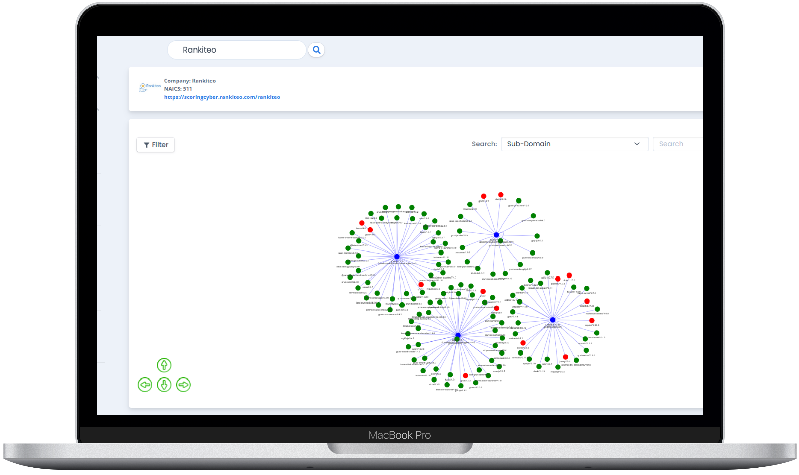
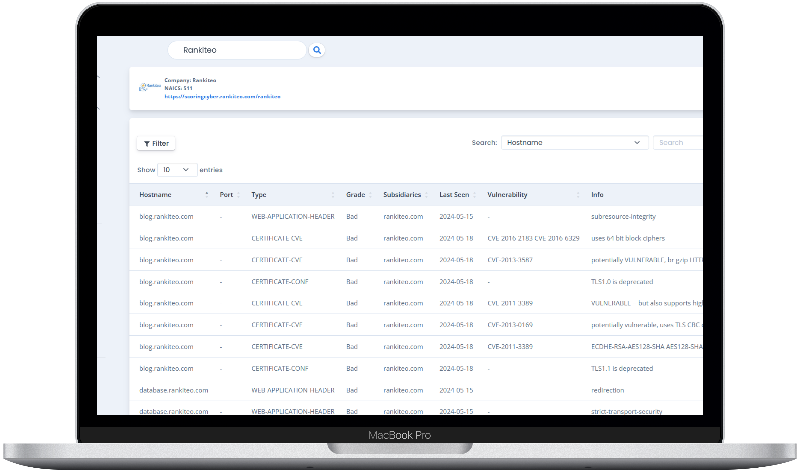
Identify exposed access points, detect misconfigured SSL certificates, and uncover vulnerabilities across the network infrastructure.
Gain visibility into the software components used within an organization to detect vulnerabilities, manage risk, and ensure supply chain security.
Monitor and manage all IT assets and their configurations to ensure accurate, real-time visibility across the company's technology environment.
Leverage real-time insights on active threats, malware campaigns, and emerging vulnerabilities to proactively defend against evolving cyberattacks.



 Kiteworks



 Rapid
Rapid