













THR
Company Details
Linkedin ID:
texas-health-resources
Website:
Employees number:
16,844
Number of followers:
117,739
NAICS:
62
Industry Type:
Homepage:
texashealth.org
IP Addresses:
96
Company ID:
TEX_3266862
Scan Status:
Completed


Texas Health Resources Vendor Cyber Rating & Cyber Score
texashealth.orgAt Texas Health Resources, our mission is to improve the health of the people in the communities we serve. We are one of the largest faith-based, nonprofit health systems in the United States with a team of more than 28,000 employees of wholly owned/operated facilities and consolidated joint ventures in the greater Dallas Fort Worth area. Our career growth and professional development opportunities are top-notch and our benefits are equally outstanding. Join our award-winning Texas Health family and become a part of a team that is improving the health of our communities daily. You belong here. Let us brag for a minute on just a few of our recent accomplishments. • Fortune’s 100 Best Companies to Work For® 2025 • Business Group on Health Best Employers: Excellence in Health & Well-being Award 2025 • 20 Best Workplaces in Health Care by Great Place to Work® and Fortune 2025 • Companies That Care® by PEOPLE magazine and Great Place to Work® 2025 • America’s Best Large Employers by Forbes for 2025 • Fortune’s Best Workplaces for Women™ 2025 We are an Equal Opportunity Employer and do not discriminate against any employees or applicant for employment because of race, color, sex, age, national origin, religion, sexual orientation, gender identity, status as a veteran, and basis of disability or any other federal, state or local protected class.
Company Details
texas-health-resources
16,844
117,739
62
texashealth.org
96
TEX_3266862
Completed
 THR Risk Score (AI oriented)
Between 550 and 599
 THR Global Score (TPRM)
XXXX
Description: Massive Conduent Data Breach Exposes Tens of Millions Across U.S. States A cyberattack on government technology contractor Conduent has resulted in a far larger data breach than initially reported, potentially affecting tens of millions of Americans. The incident, first disclosed in April 2024, occurred after hackers disrupted the company’s systems, causing widespread outages in government services. Newly released data reveals that 15.4 million people in Texas nearly half the state’s population had their personal information compromised, a sharp increase from the 4 million initially reported in October. In Oregon, 10.5 million individuals were affected, while hundreds of thousands more in Delaware, Massachusetts, New Hampshire, and other states also had their data exposed. The stolen information includes names, Social Security numbers, medical records, and health insurance details. Conduent, a major provider of government and corporate technology services, processes sensitive data for over 100 million people through healthcare programs and other public-sector contracts. Despite the scale of the breach, the company has not confirmed the total number of affected individuals or whether the incident impacted more than 100 million people. A spokesperson declined to answer key questions, including how many breach notifications have been sent. The Safeway ransomware group claimed responsibility for the attack, asserting it exfiltrated over 8 terabytes of data. In an SEC filing, Conduent acknowledged that the stolen datasets contained personal information of end users but did not provide a clear timeline for completing notifications, stating only that the process would continue into early 2026. The full extent of the breach and its long-term impact remain unclear.
Description: Massive Conduent Data Breach Exposes Personal Data of Over 25 Million Americans A January 2025 ransomware attack on government technology contractor Conduent has compromised the personal data of at least 25.9 million individuals across the U.S., far exceeding initial estimates. The breach, which disrupted the company’s operations for days, has now been confirmed to impact 15.4 million people in Texas nearly half the state’s population up from the 4 million initially reported in October. An additional 10.5 million Oregonians are affected, along with hundreds of thousands in Delaware, Massachusetts, New Hampshire, and other states. The stolen data includes names, Social Security numbers, medical records, and health insurance information, exposing victims to potential identity theft and fraud. Conduent, a major government contractor serving over 100 million Americans through healthcare and administrative programs, has provided limited details about the incident. The company disclosed the attack in April 2025, months after hackers infiltrated its systems, causing outages in government services nationwide. The Safeway ransomware gang claimed responsibility, alleging they exfiltrated 8 terabytes of data. In an SEC filing, Conduent acknowledged the breach involved "a significant number of individuals’ personal information" tied to its corporate and government clients. While the company is still analyzing the scope of the breach, it expects to complete notifications to affected individuals by early 2026, though no precise timeline has been provided. Conduent has not confirmed whether the breach affects more than 100 million people, despite its vast user base. The company has yet to disclose how many breach notifications it has sent or provide further details on the attack’s origins. The incident underscores the growing risk of ransomware targeting critical infrastructure and third-party vendors handling sensitive data.
Description: Texas Health Resources notified fewer than 4,000 patients about an email incident last year. An unauthorized third party may have gained access to some Texas Health email accounts. Law enforcement indicated this was part of a larger incident affecting multiple entities across the country and did not just affect Texas Health entities and patients. Some patients’ information may have been in the affected email accounts. It may have included patients’ names, medical record numbers, dates of birth, addresses, insurance information, clinical information, and in some instances Social Security numbers and driver’s license and state identification numbers.


Texas Health Resources has 29.58% fewer incidents than the average of same-industry companies with at least one recorded incident.
Texas Health Resources has 15.25% fewer incidents than the average of all companies with at least one recorded incident.
Texas Health Resources reported 1 incidents this year: 0 cyber attacks, 1 ransomware, 0 vulnerabilities, 0 data breaches, compared to industry peers with at least 1 incident.
THR cyber incidents detection timeline including parent company and subsidiaries

At Texas Health Resources, our mission is to improve the health of the people in the communities we serve. We are one of the largest faith-based, nonprofit health systems in the United States with a team of more than 28,000 employees of wholly owned/operated facilities and consolidated joint ventures in the greater Dallas Fort Worth area. Our career growth and professional development opportunities are top-notch and our benefits are equally outstanding. Join our award-winning Texas Health family and become a part of a team that is improving the health of our communities daily. You belong here. Let us brag for a minute on just a few of our recent accomplishments. • Fortune’s 100 Best Companies to Work For® 2025 • Business Group on Health Best Employers: Excellence in Health & Well-being Award 2025 • 20 Best Workplaces in Health Care by Great Place to Work® and Fortune 2025 • Companies That Care® by PEOPLE magazine and Great Place to Work® 2025 • America’s Best Large Employers by Forbes for 2025 • Fortune’s Best Workplaces for Women™ 2025 We are an Equal Opportunity Employer and do not discriminate against any employees or applicant for employment because of race, color, sex, age, national origin, religion, sexual orientation, gender identity, status as a veteran, and basis of disability or any other federal, state or local protected class.


On September 1, 2018 Bon Secours Health System and Mercy Health combined to become the United States’ fifth largest Catholic health care ministry and one of the nation’s 20 largest health care systems. With 48 hospitals, thousands of providers, over 1,000 points of care and over 60,000 employees Bon

OSF HealthCare is an integrated health system founded by The Sisters of the Third Order of St. Francis. Headquartered in Peoria, Illinois, OSF HealthCare has 17 hospitals – 11 acute care, five critical access and one continuing care – with 2,305 licensed beds throughout Illinois and Michigan. OSF e

A Amil é uma empresa do setor de saúde que atua no Brasil combinando expertise e liderança para coordenar todos os agentes desse mercado - criando relações sustentáveis para conhecer e atender às necessidades de cada cliente e permitir que ele aproveite o melhor da vida. Diariamente, nos preocupamo

Our mission is to improve the health and well-being of North Carolinians and others whom we serve. We accomplish this by providing leadership and excellence in the interrelated areas of patient care, education and research. UNC Health and its 40,000 teammates, continue to serve as North Carolina’s

When it comes to your health, everything matters. That’s why UnitedHealthcare is helping people live healthier lives and making the health system work better for everyone. Our health plans are there for you in moments big and small, delivering a simple experience, affordable coverage, and supportive
Relationships are the heart of our culture. They help us create a sense of family among our residents, associates and patients. Integrity is our soul. It guides us to be open in our communication with each other, and it enables us to make the right decisions for the people who have entrusted us with

Since its beginning in 1902, Cedars-Sinai has evolved to meet the healthcare needs of one of the most diverse regions in the nation, continually setting new standards for quality and innovation in patient care, research, teaching and community service. Today, Cedars-Sinai is widely known for its na

NMC Healthcare is one of the largest private healthcare networks in the United Arab Emirates. Since 1975, we have provided high quality, personalised, and compassionate care to our patients and are proud to have earned the trust of millions of people in the UAE and around the world. ---------------
The people of Memorial Sloan Kettering Cancer Center (MSK) are united by a singular mission: ending cancer for life. Our specialized care teams provide personalized, compassionate, expert care to patients of all ages. Informed by basic research done at our Sloan Kettering Institute, scientists acros
.png)
This Week in Austin: Gov. Abbott to require health agencies to address cybersecurity threats by People's Republic of China.
Career paths in management, information technology, law, mission support, public affairs and community outreach are available within the agency.
Texas state agencies and publicly owned medical facilities have been directed to review potential cybersecurity risks linked to certain...
Texas Governor Greg Abbott has directed state health agencies and universities to review cybersecurity policies and inventory...
Hospital preparedness programs are craving cyber components. At HIMSS26, a panel dispelled some of the confusion over resource sharing...
It has been more than four months since TriZetto Provider Solutions discovered unauthorized access to its IT environment, and it has now...
Steve Morgan, Editor-in-Chief. Northport, N.Y. – Aug. 30, 2024. Over an eight-year period tracked by Cybersecurity Ventures, the number of...
CyberScoop reports that the Senate Health, Education, and Labor Committee has passed the bipartisan Health Care Cybersecurity and Resiliency...
The HHS' Office for Civil Rights (OCR) healthcare data breach portal shows a slight month-over-month decline in large healthcare data...

Explore insights on cybersecurity incidents, risk posture, and Rankiteo's assessments.
The official website of Texas Health Resources is https://jobs.texashealth.org/.
According to Rankiteo, Texas Health Resources’s AI-generated cybersecurity score is 555, reflecting their Very Poor security posture.
According to Rankiteo, Texas Health Resources currently holds 0 security badges, indicating that no recognized compliance certifications are currently verified for the organization.
According to Rankiteo, Texas Health Resources has been affected by multiple supply chain cyber incidents. The affected supply chain sources and their corresponding incident IDs are:
According to Rankiteo, Texas Health Resources is not certified under SOC 2 Type 1.
According to Rankiteo, Texas Health Resources does not hold a SOC 2 Type 2 certification.
According to Rankiteo, Texas Health Resources is not listed as GDPR compliant.
According to Rankiteo, Texas Health Resources does not currently maintain PCI DSS compliance.
According to Rankiteo, Texas Health Resources is not compliant with HIPAA regulations.
According to Rankiteo,Texas Health Resources is not certified under ISO 27001, indicating the absence of a formally recognized information security management framework.
Texas Health Resources operates primarily in the Hospitals and Health Care industry.
Texas Health Resources employs approximately 16,844 people worldwide.
Texas Health Resources presently has no subsidiaries across any sectors.
Texas Health Resources’s official LinkedIn profile has approximately 117,739 followers.
Texas Health Resources is classified under the NAICS code 62, which corresponds to Health Care and Social Assistance.
Yes, Texas Health Resources has an official profile on Crunchbase, which can be accessed here: https://www.crunchbase.com/organization/texas-health-resources.
Yes, Texas Health Resources maintains an official LinkedIn profile, which is actively utilized for branding and talent engagement, which can be accessed here: https://www.linkedin.com/company/texas-health-resources.
As of March 30, 2026, Rankiteo reports that Texas Health Resources has experienced 3 cybersecurity incidents.
Texas Health Resources has an estimated 32,297 peer or competitor companies worldwide.
Incident Types: The types of cybersecurity incidents that have occurred include Breach and Ransomware.
Detection and Response: The company detects and responds to cybersecurity incidents through an communication strategy with limited details disclosed; notifications expected by early 2026, and communication strategy with breach notifications to continue into early 2026..
Title: Email Incident at Texas Health Resources
Description: Texas Health Resources notified fewer than 4,000 patients about an email incident last year. An unauthorized third party may have gained access to some Texas Health email accounts. Law enforcement indicated this was part of a larger incident affecting multiple entities across the country and did not just affect Texas Health entities and patients. Some patients’ information may have been in the affected email accounts. It may have included patients’ names, medical record numbers, dates of birth, addresses, insurance information, clinical information, and in some instances Social Security numbers and driver’s license and state identification numbers.
Type: Email Breach
Attack Vector: Email Account Compromise
Threat Actor: Unauthorized third party
Title: Massive Conduent Data Breach Exposes Personal Data of Over 25 Million Americans
Description: A January 2025 ransomware attack on government technology contractor Conduent has compromised the personal data of at least 25.9 million individuals across the U.S. The breach disrupted the company’s operations for days and includes names, Social Security numbers, medical records, and health insurance information, exposing victims to potential identity theft and fraud. The Safeway ransomware gang claimed responsibility, alleging they exfiltrated 8 terabytes of data.
Date Detected: 2025-01
Date Publicly Disclosed: 2025-04
Type: Ransomware
Threat Actor: Safeway ransomware gang
Title: Massive Conduent Data Breach Exposes Tens of Millions Across U.S. States
Description: A cyberattack on government technology contractor Conduent has resulted in a far larger data breach than initially reported, potentially affecting tens of millions of Americans. The incident, first disclosed in April 2024, occurred after hackers disrupted the company’s systems, causing widespread outages in government services. The stolen information includes names, Social Security numbers, medical records, and health insurance details.
Date Publicly Disclosed: 2024-04
Type: Data Breach
Threat Actor: Safeway ransomware group
Common Attack Types: The most common types of attacks the company has faced is Ransomware.
Identification of Attack Vectors: The company identifies the attack vectors used in incidents through Email Account Compromise.

Data Compromised: Patients’ names, Medical record numbers, Dates of birth, Addresses, Insurance information, Clinical information, Social security numbers, Driver’s license and state identification numbers

Data Compromised: 8 terabytes
Downtime: days
Operational Impact: Disrupted government services nationwide
Identity Theft Risk: High
Data Compromised: Names, Social Security numbers, medical records, health insurance details
Downtime: Widespread outages in government services
Identity Theft Risk: High
Commonly Compromised Data Types: The types of data most commonly compromised in incidents are Patients’ Names, Medical Record Numbers, Dates Of Birth, Addresses, Insurance Information, Clinical Information, Social Security Numbers, Driver’S License And State Identification Numbers, , Names, Social Security Numbers, Medical Records, Health Insurance Information, , Names, Social Security Numbers, Medical Records, Health Insurance Details and .
Entity Name: Texas Health Resources
Entity Type: Healthcare Provider
Industry: Healthcare
Customers Affected: Fewer than 4,000 patients
Entity Name: Conduent
Entity Type: Government technology contractor
Industry: Healthcare and administrative services
Location: U.S.
Size: Serves over 100 million Americans
Customers Affected: 25.9 million individuals
Entity Name: Conduent
Entity Type: Government technology contractor
Industry: Technology/IT Services
Location: U.S.
Size: Major provider (processes data for over 100 million people)
Customers Affected: Tens of millions of Americans
Entity Name: Texas residents
Entity Type: Individuals
Location: Texas, U.S.
Size: 15.4 million people
Customers Affected: 15.4 million
Entity Name: Oregon residents
Entity Type: Individuals
Location: Oregon, U.S.
Size: 10.5 million people
Customers Affected: 10.5 million
Entity Name: Delaware residents
Entity Type: Individuals
Location: Delaware, U.S.
Size: Hundreds of thousands
Customers Affected: Hundreds of thousands
Entity Name: Massachusetts residents
Entity Type: Individuals
Location: Massachusetts, U.S.
Size: Hundreds of thousands
Customers Affected: Hundreds of thousands
Entity Name: New Hampshire residents
Entity Type: Individuals
Location: New Hampshire, U.S.
Size: Hundreds of thousands
Customers Affected: Hundreds of thousands
Communication Strategy: Limited details disclosed; notifications expected by early 2026
Communication Strategy: Breach notifications to continue into early 2026
Type of Data Compromised: Patients’ names, Medical record numbers, Dates of birth, Addresses, Insurance information, Clinical information, Social security numbers, Driver’s license and state identification numbers
Number of Records Exposed: Fewer than 4,000
Sensitivity of Data: High
Type of Data Compromised: Names, Social security numbers, Medical records, Health insurance information
Number of Records Exposed: 25.9 million individuals
Sensitivity of Data: High
Data Exfiltration: 8 terabytes
Personally Identifiable Information: Yes
Type of Data Compromised: Names, Social security numbers, Medical records, Health insurance details
Number of Records Exposed: Over 8 terabytes of data (potentially 100+ million individuals)
Sensitivity of Data: High (Personally Identifiable Information, medical records)
Data Exfiltration: Yes
Personally Identifiable Information: Yes
Data Exfiltration: 8 terabytes
Source: SEC filing
Source: SEC filing
Additional Resources: Stakeholders can find additional resources on cybersecurity best practices at and Source: SEC filing, and Source: SEC filing.
Investigation Status: Ongoing
Investigation Status: Ongoing
Communication of Investigation Status: The company communicates the status of incident investigations to stakeholders through Limited details disclosed; notifications expected by early 2026 and Breach notifications to continue into early 2026.
Customer Advisories: Notifications expected by early 2026
Customer Advisories: Breach notifications to continue into early 2026
Advisories Provided: The company provides the following advisories to stakeholders and customers following an incident: were Notifications expected by early 2026 and Breach notifications to continue into early 2026.
Entry Point: Email Account Compromise
Last Attacking Group: The attacking group in the last incident were an Unauthorized third party, Safeway ransomware gang and Safeway ransomware group.
Most Recent Incident Detected: The most recent incident detected was on 2025-01.
Most Recent Incident Publicly Disclosed: The most recent incident publicly disclosed was on 2024-04.
Most Significant Data Compromised: The most significant data compromised in an incident were Patients’ names, Medical record numbers, Dates of birth, Addresses, Insurance information, Clinical information, Social Security numbers, Driver’s license and state identification numbers, , 8 terabytes, Names, Social Security numbers, medical records and health insurance details.
Most Sensitive Data Compromised: The most sensitive data compromised in a breach were Dates of birth, Driver’s license and state identification numbers, Addresses, Clinical information, 8 terabytes, Insurance information, Social Security numbers, Names, Social Security numbers, medical records, health insurance details, Medical record numbers and Patients’ names.
Number of Records Exposed in Most Significant Breach: The number of records exposed in the most significant breach was 25.9M.
Most Recent Source: The most recent source of information about an incident is SEC filing.
Current Status of Most Recent Investigation: The current status of the most recent investigation is Ongoing.
Most Recent Customer Advisory: The most recent customer advisory issued were an Notifications expected by early 2026 and Breach notifications to continue into early 2026.
Most Recent Entry Point: The most recent entry point used by an initial access broker was an Email Account Compromise.
.png)
A vulnerability was identified in Totolink A3300R 17.0.0cu.557_b20221024. This affects the function setLanCfg of the file /cgi-bin/cstecgi.cgi of the component Parameter Handler. The manipulation of the argument lanIp leads to command injection. Remote exploitation of the attack is possible. The exploit is publicly available and might be used.
Perl versions from 5.9.4 before 5.40.4-RC1, from 5.41.0 before 5.42.2-RC1, from 5.43.0 before 5.43.9 contain a vulnerable version of Compress::Raw::Zlib. Compress::Raw::Zlib is included in the Perl package as a dual-life core module, and is vulnerable to CVE-2026-3381 due to a vendored version of zlib which has several vulnerabilities, including CVE-2026-27171. The bundled Compress::Raw::Zlib was updated to version 2.221 in Perl blead commit c75ae9cc164205e1b6d6dbd57bd2c65c8593fe94.
Ghidra versions prior to 12.0.3 improperly process annotation directives embedded in automatically extracted binary data, resulting in arbitrary command execution when an analyst interacts with the UI. Specifically, the @execute annotation (which is intended for trusted, user-authored comments) is also parsed in comments generated during auto-analysis (such as CFStrings in Mach-O binaries). This allows a crafted binary to present seemingly benign clickable text which, when clicked, executes attacker-controlled commands on the analyst’s machine.
A critical security vulnerability in parisneo/lollms versions up to 2.2.0 allows any authenticated user to accept or reject friend requests belonging to other users. The `respond_request()` function in `backend/routers/friends.py` does not implement proper authorization checks, enabling Insecure Direct Object Reference (IDOR) attacks. Specifically, the `/api/friends/requests/{friendship_id}` endpoint fails to verify whether the authenticated user is part of the friendship or the intended recipient of the request. This vulnerability can lead to unauthorized access, privacy violations, and potential social engineering attacks. The issue has been addressed in version 2.2.0.
A Server-Side Request Forgery (SSRF) vulnerability exists in parisneo/lollms versions prior to 2.2.0, specifically in the `/api/files/export-content` endpoint. The `_download_image_to_temp()` function in `backend/routers/files.py` fails to validate user-controlled URLs, allowing attackers to make arbitrary HTTP requests to internal services and cloud metadata endpoints. This vulnerability can lead to internal network access, cloud metadata access, information disclosure, port scanning, and potentially remote code execution.

Get company history

Every week, Rankiteo analyzes billions of signals to give organizations a sharper, faster view of emerging risks. With deeper, more actionable intelligence at their fingertips, security teams can outpace threat actors, respond instantly to Zero-Day attacks, and dramatically shrink their risk exposure window.
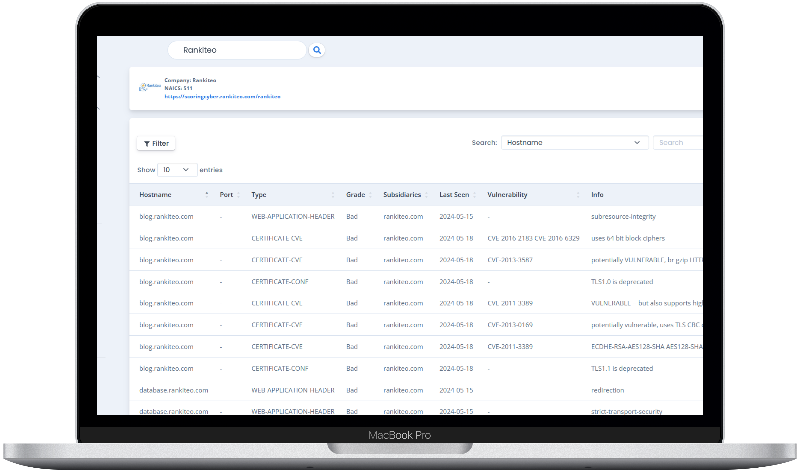
Identify exposed access points, detect misconfigured SSL certificates, and uncover vulnerabilities across the network infrastructure.
Gain visibility into the software components used within an organization to detect vulnerabilities, manage risk, and ensure supply chain security.
Monitor and manage all IT assets and their configurations to ensure accurate, real-time visibility across the company's technology environment.
Leverage real-time insights on active threats, malware campaigns, and emerging vulnerabilities to proactively defend against evolving cyberattacks.



 Conduent



 Rapid
Rapid