










NPS
Company Details
Linkedin ID:
nyc-department-of-education
Website:
Employees number:
77,240
Number of followers:
183,398
NAICS:
6111
Industry Type:
Homepage:
nyc.gov
IP Addresses:
0
Company ID:
NYC_1398679
Scan Status:
In-progress


NYC Public Schools Vendor Cyber Rating & Cyber Score
nyc.govNew York City Public Schools (NYCPS) is the largest public school system in the United States, serving approximately 1 million students across more than 1,600 schools in all five boroughs. Our schools are powered by over 75,000 teachers and thousands of paraprofessionals, school counselors, social workers, administrators, and central office professionals—each playing a vital role in delivering bright starts and bold futures for every student. NYCPS reflects the city it serves: vibrant, diverse, and dynamic. We are deeply committed to equity, inclusion, and excellence in education. Our workforce mirrors the cultural richness of New York City, and we actively recruit individuals from all backgrounds to help shape the future of urban education. Whether you're looking to teach, support, lead, or innovate—there’s a place for you at NYC Public Schools. Join us in building a school system where every student is seen, supported, and set up to thrive.
Company Details
nyc-department-of-education
77,240
183,398
6111
nyc.gov
0
NYC_1398679
In-progress
 NPS Risk Score (AI oriented)
Between 700 and 749
 NPS Global Score (TPRM)
XXXX
Description: A phishing email targeting employees of the New York City Department of Education (DOE) was detected by an 18-year-old student apprentice, Addison Wang, working in the DOE’s IT security office. The malicious email directed recipients to a potentially harmful website, posing a risk of credential theft, malware deployment, or unauthorized system access. While only eight employees received the email, none interacted with the link, preventing a breach or data compromise. The incident was swiftly contained through email system searches and monitoring. The attack targeted a public education infrastructure supporting over 1 million students and staff, where a successful breach could have exposed sensitive data (e.g., student records, employee credentials, or financial details). The DOE’s reliance on student apprentices for cybersecurity tasks also highlights potential vulnerabilities in workforce training and incident response protocols. Had employees clicked the link, the attack could have escalated to data exfiltration, ransomware deployment, or lateral movement within the DOE’s network, disrupting operations for schools citywide. The lack of clicks mitigated immediate harm, but the attempt underscores persistent threats to government-run educational systems.
Description: The file transfer programme MOVEit was involved in a hack that, according to the New York City Department of Education, exposed the personal information of around 45,000 children. Social security numbers, birth dates, and some student ratings are among the data that has been compromised, according to officials, though the specific data breaches per student vary. According to officials, employee information was also impacted, however they did not specify how many employees were involved. According to officials, the hack has not yet resulted in the publication of any education department data, and this summer, the department will start notifying those who were affected.
Description: New York City’s Department of Education accidentally sent an email that exposed 439 paraprofessionals' information. The Department of Education exposed exactly 439 names, first, last names, and Social Security numbers. They took immediate steps and offered identity theft protection. DOE revived its policies to ensure this does not happen again.


No incidents recorded for NYC Public Schools in 2026.
No incidents recorded for NYC Public Schools in 2026.
No incidents recorded for NYC Public Schools in 2026.
NPS cyber incidents detection timeline including parent company and subsidiaries

New York City Public Schools (NYCPS) is the largest public school system in the United States, serving approximately 1 million students across more than 1,600 schools in all five boroughs. Our schools are powered by over 75,000 teachers and thousands of paraprofessionals, school counselors, social workers, administrators, and central office professionals—each playing a vital role in delivering bright starts and bold futures for every student. NYCPS reflects the city it serves: vibrant, diverse, and dynamic. We are deeply committed to equity, inclusion, and excellence in education. Our workforce mirrors the cultural richness of New York City, and we actively recruit individuals from all backgrounds to help shape the future of urban education. Whether you're looking to teach, support, lead, or innovate—there’s a place for you at NYC Public Schools. Join us in building a school system where every student is seen, supported, and set up to thrive.


Hillsborough County Public Schools is the seventh largest school district in the nation, with more than 210,000 students. More than 50,000 students attend a school through one of the district’s many school choice programs. HCPS is the largest employer in Hillsborough County, with more than 24,000 e

Fairfax County Public Schools (FCPS), located in Northern Virginia, is the nation’s 9th largest public school system, serves a diverse population of more than 180,000 students in grades prekindergarten through 12. Fairfax County high schools are recognized annually by the Washington Post as being am
The Peel District School Board serves more than 156,000 students in kindergarten to grade 12. Operating more than 257 schools in the municipalities of Brampton, Caledon and Mississauga, the Peel board is the largest employer in Peel. At the Peel board, we inspire success, confidence and hope in ea

The Toronto District School Board (TDSB) is the largest and one of the most diverse school boards in Canada, and recognized by Forbes and Statista as one of Canada's Best Employers for Diversity for 2023. We serve more than 239,000 students in 582 schools throughout Toronto, and more than 100,000 li

Austin ISD is a diverse community of more than 10,000 employees, and we recognize that nothing is more essential to a great education system than innovative, talented, passionate educators. Whether you’re a recent graduate or an experienced professional seeking a new career opportunity, AISD has a

Gwinnett County Public Schools (GCPS), located in the metro Atlanta area, is the largest school system in Georgia and the 11th largest school district in the country, offering education professionals and support staff endless opportunities to SHINE. GCPS is one of the nation’s top urban school dist

Montgomery County Public Schools (MCPS), located in Maryland outside of Washington, D.C., is the largest school district in the state. MCPS has 209 schools and serves a diverse population of more than 160,000 students. MCPS offers competitive salaries and benefits, has a nationally recognized prof

The COBB COUNTY SCHOOL DISTRICT is a public school system with administrative offices based at 514 Glover St., Marietta, GA 30060. Cobb County School District (CCSD) is the second largest school system in Georgia. CCSD is responsible for educating more than 112,000 students in a diverse, constantly

Prince George's County Public Schools (PGCPS), one of the nation's 25 largest school districts, has 200 schools and centers, more than 133,000 students and 22,000 employees. The school system serves a diverse student population from urban, suburban and rural communities located in the Washington, DC
.png)
The education department wants to open a new Next Generation Technology High School.
Seven schools and one municipality in Chautauqua County are receiving cybersecurity assistance from New York State.
Funding will provide multi-factor authentication hard tokens to various school districts, towns and villages within several counties.
New York State is investing $9 million to improve cybersecurity for local entities with new Multi-Factor Authentication hard tokens.
Gov. Hochul announced that $9M in federal funding has been awarded to strengthen cybersecurity protections for local governments & school...
Many states are working to protect highly vulnerable entities—including local governments, schools, and public infrastructure—from...
New York has renewed its Local Government Efficiency Grant (LGEG) program, making $8 million available to help counties.
On Dec. 19, Gov. Kathy Hochul signed a bill sponsored by South Queens Assemblymember Jenifer Rajkumar, which passed the state Assembly by a...
New York State Assemblywoman Jenifer Rajkumar has announced that her cybersecurity legislation, A2237, has been signed into law following...

Explore insights on cybersecurity incidents, risk posture, and Rankiteo's assessments.
The official website of NYC Public Schools is https://schools.nyc.gov.
According to Rankiteo, NYC Public Schools’s AI-generated cybersecurity score is 742, reflecting their Moderate security posture.
According to Rankiteo, NYC Public Schools currently holds 0 security badges, indicating that no recognized compliance certifications are currently verified for the organization.
According to Rankiteo, NYC Public Schools has not been affected by any supply chain cyber incidents, and no incident IDs are currently listed for the organization.
According to Rankiteo, NYC Public Schools is not certified under SOC 2 Type 1.
According to Rankiteo, NYC Public Schools does not hold a SOC 2 Type 2 certification.
According to Rankiteo, NYC Public Schools is not listed as GDPR compliant.
According to Rankiteo, NYC Public Schools does not currently maintain PCI DSS compliance.
According to Rankiteo, NYC Public Schools is not compliant with HIPAA regulations.
According to Rankiteo,NYC Public Schools is not certified under ISO 27001, indicating the absence of a formally recognized information security management framework.
NYC Public Schools operates primarily in the Primary and Secondary Education industry.
NYC Public Schools employs approximately 77,240 people worldwide.
NYC Public Schools presently has no subsidiaries across any sectors.
NYC Public Schools’s official LinkedIn profile has approximately 183,398 followers.
NYC Public Schools is classified under the NAICS code 6111, which corresponds to Elementary and Secondary Schools.
Yes, NYC Public Schools has an official profile on Crunchbase, which can be accessed here: https://www.crunchbase.com/organization/new-york-city-department-of-education-2.
Yes, NYC Public Schools maintains an official LinkedIn profile, which is actively utilized for branding and talent engagement, which can be accessed here: https://www.linkedin.com/company/nyc-department-of-education.
As of April 04, 2026, Rankiteo reports that NYC Public Schools has experienced 3 cybersecurity incidents.
NYC Public Schools has an estimated 8,069 peer or competitor companies worldwide.
Incident Types: The types of cybersecurity incidents that have occurred include Data Leak, Breach and Cyber Attack.
Detection and Response: The company detects and responds to cybersecurity incidents through an containment measures with immediate steps taken to address the issue, and remediation measures with offered identity theft protection, and communication strategy with notifying affected individuals this summer, and and containment measures with email system search conducted; confirmed no clicks on malicious link...
Title: New York City’s Department of Education Data Exposure Incident
Description: New York City’s Department of Education accidentally sent an email that exposed 439 paraprofessionals' information, including names and Social Security numbers.
Type: Data Breach
Attack Vector: Email
Vulnerability Exploited: Human Error
Title: New York City Department of Education Data Breach
Description: The file transfer programme MOVEit was involved in a hack that, according to the New York City Department of Education, exposed the personal information of around 45,000 children.
Type: Data Breach
Attack Vector: Exploitation of MOVEit file transfer programme
Title: Phishing Email Incident at New York City Department of Education
Description: A phishing email was circulated among New York City Department of Education employees, directing them to a potentially malicious website. The incident was detected and investigated by an 18-year-old student apprentice, Addison Wang, who confirmed that while 8 employees received the email, none clicked on the malicious link. The incident was contained without further impact.
Type: Phishing Attempt
Attack Vector: Email (Malicious Link)
Common Attack Types: The most common types of attacks the company has faced is Cyber Attack.

Data Compromised: Names, Social security numbers
Identity Theft Risk: High
Data Compromised: Social security numbers, Birth dates, Student ratings, Employee information

Operational Impact: Minimal (8 employees received the email; no clicks recorded)
Commonly Compromised Data Types: The types of data most commonly compromised in incidents are Names, Social Security Numbers, , Social Security Numbers, Birth Dates, Student Ratings, Employee Information and .
Entity Name: New York City’s Department of Education
Entity Type: Government
Industry: Education
Location: New York City
Entity Name: New York City Department of Education
Entity Type: Government
Industry: Education
Location: New York City
Customers Affected: 45000
Entity Name: New York City Department of Education (DOE)
Entity Type: Government Agency (Education)
Industry: Public Education
Location: New York City, New York, USA
Size: Large (serves over 1 million students and staff)
Customers Affected: 8 employees (no further impact)
Containment Measures: Immediate steps taken to address the issue
Remediation Measures: Offered identity theft protection
Communication Strategy: Notifying affected individuals this summer
Incident Response Plan Activated: True
Containment Measures: Email system search conducted; confirmed no clicks on malicious link.
Type of Data Compromised: Names, Social security numbers
Number of Records Exposed: 439
Sensitivity of Data: High
Personally Identifiable Information: Yes
Type of Data Compromised: Social security numbers, Birth dates, Student ratings, Employee information
Number of Records Exposed: 45000
Sensitivity of Data: High
Personally Identifiable Information: Social security numbersBirth dates
Prevention of Data Exfiltration: The company takes the following measures to prevent data exfiltration: Offered identity theft protection.
Handling of PII Incidents: The company handles incidents involving personally identifiable information (PII) through by immediate steps taken to address the issue and email system search conducted; confirmed no clicks on malicious link..
Lessons Learned: Revised policies to ensure this does not happen again
Lessons Learned: Student apprentices can play a valuable role in incident response. Early detection and swift investigation mitigated potential impact. Importance of training and supervision for apprentices in cybersecurity roles.
Recommendations: Expand cybersecurity training for apprentices to enhance detection capabilities., Implement automated tools to flag and quarantine suspicious emails more efficiently., Encourage broader participation in apprenticeship programs to build a pipeline of skilled cybersecurity professionals.Expand cybersecurity training for apprentices to enhance detection capabilities., Implement automated tools to flag and quarantine suspicious emails more efficiently., Encourage broader participation in apprenticeship programs to build a pipeline of skilled cybersecurity professionals.Expand cybersecurity training for apprentices to enhance detection capabilities., Implement automated tools to flag and quarantine suspicious emails more efficiently., Encourage broader participation in apprenticeship programs to build a pipeline of skilled cybersecurity professionals.
Key Lessons Learned: The key lessons learned from past incidents are Revised policies to ensure this does not happen againStudent apprentices can play a valuable role in incident response. Early detection and swift investigation mitigated potential impact. Importance of training and supervision for apprentices in cybersecurity roles.
Source: New York City Department of Education
Source: Chalkbeat New York
Additional Resources: Stakeholders can find additional resources on cybersecurity best practices at and Source: New York City Department of Education, and Source: Chalkbeat New YorkUrl: https://www.chalkbeat.org/newyork/.
Investigation Status: Resolved (no further action required)
Communication of Investigation Status: The company communicates the status of incident investigations to stakeholders through Notifying affected individuals this summer.
Root Causes: Phishing email bypassed initial email filters; human error (employees targeted).
Corrective Actions: Review And Strengthen Email Filtering Rules., Conduct Phishing Awareness Training For Employees., Leverage Apprentice Insights (E.G., Addison Wang'S Chromebook Troubleshooting) To Improve It Policies.,
Corrective Actions Taken: The company has taken the following corrective actions based on post-incident analysis: Revised policies, Review And Strengthen Email Filtering Rules., Conduct Phishing Awareness Training For Employees., Leverage Apprentice Insights (E.G., Addison Wang'S Chromebook Troubleshooting) To Improve It Policies., .
Most Significant Data Compromised: The most significant data compromised in an incident were Names, Social Security numbers, , Social security numbers, Birth dates, Student ratings, Employee information and .
Containment Measures in Most Recent Incident: The containment measures taken in the most recent incident were Immediate steps taken to address the issue and Email system search conducted; confirmed no clicks on malicious link..
Most Sensitive Data Compromised: The most sensitive data compromised in a breach were Social Security numbers, Birth dates, Social security numbers, Employee information, Student ratings and Names.
Number of Records Exposed in Most Significant Breach: The number of records exposed in the most significant breach was 889.0.
Most Significant Lesson Learned: The most significant lesson learned from past incidents was Revised policies to ensure this does not happen again, Student apprentices can play a valuable role in incident response. Early detection and swift investigation mitigated potential impact. Importance of training and supervision for apprentices in cybersecurity roles.
Most Significant Recommendation Implemented: The most significant recommendation implemented to improve cybersecurity was Expand cybersecurity training for apprentices to enhance detection capabilities., Encourage broader participation in apprenticeship programs to build a pipeline of skilled cybersecurity professionals. and Implement automated tools to flag and quarantine suspicious emails more efficiently..
Most Recent Source: The most recent source of information about an incident are New York City Department of Education and Chalkbeat New York.
Most Recent URL for Additional Resources: The most recent URL for additional resources on cybersecurity best practices is https://www.chalkbeat.org/newyork/ .
Current Status of Most Recent Investigation: The current status of the most recent investigation is Resolved (no further action required).
Most Significant Root Cause: The most significant root cause identified in post-incident analysis was Human Error, Phishing email bypassed initial email filters; human error (employees targeted)..
Most Significant Corrective Action: The most significant corrective action taken based on post-incident analysis was Revised policies, Review and strengthen email filtering rules.Conduct phishing awareness training for employees.Leverage apprentice insights (e.g., Addison Wang's Chromebook troubleshooting) to improve IT policies..
.png)
nimiq/core-rs-albatross is a Rust implementation of the Nimiq Proof-of-Stake protocol based on the Albatross consensus algorithm. Prior to version 1.3.0, two peer-facing consensus request handlers assume that the history index is always available and call blockchain.history_store.history_index().unwrap() directly. That assumption is false by construction. HistoryStoreProxy::history_index() explicitly returns None for the valid HistoryStoreProxy::WithoutIndex state. when a full node is syncing or otherwise running without the history index, a remote peer can send RequestTransactionsProof or RequestTransactionReceiptsByAddress and trigger an Option::unwrap() panic on the request path. This issue has been patched in version 1.3.0.
PraisonAI is a multi-agent teams system. Prior to version 1.5.95, FileTools.download_file() in praisonaiagents validates the destination path but performs no validation on the url parameter, passing it directly to httpx.stream() with follow_redirects=True. An attacker who controls the URL can reach any host accessible from the server including cloud metadata services and internal network services. This issue has been patched in version 1.5.95.
PraisonAI is a multi-agent teams system. Prior to version 4.5.97, OAuthManager.validate_token() returns True for any token not found in its internal store, which is empty by default. Any HTTP request to the MCP server with an arbitrary Bearer token is treated as authenticated, granting full access to all registered tools and agent capabilities. This issue has been patched in version 4.5.97.
PraisonAI is a multi-agent teams system. Prior to version 4.5.97, the PraisonAI Gateway server accepts WebSocket connections at /ws and serves agent topology at /info with no authentication. Any network client can connect, enumerate registered agents, and send arbitrary messages to agents and their tool sets. This issue has been patched in version 4.5.97.
PraisonAI is a multi-agent teams system. Prior to version 4.5.90, MCPToolIndex.search_tools() compiles a caller-supplied string directly as a Python regular expression with no validation, sanitization, or timeout. A crafted regex causes catastrophic backtracking in the re engine, blocking the Python thread for hundreds of seconds and causing a complete service outage. This issue has been patched in version 4.5.90.

Get company history

Every week, Rankiteo analyzes billions of signals to give organizations a sharper, faster view of emerging risks. With deeper, more actionable intelligence at their fingertips, security teams can outpace threat actors, respond instantly to Zero-Day attacks, and dramatically shrink their risk exposure window.
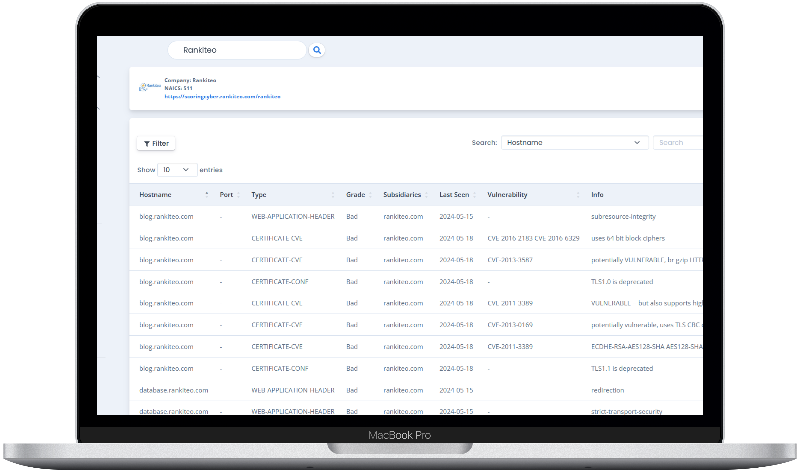
Identify exposed access points, detect misconfigured SSL certificates, and uncover vulnerabilities across the network infrastructure.
Gain visibility into the software components used within an organization to detect vulnerabilities, manage risk, and ensure supply chain security.
Monitor and manage all IT assets and their configurations to ensure accurate, real-time visibility across the company's technology environment.
Leverage real-time insights on active threats, malware campaigns, and emerging vulnerabilities to proactively defend against evolving cyberattacks.






 Rapid
Rapid