







NDE
Company Details
Linkedin ID:
nsw-department-of-education
Website:
Employees number:
37,355
Number of followers:
149,501
NAICS:
92311
Industry Type:
Homepage:
nsw.gov.au
IP Addresses:
0
Company ID:
NSW_1269060
Scan Status:
In-progress


NSW Department of Education Vendor Cyber Rating & Cyber Score
nsw.gov.auAt the NSW Department of Education, our goal is to be Australia's best education system and one of the finest in the world. We prepare young people for rewarding lives as engaged citizens in a complex and dynamic society. With nearly 100,000 employees working in schools and offices throughout the state, we can offer you a varied and rewarding career in your chosen field. Working with us gives you access to: - flexible working conditions - attractive salaries - generous holidays - opportunities for advancement - a culture of professional support By supporting every one of our employees to meet their personal goals at work, we can best meet NSW's goals for quality public education. Follow us on Twitter: @NSWEducation
Company Details
nsw-department-of-education
37,355
149,501
92311
nsw.gov.au
0
NSW_1269060
In-progress
 NDE Risk Score (AI oriented)
Between 750 and 799
 NDE Global Score (TPRM)
XXXX
Description: NSW Police Leak Exposes Email Addresses of 150 Complaintants in Data Breach The NSW Police have inadvertently disclosed the email addresses of over 150 individuals who filed complaints regarding officers’ use of force during the Sydney Black Lives Matter protest on 6 June. The breach occurred when a police response to a complainant Samuel Leighton-Dore, who raised concerns after viewing footage of officers deploying pepper spray into a kettled crowd was sent with an attached list of all recipients’ emails. Leighton-Dore, who was advised by the Law Enforcement Conduct Commission (LECC) to direct his complaint to NSW Police, received a one-page response from Craig Lowery, Professional Standards Manager, stating that no further investigation was warranted after reviewing body-worn camera footage. Dissatisfied with the decision, Leighton-Dore later received a second email containing the original letter along with a page listing the email addresses of 150 other complainants. The incident appears to violate Section 169A of the Police Act 1990 (NSW), which prohibits the disclosure of complainants’ identities without proper authorization. A NSW Police spokesperson acknowledged the error as an "administrative mistake" but provided no further details on how it occurred or whether affected individuals would be notified. The breach has intensified criticism of NSW Police’s internal handling of complaints, with one commentator calling it a "complete betrayal of public trust and accountability." Leighton-Dore reported that police initially claimed he was the sole complainant, contradicting the lengthy list of exposed emails. The LECC, tasked with overseeing police misconduct investigations, faces chronic underfunding, allowing NSW Police to self-investigate most complaints a process advocates argue is inherently biased. The commission reportedly investigates only 2% of reported cases, raising concerns about systemic oversight failures.
Description: The NSW government's QR code data breach accidently exposed the regional addresses of more than 500,000 organisations including defence sites, a missile maintenance unit and domestic violence shelters The addresses collected by the NSW government including correctional facilities, critical infrastructure networks including power stations and tunnel entry sites as well as dozens of shelters and crisis accommodation centres for women across the state was also found NSW data website. The cyber experts raised the alarm to the NSW government to secure the data immediately.
Description: The New South Wales (NSW) education department in Australia stated that their internal system had been a victim of a cyber attack. The department took some systems offline while conducting its investigation because protecting student and staff data is of the utmost importance. The department has reported the issue to the state's police and federal government organizations and collaborated with Cyber Security NSW to find a solution.
Description: In February 2021, Transport for NSW, an Australian government agency responsible for managing the state’s transport systems, fell victim to a Clop ransomware attack. The breach was part of a broader global campaign exploiting vulnerabilities in Accellion’s File Transfer Appliance (FTA), a third-party file-sharing service used by the agency. While the full extent of the data compromise was not publicly disclosed, the attack exposed sensitive internal documents, including employee records, financial data, and potentially customer-related information. The Clop ransomware group, known for double-extortion tactics, threatened to leak stolen data unless a ransom was paid. Although Transport for NSW refused to negotiate, the incident disrupted operations, raised concerns over data security, and prompted an urgent review of cybersecurity protocols. The breach highlighted vulnerabilities in third-party vendor systems and underscored the growing threat of ransomware targeting critical public infrastructure. Authorities warned that the stolen data could be used for further phishing attacks or sold on the dark web, posing long-term risks to both the organization and affected individuals.


No incidents recorded for NSW Department of Education in 2026.
No incidents recorded for NSW Department of Education in 2026.
No incidents recorded for NSW Department of Education in 2026.
NDE cyber incidents detection timeline including parent company and subsidiaries

At the NSW Department of Education, our goal is to be Australia's best education system and one of the finest in the world. We prepare young people for rewarding lives as engaged citizens in a complex and dynamic society. With nearly 100,000 employees working in schools and offices throughout the state, we can offer you a varied and rewarding career in your chosen field. Working with us gives you access to: - flexible working conditions - attractive salaries - generous holidays - opportunities for advancement - a culture of professional support By supporting every one of our employees to meet their personal goals at work, we can best meet NSW's goals for quality public education. Follow us on Twitter: @NSWEducation


For forward-thinking administrators and educators, opportunities abound in The School District of Philadelphia. The School District of Philadelphia is committed to transforming the education opportunities it offers the city’s 200,000 school-aged children. Located in a historic and culturally rich se

The Houston Independent School District is the largest public school system in Texas and the eighth largest in the United States. Its schools are dedicated to giving every student the best possible education through an intensive core curriculum and specialized, challenging instructional and career p

— 30th largest school district in the U.S. — 96,000+ students — 17,400+ full- and part-time employees, including 6,800+ certified teachers Vision All JCPS students graduate prepared, empowered, and inspired to reach their full potential and contribute as thoughtful, responsible citizens of our div
As leaders in the education staffing space since 2000, ESS specializes in placing qualified staff in daily, long-term, and permanent K-12 school district positions, including substitute teachers, paraprofessionals, and other school support staff. Over the last 24 years, we have innovated education s

Broward County Public Schools (BCPS) is the sixth largest public school system in the United States, the second largest in the state of Florida and the largest fully accredited K-12 and adult school district in the nation. BCPS has over 247,500 students and approximately 125,000 adult students in 23

TAFE NSW is one of Australia's leading vocational education and training provider with over 100 years of experience. It caters for students at the local level, the national level and the international level. TAFE NSW has over 130 locations across the state. Through a series of forums, TAFE NSW work

Kaplan is a global educational services company that provides individuals, universities, and businesses with a diverse array of services, including higher and professional education, test preparation, language training, corporate and leadership training, and student recruitment, online enablement an

Lovely Professional University (LPU) is an ASSOCHAM’s National Education Excellence Award-winning institution and has also been ranked as top Education Brand of India in Economic Times. LPU is a multi-disciplined university and offers 200+ programs in 40+ disciplines. These programs are recognized

The School District of Palm Beach County is the tenth-largest school district in the nation and the fifth-largest in the state of Florida with 180 schools, serving more than 170,000 students. As the largest employer in Palm Beach County, the school district has more than 23,000 employees, including
.png)
The changes came into effect last week, and will immediately apply to more than 3000 government, independent, and Catholic schools.
Students' behavioural testing records and parents' personal information were leaked in data breaches that have plagued NSW departments since...
The NSW Department of Education says there are early indications that its website modernisation program is driving higher enrolment rates at...
We've ranked the 20 most influential education figures in NSW, from prominent principals to policy heavyweights and uni visionaries.
A contractor's ChatGPT upload has triggered a data breach at the NSW Reconstruction Authority, affecting up to 3000 people.
All NSW public school students from Year 5 onwards will gain access to the state's ChatGPT-style platform, NSWEduChat, from October 14,...
The NSW Department of Education has handed $69 million to Deloitte to help deliver its new human resources platform over the next three...
The NSW Department of Education has enlisted global IT services giant Infosys to help uplift its SAP enterprise resource planning system.
Responsibility means, perhaps, picking up your own trash? New state school janitor contracts established to drive improved cleaning...

Explore insights on cybersecurity incidents, risk posture, and Rankiteo's assessments.
The official website of NSW Department of Education is https://education.nsw.gov.au/.
According to Rankiteo, NSW Department of Education’s AI-generated cybersecurity score is 783, reflecting their Fair security posture.
According to Rankiteo, NSW Department of Education currently holds 0 security badges, indicating that no recognized compliance certifications are currently verified for the organization.
According to Rankiteo, NSW Department of Education has not been affected by any supply chain cyber incidents, and no incident IDs are currently listed for the organization.
According to Rankiteo, NSW Department of Education is not certified under SOC 2 Type 1.
According to Rankiteo, NSW Department of Education does not hold a SOC 2 Type 2 certification.
According to Rankiteo, NSW Department of Education is not listed as GDPR compliant.
According to Rankiteo, NSW Department of Education does not currently maintain PCI DSS compliance.
According to Rankiteo, NSW Department of Education is not compliant with HIPAA regulations.
According to Rankiteo,NSW Department of Education is not certified under ISO 27001, indicating the absence of a formally recognized information security management framework.
NSW Department of Education operates primarily in the Education Administration Programs industry.
NSW Department of Education employs approximately 37,355 people worldwide.
NSW Department of Education presently has no subsidiaries across any sectors.
NSW Department of Education’s official LinkedIn profile has approximately 149,501 followers.
NSW Department of Education is classified under the NAICS code 92311, which corresponds to Administration of Education Programs.
No, NSW Department of Education does not have a profile on Crunchbase.
Yes, NSW Department of Education maintains an official LinkedIn profile, which is actively utilized for branding and talent engagement, which can be accessed here: https://www.linkedin.com/company/nsw-department-of-education.
As of April 04, 2026, Rankiteo reports that NSW Department of Education has experienced 4 cybersecurity incidents.
NSW Department of Education has an estimated 14,701 peer or competitor companies worldwide.
Incident Types: The types of cybersecurity incidents that have occurred include Ransomware, Breach and Cyber Attack.
Detection and Response: The company detects and responds to cybersecurity incidents through an remediation measures with cyber experts raised the alarm to the nsw government to secure the data immediately, and third party assistance with cyber security nsw, and and containment measures with taking some systems offline, and communication strategy with acknowledged as an 'administrative mistake'..
Title: NSW Government QR Code Data Breach
Description: The NSW government's QR code data breach accidentally exposed the regional addresses of more than 500,000 organisations including defence sites, a missile maintenance unit, and domestic violence shelters. The addresses collected by the NSW government including correctional facilities, critical infrastructure networks including power stations and tunnel entry sites as well as dozens of shelters and crisis accommodation centres for women across the state was also found on NSW data website. Cyber experts raised the alarm to the NSW government to secure the data immediately.
Type: Data Breach
Attack Vector: Accidental Exposure
Title: Cyber Attack on NSW Education Department
Description: The New South Wales (NSW) education department in Australia stated that their internal system had been a victim of a cyber attack. The department took some systems offline while conducting its investigation because protecting student and staff data is of the utmost importance. The department has reported the issue to the state's police and federal government organizations and collaborated with Cyber Security NSW to find a solution.
Type: Cyber Attack
Title: Transport for NSW Clop Ransomware Breach (2021)
Description: In February 2021, Transport for NSW, an Australian government agency responsible for transport infrastructure, was breached by the Clop ransomware group.
Date Detected: 2021-02
Type: ransomware
Threat Actor: Clop ransomware group
Motivation: financial gaindata exfiltration
Title: NSW Police Leak Exposes Email Addresses of 150 Complainants in Data Breach
Description: The NSW Police inadvertently disclosed the email addresses of over 150 individuals who filed complaints regarding officers’ use of force during the Sydney Black Lives Matter protest on 6 June. The breach occurred when a police response to a complainant was sent with an attached list of all recipients’ emails.
Type: Data Breach
Attack Vector: Administrative Error
Common Attack Types: The most common types of attacks the company has faced is Breach.

Data Compromised: Regional addresses, Defence sites, Missile maintenance unit, Domestic violence shelters, Correctional facilities, Critical infrastructure networks, Power stations, Tunnel entry sites, Shelters and crisis accommodation centres

Data Compromised: Email addresses of 150 complainants
Operational Impact: Betrayal of public trust and accountability
Brand Reputation Impact: Intensified criticism of NSW Police’s internal handling of complaints
Legal Liabilities: Potential violation of Section 169A of the Police Act 1990 (NSW)
Commonly Compromised Data Types: The types of data most commonly compromised in incidents are Addresses, and Email addresses.
Entity Name: NSW Government
Entity Type: Government
Industry: Public Sector
Location: New South Wales, Australia

Entity Name: New South Wales Education Department
Entity Type: Government Department
Industry: Education
Location: New South Wales, Australia
Entity Name: Transport for NSW
Entity Type: government agency
Industry: transportation
Location: New South Wales, Australia
Entity Name: NSW Police
Entity Type: Government Agency
Industry: Law Enforcement
Location: New South Wales, Australia
Customers Affected: 150 complainants
Remediation Measures: Cyber experts raised the alarm to the NSW government to secure the data immediately
Third Party Assistance: Cyber Security NSW
Containment Measures: Taking some systems offline
Communication Strategy: Acknowledged as an 'administrative mistake'
Third-Party Assistance: The company involves third-party assistance in incident response through Cyber Security NSW.
Type of Data Compromised: Addresses
Number of Records Exposed: 500,000
Sensitivity of Data: High
Data Encryption: True
Type of Data Compromised: Email addresses
Number of Records Exposed: 150
Sensitivity of Data: Personally identifiable information (complainants' identities)
Personally Identifiable Information: Yes
Prevention of Data Exfiltration: The company takes the following measures to prevent data exfiltration: Cyber experts raised the alarm to the NSW government to secure the data immediately, .
Handling of PII Incidents: The company handles incidents involving personally identifiable information (PII) through by taking some systems offline.
Ransomware Strain: Clop
Data Encryption: True
Data Exfiltration: True
Regulations Violated: Section 169A of the Police Act 1990 (NSW),
Source: NSW Government QR Code Data Breach
Source: Original Incident Description
Additional Resources: Stakeholders can find additional resources on cybersecurity best practices at and Source: NSW Government QR Code Data Breach, and Source: Original Incident Description.
Investigation Status: Ongoing
Communication of Investigation Status: The company communicates the status of incident investigations to stakeholders through Acknowledged as an 'administrative mistake'.
Root Causes: Administrative mistake in email handling
Post-Incident Analysis Process: The company's process for conducting post-incident analysis is described as Cyber Security NSW.
Last Attacking Group: The attacking group in the last incident was an Clop ransomware group.
Most Recent Incident Detected: The most recent incident detected was on 2021-02.
Most Significant Data Compromised: The most significant data compromised in an incident were Regional addresses, Defence sites, Missile maintenance unit, Domestic violence shelters, Correctional facilities, Critical infrastructure networks, Power stations, Tunnel entry sites, Shelters and crisis accommodation centres, , and Email addresses of 150 complainants.
Third-Party Assistance in Most Recent Incident: The third-party assistance involved in the most recent incident was Cyber Security NSW.
Containment Measures in Most Recent Incident: The containment measures taken in the most recent incident was Taking some systems offline.
Most Sensitive Data Compromised: The most sensitive data compromised in a breach were Critical infrastructure networks, Shelters and crisis accommodation centres, Email addresses of 150 complainants, Tunnel entry sites, Power stations, Defence sites, Regional addresses, Correctional facilities, Domestic violence shelters and Missile maintenance unit.
Number of Records Exposed in Most Significant Breach: The number of records exposed in the most significant breach was 500.1K.
Most Recent Source: The most recent source of information about an incident are NSW Government QR Code Data Breach and Original Incident Description.
Current Status of Most Recent Investigation: The current status of the most recent investigation is Ongoing.
.png)
nimiq/core-rs-albatross is a Rust implementation of the Nimiq Proof-of-Stake protocol based on the Albatross consensus algorithm. Prior to version 1.3.0, two peer-facing consensus request handlers assume that the history index is always available and call blockchain.history_store.history_index().unwrap() directly. That assumption is false by construction. HistoryStoreProxy::history_index() explicitly returns None for the valid HistoryStoreProxy::WithoutIndex state. when a full node is syncing or otherwise running without the history index, a remote peer can send RequestTransactionsProof or RequestTransactionReceiptsByAddress and trigger an Option::unwrap() panic on the request path. This issue has been patched in version 1.3.0.
PraisonAI is a multi-agent teams system. Prior to version 1.5.95, FileTools.download_file() in praisonaiagents validates the destination path but performs no validation on the url parameter, passing it directly to httpx.stream() with follow_redirects=True. An attacker who controls the URL can reach any host accessible from the server including cloud metadata services and internal network services. This issue has been patched in version 1.5.95.
PraisonAI is a multi-agent teams system. Prior to version 4.5.97, OAuthManager.validate_token() returns True for any token not found in its internal store, which is empty by default. Any HTTP request to the MCP server with an arbitrary Bearer token is treated as authenticated, granting full access to all registered tools and agent capabilities. This issue has been patched in version 4.5.97.
PraisonAI is a multi-agent teams system. Prior to version 4.5.97, the PraisonAI Gateway server accepts WebSocket connections at /ws and serves agent topology at /info with no authentication. Any network client can connect, enumerate registered agents, and send arbitrary messages to agents and their tool sets. This issue has been patched in version 4.5.97.
PraisonAI is a multi-agent teams system. Prior to version 4.5.90, MCPToolIndex.search_tools() compiles a caller-supplied string directly as a Python regular expression with no validation, sanitization, or timeout. A crafted regex causes catastrophic backtracking in the re engine, blocking the Python thread for hundreds of seconds and causing a complete service outage. This issue has been patched in version 4.5.90.

Get company history

Every week, Rankiteo analyzes billions of signals to give organizations a sharper, faster view of emerging risks. With deeper, more actionable intelligence at their fingertips, security teams can outpace threat actors, respond instantly to Zero-Day attacks, and dramatically shrink their risk exposure window.
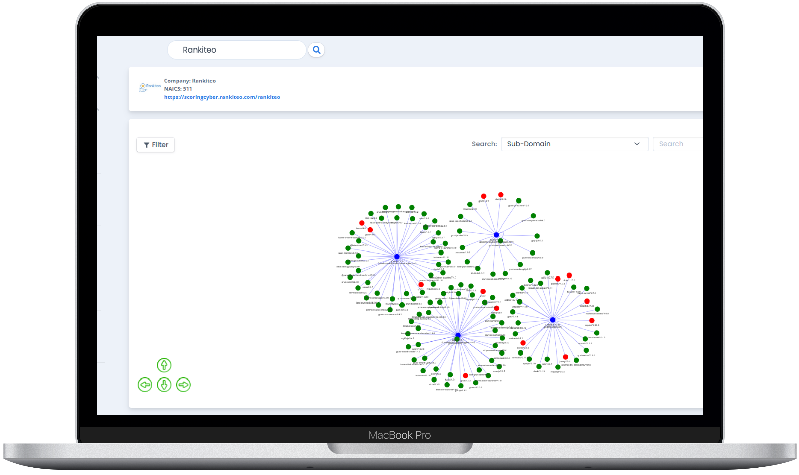
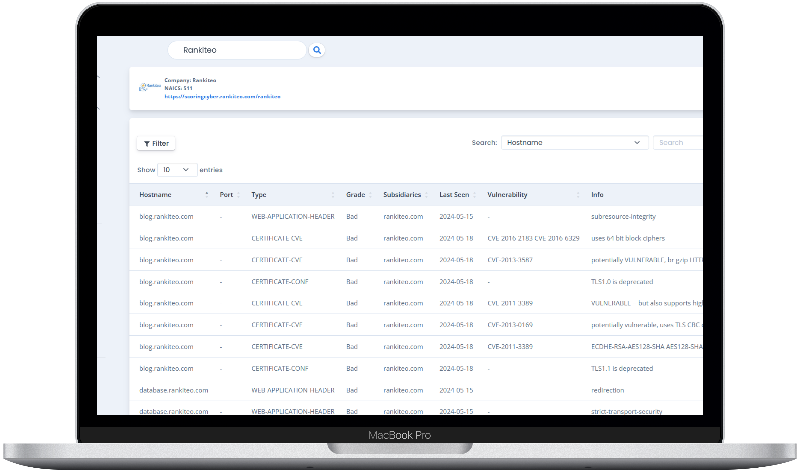
Identify exposed access points, detect misconfigured SSL certificates, and uncover vulnerabilities across the network infrastructure.
Gain visibility into the software components used within an organization to detect vulnerabilities, manage risk, and ensure supply chain security.
Monitor and manage all IT assets and their configurations to ensure accurate, real-time visibility across the company's technology environment.
Leverage real-time insights on active threats, malware campaigns, and emerging vulnerabilities to proactively defend against evolving cyberattacks.





 Rapid
Rapid