











Lenovo
Company Details
Linkedin ID:
lenovo
Website:
Employees number:
46,066
Number of followers:
1,250,702
NAICS:
5415
Industry Type:
Homepage:
lenovo.com
IP Addresses:
0
Company ID:
LEN_3024493
Scan Status:
In-progress


Lenovo Vendor Cyber Rating & Cyber Score
lenovo.comLenovo is a US$69 billion revenue global technology powerhouse, ranked #196 in the Fortune Global 500, and serving millions of customers every day in 180 markets. Focused on a bold vision to deliver Smarter Technology for All, Lenovo has built on its success as the world’s largest PC company with a full-stack portfolio of AI-enabled, AI-ready, and AI-optimized devices (PCs, workstations, smartphones, tablets), infrastructure (server, storage, edge, high performance computing and software defined infrastructure), software, solutions, and services. Lenovo’s continued investment in world-changing innovation is building a more equitable, trustworthy, and smarter future for everyone, everywhere. Lenovo is listed on the Hong Kong stock exchange under Lenovo Group Limited (HKSE: 992) (ADR: LNVGY). To find out more visit https://www.lenovo.com, and read about the latest news via our StoryHub at https://news.lenovo.com/. To learn more about our career opportunities, visit our careers page at http://jobs.lenovo.com/.
Company Details
lenovo
46,066
1,250,702
5415
lenovo.com
0
LEN_3024493
In-progress
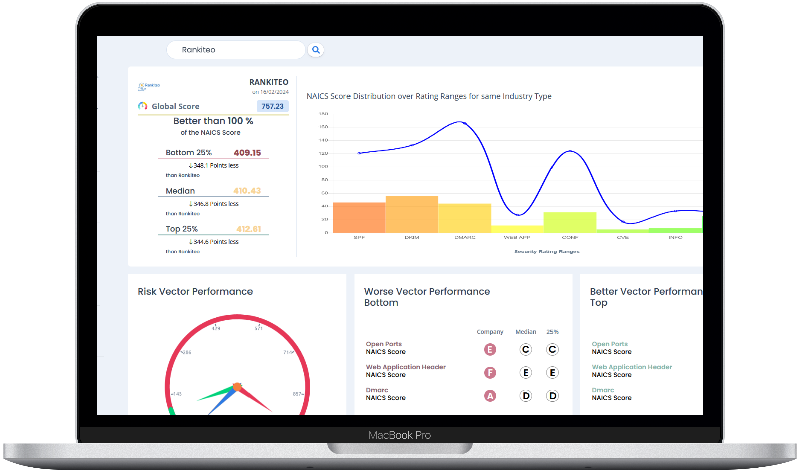
 Lenovo Risk Score (AI oriented)
Between 750 and 799
 Lenovo Global Score (TPRM)
XXXX
Description: Critical vulnerabilities were discovered in Lenovo’s AI-powered customer support chatbot, Lena, which leverages OpenAI’s GPT-4. The flaw stemmed from improper input and output sanitization, exposing the system to cross-site scripting (XSS) attacks. Security researchers at Cybernews demonstrated that attackers could exploit this by injecting malicious code via a 400-character prompt, tricking the AI into generating harmful HTML content. This enabled threat actors to steal session cookies, potentially granting unauthorized access to Lenovo’s customer support systems.The vulnerability highlighted significant risks in poorly secured AI implementations, particularly as enterprises accelerate AI adoption. While no evidence of active exploitation was reported, the flaw posed a serious threat to customer data integrity and system security. Had attackers successfully leveraged this, they could have compromised user sessions, accessed sensitive support-related information, or escalated privileges within Lenovo’s infrastructure. The incident underscores the urgency for robust AI security frameworks to prevent such exposures in high-stakes enterprise environments.
Description: Lenovo devices running on vulnerable Insyde firmware were targeted by the BootKitty Linux UEFI bootkit exploiting the LogoFAIL flaws (CVE-2023-40238). BootKitty bypassed UEFI Secure Boot by injecting rogue certificates and exploiting vulnerabilities in UEFI image-parsing components through tampered BMP files. The bootkit was capable of disabling kernel signature verification, preloading malicious binaries, and targeting specific Ubuntu versions. Despite available security patches, many devices remained at risk. The incident served as a reminder of the dangers associated with unaddressed vulnerabilities and the importance of timely updates to safeguard devices in the field.
Description: A significant security vulnerability has been discovered in Lenovo’s preloaded Windows operating systems, where a writable file in the Windows directory enables attackers to bypass Microsoft’s AppLocker security framework. The issue affects all variants of Lenovo machines running default Windows installations and poses serious implications for enterprise security environments. Key takeaways include the writable MFGSTAT.zip file bypassing AppLocker security due to incorrect permissions, the use of Alternate Data Streams to hide executables, and the persistence of the vulnerability from 2019 to 2025. Mitigation strategies involve removing the vulnerable file using PowerShell or other enterprise management tools.


No incidents recorded for Lenovo in 2026.
No incidents recorded for Lenovo in 2026.
No incidents recorded for Lenovo in 2026.
Lenovo cyber incidents detection timeline including parent company and subsidiaries

Lenovo is a US$69 billion revenue global technology powerhouse, ranked #196 in the Fortune Global 500, and serving millions of customers every day in 180 markets. Focused on a bold vision to deliver Smarter Technology for All, Lenovo has built on its success as the world’s largest PC company with a full-stack portfolio of AI-enabled, AI-ready, and AI-optimized devices (PCs, workstations, smartphones, tablets), infrastructure (server, storage, edge, high performance computing and software defined infrastructure), software, solutions, and services. Lenovo’s continued investment in world-changing innovation is building a more equitable, trustworthy, and smarter future for everyone, everywhere. Lenovo is listed on the Hong Kong stock exchange under Lenovo Group Limited (HKSE: 992) (ADR: LNVGY). To find out more visit https://www.lenovo.com, and read about the latest news via our StoryHub at https://news.lenovo.com/. To learn more about our career opportunities, visit our careers page at http://jobs.lenovo.com/.

Founded in 1982 by a small group of entrepreneurs, Softtek started out in Mexico providing local IT services, and today is a global leader in next-generation digital solutions. The first company to introduce the Nearshore model, Softtek helps Global 2000 organizations build their digital capabilitie

With its headquarters in Munich, Germany, Allianz Technology is Allianz's global IT service provider and delivers IT solutions that drive the group's digitalization. With more than 11,000 employees in more than 20 countries around the world, Allianz Technology is tasked to run, optimize, transform,

TELUS Digital crafts unique and enduring experiences for customers and employees, and creates future-focused digital transformations that stand the test of time. We are the brand behind the brands. Our global team members are both passionate ambassadors of our clients’ products and services, and vis

UST is a global digital transformation solutions provider. For more than 20 years, UST has worked side by side with the world’s best companies to make a real impact through transformation. Powered by technology, inspired by people and led by purpose, UST partners with their clients from design to

Líder em transformação digital nos mercados de Customer Experience e Debt Collection na América Latina. Combinamos tecnologia, inteligência e excelência operacional para entregar soluções completas que antecipam as necessidades dos nossos Clientes. São mais de 530 milhões de interações anuais, met

Engineering Group is the Digital Transformation Company, leader in Italy and expanding its global footprint, with around 14,000 associates and with over 80 offices spread across Europe, the United States, and South America and global delivery. The Engineering Group, consisting of over 70 companies
Akkodis is a global digital engineering company and Smart Industry leader. We enable clients to advance in their digital transformation with Talent, Academy, Consulting, and Solutions services. Our 50,000 experts combine best-in-class technologies, R&D, and deep sector know-how for purposeful innova
A leading applied technology services company, we innovate to deliver service excellence and successful outcomes across sales, delivery and development. With our strategy to be agile, nimble and customer-centric, we anticipate the future of applied technology and predict tomorrow’s trends to keep ou

We’re a cloud technology company that provides organizations around the world with computing infrastructure and software to help them innovate, unlock efficiencies and become more effective. We also created the world’s first – and only – autonomous database to help organize and secure our customers’
.png)
Lenovo is expanding its global Research & Development (R&D) capabilities by adding new facilities in the Europe, Middle East,...
The lawsuit explicitly connects these alleged transfers to Executive Order 14117's implementing framework, arguing that cross-border access to...
Key announcements from Lenovo AI TechWorld at CES 2026, covering the QIRA AI agent, AI PCs, and the NVIDIA AI Cloud Gigafactory.
Lenovo reveals 65% of IT leaders say current architecture fails against AI threats, urging defences for endpoints, identities and AI...
AI can be a dual-edged sword when it comes to security, Lenovo chief tells us.
Lenovo Q2 FY 2026 shows AI growth across PCs, servers, and services, with rising AI mix pointing to hybrid AI adoption ahead.
IT leaders are under pressure to transform the digital workplace and supercharge employee productivity with AI. But as security threats evolve,...
Combining Lenovo's global resources with LPS' local expertise, the Next-Gen ecosystem covers four key domains: application software,...
Doug Fisher on centering trust, from AI governance to our global supply chain, and from how we design products to how we protect data.

Explore insights on cybersecurity incidents, risk posture, and Rankiteo's assessments.
The official website of Lenovo is http://www.lenovo.com.
According to Rankiteo, Lenovo’s AI-generated cybersecurity score is 787, reflecting their Fair security posture.
According to Rankiteo, Lenovo currently holds 0 security badges, indicating that no recognized compliance certifications are currently verified for the organization.
According to Rankiteo, Lenovo has not been affected by any supply chain cyber incidents, and no incident IDs are currently listed for the organization.
According to Rankiteo, Lenovo is not certified under SOC 2 Type 1.
According to Rankiteo, Lenovo does not hold a SOC 2 Type 2 certification.
According to Rankiteo, Lenovo is not listed as GDPR compliant.
According to Rankiteo, Lenovo does not currently maintain PCI DSS compliance.
According to Rankiteo, Lenovo is not compliant with HIPAA regulations.
According to Rankiteo,Lenovo is not certified under ISO 27001, indicating the absence of a formally recognized information security management framework.
Lenovo operates primarily in the IT Services and IT Consulting industry.
Lenovo employs approximately 46,066 people worldwide.
Lenovo presently has no subsidiaries across any sectors.
Lenovo’s official LinkedIn profile has approximately 1,250,702 followers.
Lenovo is classified under the NAICS code 5415, which corresponds to Computer Systems Design and Related Services.
Yes, Lenovo has an official profile on Crunchbase, which can be accessed here: https://www.crunchbase.com/organization/lenovo.
Yes, Lenovo maintains an official LinkedIn profile, which is actively utilized for branding and talent engagement, which can be accessed here: https://www.linkedin.com/company/lenovo.
As of March 28, 2026, Rankiteo reports that Lenovo has experienced 3 cybersecurity incidents.
Lenovo has an estimated 39,816 peer or competitor companies worldwide.
Incident Types: The types of cybersecurity incidents that have occurred include Vulnerability.
Detection and Response: The company detects and responds to cybersecurity incidents through an containment measures with remove the vulnerable file using powershell or command prompt, and remediation measures with use enterprise management tools like group policy preferences or sccm..
Title: Lenovo Devices Targeted by BootKitty Linux UEFI Bootkit
Description: Lenovo devices running on vulnerable Insyde firmware were targeted by the BootKitty Linux UEFI bootkit exploiting the LogoFAIL flaws (CVE-2023-40238). BootKitty bypassed UEFI Secure Boot by injecting rogue certificates and exploiting vulnerabilities in UEFI image-parsing components through tampered BMP files. The bootkit was capable of disabling kernel signature verification, preloading malicious binaries, and targeting specific Ubuntu versions. Despite available security patches, many devices remained at risk. The incident served as a reminder of the dangers associated with unaddressed vulnerabilities and the importance of timely updates to safeguard devices in the field.
Type: UEFI Bootkit
Attack Vector: UEFI Secure Boot Bypass
Vulnerability Exploited: LogoFAIL flaws (CVE-2023-40238)
Threat Actor: BootKitty
Title: Lenovo Preloaded Windows Vulnerability
Description: A significant security vulnerability has been discovered in Lenovo’s preloaded Windows operating systems, where a writable file in the Windows directory enables attackers to bypass Microsoft’s AppLocker security framework.
Date Detected: 2019
Type: Vulnerability Exploitation
Attack Vector: Alternate Data Streams (ADS)
Vulnerability Exploited: Writable MFGSTAT.zip file with incorrect permissions
Title: Critical XSS Vulnerabilities in Lenovo’s AI-Powered Customer Support Chatbot 'Lena'
Description: Critical vulnerabilities were discovered in Lenovo’s AI-powered customer support chatbot, 'Lena' (powered by OpenAI’s GPT-4), allowing attackers to steal session cookies and potentially gain unauthorized access to customer support systems via a single malicious 400-character prompt. The flaw stemmed from improper input/output sanitization, enabling cross-site scripting (XSS) attacks by injecting malicious code through crafted prompts, which tricked the AI into generating harmful HTML content. The incident highlights security risks in poorly implemented AI chatbots as organizations rapidly adopt AI in enterprise environments.
Type: Vulnerability Exploitation
Attack Vector: Malicious Prompt Injection (400-character payload)
Vulnerability Exploited: Improper Input/Output Sanitization in AI Chatbot (XSS)
Common Attack Types: The most common types of attacks the company has faced is Vulnerability.
Identification of Attack Vectors: The company identifies the attack vectors used in incidents through AI Chatbot ('Lena') via Malicious Prompt.

Systems Affected: Lenovo devices

Systems Affected: All Lenovo machines with preloaded Windows
Data Compromised: Session cookies, Potential unauthorized access to customer support systems
Systems Affected: Lenovo AI Chatbot 'Lena' (GPT-4 Powered)
Operational Impact: Potential Unauthorized Access to Customer Support Systems
Brand Reputation Impact: High (Warning About AI Security Risks in Enterprise Adoption)
Identity Theft Risk: Potential (via Stolen Session Cookies)
Commonly Compromised Data Types: The types of data most commonly compromised in incidents are Session Cookies and .
Entity Name: Lenovo
Entity Type: Corporation
Industry: Technology
Entity Name: Lenovo
Entity Type: Corporation
Industry: Technology (Hardware/Software)
Location: Global (HQ: Hong Kong/China, Operations: Worldwide)
Size: Large (Multinational)
Containment Measures: Remove the vulnerable file using PowerShell or Command Prompt
Remediation Measures: Use enterprise management tools like Group Policy Preferences or SCCM
Type of Data Compromised: Session cookies
Sensitivity of Data: High (Session Hijacking Risk)
Data Exfiltration: Potential (via XSS)
Personally Identifiable Information: Potential (via Session Cookies)
Prevention of Data Exfiltration: The company takes the following measures to prevent data exfiltration: Use enterprise management tools like Group Policy Preferences or SCCM, .
Handling of PII Incidents: The company handles incidents involving personally identifiable information (PII) through by remove the vulnerable file using powershell or command prompt and .
Lessons Learned: The incident served as a reminder of the dangers associated with unaddressed vulnerabilities and the importance of timely updates to safeguard devices in the field.
Lessons Learned: The importance of comprehensive filesystem auditing when implementing AppLocker deployments.
Lessons Learned: The incident underscores the critical need for robust input/output sanitization in AI-powered systems, especially in customer-facing applications. Rapid AI adoption in enterprises must be accompanied by rigorous security testing to mitigate risks like XSS and prompt injection attacks.
Recommendations: Remove the vulnerable file using PowerShell or Command Prompt, Use enterprise management tools like Group Policy Preferences or SCCMRemove the vulnerable file using PowerShell or Command Prompt, Use enterprise management tools like Group Policy Preferences or SCCM
Recommendations: Implement strict input/output sanitization for AI chatbots to prevent XSS and prompt injection., Conduct regular security audits and penetration testing for AI systems, particularly those integrated with third-party models (e.g., GPT-4)., Adopt secure coding practices for AI/ML applications, including context-aware filtering for dynamic content generation., Monitor and limit the length/complexity of user prompts to mitigate injection risks., Educate developers and security teams on emerging AI-specific threats (e.g., prompt hacking, model manipulation).Implement strict input/output sanitization for AI chatbots to prevent XSS and prompt injection., Conduct regular security audits and penetration testing for AI systems, particularly those integrated with third-party models (e.g., GPT-4)., Adopt secure coding practices for AI/ML applications, including context-aware filtering for dynamic content generation., Monitor and limit the length/complexity of user prompts to mitigate injection risks., Educate developers and security teams on emerging AI-specific threats (e.g., prompt hacking, model manipulation).Implement strict input/output sanitization for AI chatbots to prevent XSS and prompt injection., Conduct regular security audits and penetration testing for AI systems, particularly those integrated with third-party models (e.g., GPT-4)., Adopt secure coding practices for AI/ML applications, including context-aware filtering for dynamic content generation., Monitor and limit the length/complexity of user prompts to mitigate injection risks., Educate developers and security teams on emerging AI-specific threats (e.g., prompt hacking, model manipulation).Implement strict input/output sanitization for AI chatbots to prevent XSS and prompt injection., Conduct regular security audits and penetration testing for AI systems, particularly those integrated with third-party models (e.g., GPT-4)., Adopt secure coding practices for AI/ML applications, including context-aware filtering for dynamic content generation., Monitor and limit the length/complexity of user prompts to mitigate injection risks., Educate developers and security teams on emerging AI-specific threats (e.g., prompt hacking, model manipulation).Implement strict input/output sanitization for AI chatbots to prevent XSS and prompt injection., Conduct regular security audits and penetration testing for AI systems, particularly those integrated with third-party models (e.g., GPT-4)., Adopt secure coding practices for AI/ML applications, including context-aware filtering for dynamic content generation., Monitor and limit the length/complexity of user prompts to mitigate injection risks., Educate developers and security teams on emerging AI-specific threats (e.g., prompt hacking, model manipulation).
Key Lessons Learned: The key lessons learned from past incidents are The incident served as a reminder of the dangers associated with unaddressed vulnerabilities and the importance of timely updates to safeguard devices in the field.The importance of comprehensive filesystem auditing when implementing AppLocker deployments.The incident underscores the critical need for robust input/output sanitization in AI-powered systems, especially in customer-facing applications. Rapid AI adoption in enterprises must be accompanied by rigorous security testing to mitigate risks like XSS and prompt injection attacks.
Source: TrustedSec
Source: Cybernews
Additional Resources: Stakeholders can find additional resources on cybersecurity best practices at and Source: TrustedSec, and Source: Cybernews.
Investigation Status: Disclosed by Cybernews Researchers (No Further Updates)
Entry Point: AI Chatbot ('Lena') via Malicious Prompt
High Value Targets: Customer Support Systems, Session Cookies,
Data Sold on Dark Web: Customer Support Systems, Session Cookies,
Root Causes: Incorrect file permissions on MFGSTAT.zip
Corrective Actions: Remove The Vulnerable File, Use Enterprise Management Tools For Systematic Removal,
Root Causes: Lack Of Input/Output Sanitization In Ai Chatbot, Over-Reliance On Third-Party Ai Model (Gpt-4) Without Adequate Security Controls, Insufficient Security Testing For Prompt Injection Vulnerabilities,
Corrective Actions Taken: The company has taken the following corrective actions based on post-incident analysis: Remove The Vulnerable File, Use Enterprise Management Tools For Systematic Removal, .
Last Attacking Group: The attacking group in the last incident was an BootKitty.
Most Recent Incident Detected: The most recent incident detected was on 2019.
Most Significant Data Compromised: The most significant data compromised in an incident were Session Cookies, Potential Unauthorized Access to Customer Support Systems and .
Most Significant System Affected: The most significant system affected in an incident was All Lenovo machines with preloaded Windows and Lenovo AI Chatbot 'Lena' (GPT-4 Powered).
Containment Measures in Most Recent Incident: The containment measures taken in the most recent incident was Remove the vulnerable file using PowerShell or Command Prompt.
Most Sensitive Data Compromised: The most sensitive data compromised in a breach were Potential Unauthorized Access to Customer Support Systems and Session Cookies.
Most Significant Lesson Learned: The most significant lesson learned from past incidents was The incident served as a reminder of the dangers associated with unaddressed vulnerabilities and the importance of timely updates to safeguard devices in the field., The importance of comprehensive filesystem auditing when implementing AppLocker deployments., The incident underscores the critical need for robust input/output sanitization in AI-powered systems, especially in customer-facing applications. Rapid AI adoption in enterprises must be accompanied by rigorous security testing to mitigate risks like XSS and prompt injection attacks.
Most Significant Recommendation Implemented: The most significant recommendation implemented to improve cybersecurity was Use enterprise management tools like Group Policy Preferences or SCCM, Remove the vulnerable file using PowerShell or Command Prompt, Monitor and limit the length/complexity of user prompts to mitigate injection risks., Educate developers and security teams on emerging AI-specific threats (e.g., prompt hacking, model manipulation)., Adopt secure coding practices for AI/ML applications, including context-aware filtering for dynamic content generation., Conduct regular security audits and penetration testing for AI systems, particularly those integrated with third-party models (e.g., GPT-4). and Implement strict input/output sanitization for AI chatbots to prevent XSS and prompt injection..
Most Recent Source: The most recent source of information about an incident are TrustedSec and Cybernews.
Current Status of Most Recent Investigation: The current status of the most recent investigation is Disclosed by Cybernews Researchers (No Further Updates).
Most Recent Entry Point: The most recent entry point used by an initial access broker was an AI Chatbot ('Lena') via Malicious Prompt.
Most Significant Root Cause: The most significant root cause identified in post-incident analysis was Incorrect file permissions on MFGSTAT.zip, Lack of Input/Output Sanitization in AI ChatbotOver-reliance on Third-Party AI Model (GPT-4) Without Adequate Security ControlsInsufficient Security Testing for Prompt Injection Vulnerabilities.
Most Significant Corrective Action: The most significant corrective action taken based on post-incident analysis was Remove the vulnerable fileUse enterprise management tools for systematic removal.
.png)
A flaw has been found in wandb OpenUI up to 1.0. This affects the function create_share/get_share of the file backend/openui/server.py of the component HTMLAnnotator Component. Executing a manipulation of the argument ID can lead to HTML injection. The attack may be performed from remote. The exploit has been published and may be used. The vendor was contacted early about this disclosure but did not respond in any way.
A vulnerability was detected in QDOCS Smart School Management System up to 7.2. The impacted element is an unknown function of the file /admin/enquiry of the component Admission Enquiry Module. Performing a manipulation of the argument Note results in cross site scripting. The attack is possible to be carried out remotely.
The Ultimate Member plugin for WordPress is vulnerable to Sensitive Information Exposure in all versions up to, and including, 2.11.2. This is due to the '{usermeta:password_reset_link}' template tag being processed within post content via the '[um_loggedin]' shortcode, which generates a valid password reset token for the currently logged-in user viewing the page. This makes it possible for authenticated attackers, with Contributor-level access and above, to craft a malicious pending post that, when previewed by an Administrator, generates a password reset token for the Administrator and exfiltrates it to an attacker-controlled server, leading to full account takeover.
LibJWT is a C JSON Web Token Library. Starting in version 3.0.0 and prior to version 3.3.0, the JWK parsing for RSA-PSS did not protect against a NULL value when expecting to parse JSON string values. A specially crafted JWK file could exploit this behavior by using integers in places where the code expected a string. This was fixed in v3.3.0. A workaround is available. Users importing keys through a JWK file should not do so from untrusted sources. Use the `jwk2key` tool to check for validity of a JWK file. Likewise, if possible, do not use JWK files with RSA-PSS keys.
Locutus brings stdlibs of other programming languages to JavaScript for educational purposes. Starting in version 2.0.39 and prior to version 3.0.25, a prototype pollution vulnerability exists in the `parse_str` function of the npm package locutus. An attacker can pollute `Object.prototype` by overriding `RegExp.prototype.test` and then passing a crafted query string to `parse_str`, bypassing the prototype pollution guard. This vulnerability stems from an incomplete fix for CVE-2026-25521. The CVE-2026-25521 patch replaced the `String.prototype.includes()`-based guard with a `RegExp.prototype.test()`-based guard. However, `RegExp.prototype.test` is itself a writable prototype method that can be overridden, making the new guard bypassable in the same way as the original — trading one hijackable built-in for another. Version 3.0.25 contains an updated fix.

Get company history

Every week, Rankiteo analyzes billions of signals to give organizations a sharper, faster view of emerging risks. With deeper, more actionable intelligence at their fingertips, security teams can outpace threat actors, respond instantly to Zero-Day attacks, and dramatically shrink their risk exposure window.
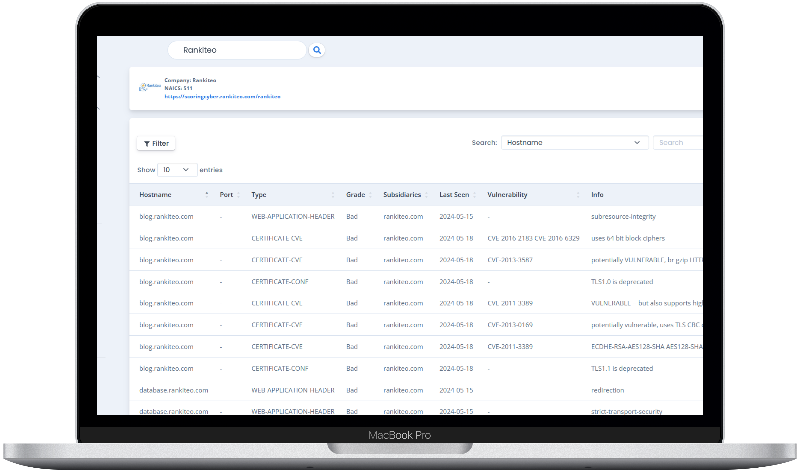
Identify exposed access points, detect misconfigured SSL certificates, and uncover vulnerabilities across the network infrastructure.
Gain visibility into the software components used within an organization to detect vulnerabilities, manage risk, and ensure supply chain security.
Monitor and manage all IT assets and their configurations to ensure accurate, real-time visibility across the company's technology environment.
Leverage real-time insights on active threats, malware campaigns, and emerging vulnerabilities to proactively defend against evolving cyberattacks.





 Rapid
Rapid