













Krispy Kreme
Company Details
Linkedin ID:
krispy-kreme
Website:
Employees number:
10,305
Number of followers:
131,591
NAICS:
722
Industry Type:
Homepage:
krispykreme.com
IP Addresses:
0
Company ID:
KRI_2894119
Scan Status:
In-progress


Krispy Kreme Vendor Cyber Rating & Cyber Score
krispykreme.comHeadquartered in Charlotte, N.C., Krispy Kreme is one of the most beloved and well-known sweet treat brands in the world. Our iconic Original Glazed® doughnut is universally recognized for its hot-off-the-line, melt-in-your-mouth experience. Krispy Kreme operates in more than 40 countries through its unique network of fresh doughnut shops, partnerships with leading retailers, and a rapidly growing digital business. Our purpose of touching and enhancing lives through the joy that is Krispy Kreme guides how we operate every day and is reflected in the love we have for our people, our communities, and the planet.
Company Details
krispy-kreme
10,305
131,591
722
krispykreme.com
0
KRI_2894119
In-progress
 Krispy Kreme Risk Score (AI oriented)
Between 0 and 549
 Krispy Kreme Global Score (TPRM)
XXXX
Description: Play Ransomware Gang Hits 900 Victims in Three-Year Spree, Governments Warn The Play ransomware gang, also known as Playcrypt, has compromised approximately 900 organizations since its emergence in June 2022, according to an updated advisory from the U.S. Cybersecurity and Infrastructure Security Agency (CISA), the FBI, and the Australian Cyber Security Centre (ACSC). The group employs double-extortion tactics, encrypting systems while also exfiltrating sensitive data to pressure victims into paying ransoms. Initially reported to have targeted around 300 victims by October 2023, Play has since escalated its operations, becoming one of the most active ransomware groups in 2024. The latest advisory, released in May 2025, highlights new tactics, techniques, and procedures (TTPs) observed in recent attacks, including the exploitation of three critical vulnerabilities in the SimpleHelp remote monitoring and management (RMM) software. Tracked as CVE-2024-57727, CVE-2024-57728, and CVE-2024-57726, these flaws can be chained to gain administrator privileges and execute arbitrary code, fully compromising vulnerable systems. Play’s operators evade detection by recompiling the ransomware for each attack, tailoring it to specific targets. Victims are contacted via unique email addresses (using @gmx.de or @web[.]de domains) or phone calls, with threat actors often routing extortion demands to publicly listed numbers, such as help desks or customer service lines. The advisory also warns of an ESXi variant of the ransomware, which shuts down virtual machines (VMs) and encrypts related files using randomly generated per-file keys. Like the Windows variant, the ESXi version is recompiled for each campaign and includes command-line flags for targeted encryption or debugging. The joint advisory underscores Play’s growing threat as the group continues to refine its methods and expand its victim count.
Description: On Black Friday 2024, Krispy Kreme detected unauthorized network activity, marking the start of a cyber-attack that crippled its online ordering system until December 30, 2024. The incident led to significant financial and operational disruptions, including lost digital sales revenue, cybersecurity advisory fees, and system restoration costs, all of which materially impacted the company’s financial condition. Months later, in May 2025, Krispy Kreme disclosed that nearly 62,000 individuals had their highly sensitive data stolen, including Social Security numbers, financial account details, passport numbers, and biometric data. The breach exploited potential holiday-season vulnerabilities, such as understaffed security teams and relaxed IT monitoring. The prolonged investigation and recovery underscored the attack’s severity, with long-term reputational and financial repercussions for the company.
Description: Krispy Kreme Doughnut Corporation experienced a significant data breach in late November 2024, affecting thousands of current and former employees, along with their family members. The breach exposed highly sensitive personal information, including Social Security numbers, financial account information, biometric data, and medical information. The company has since implemented additional security measures and is offering complimentary credit monitoring and identity protection services to those affected.
Description: Krispy Kreme Settles $1.6M Class Action Over 2024 Employee Data Breach Krispy Kreme Inc. has agreed to pay $1.6 million to resolve a proposed class action lawsuit alleging the company failed to adequately protect the personal data of nearly 162,000 employees exposed in a 2024 breach. The settlement received preliminary approval from the U.S. District Court for the Western District of North Carolina. Under the terms of the deal, affected employees defined as class members may claim up to $3,500 in reimbursement for documented losses tied to the breach or opt for a $75 cash payment. The incident underscores the financial and reputational risks companies face when employee data is compromised due to insufficient security measures. The breach highlights ongoing vulnerabilities in corporate data protection, particularly for large employers handling sensitive workforce information. The settlement reflects a growing trend of legal and financial consequences for organizations following cybersecurity failures.


No incidents recorded for Krispy Kreme in 2026.
No incidents recorded for Krispy Kreme in 2026.
No incidents recorded for Krispy Kreme in 2026.
Krispy Kreme cyber incidents detection timeline including parent company and subsidiaries

Headquartered in Charlotte, N.C., Krispy Kreme is one of the most beloved and well-known sweet treat brands in the world. Our iconic Original Glazed® doughnut is universally recognized for its hot-off-the-line, melt-in-your-mouth experience. Krispy Kreme operates in more than 40 countries through its unique network of fresh doughnut shops, partnerships with leading retailers, and a rapidly growing digital business. Our purpose of touching and enhancing lives through the joy that is Krispy Kreme guides how we operate every day and is reflected in the love we have for our people, our communities, and the planet.

The Kraft Heinz Company is one of the largest food and beverage companies in the world, with eight $1 billion+ brands and global sales of approximately $25 billion. We’re a globally trusted producer of high-quality, great-tasting, and nutritious foods for over 150 years. While Kraft Heinz is co-head
Compass Group is a global leader in food services operating in over 25 countries with around 590,000 employees worldwide and generating underlying revenues of over $46 billion for the 2025 fiscal year. Our vision is to be a world-class provider of contract food services and support services, renowne

Coffee is at the heart of everything we do, and consumer satisfaction is why we do it. Our story started with one simple idea: everyone should be able to make the perfect cup of coffee at home. Something we still believe today, which is why we think delivering the highest quality coffee, sip after

Compass Group is redefining the food and facility services landscape with innovation and passion through the lens of what’s next. Serving premier healthcare systems, respected educational institutions, world-renowned cultural centers, popular sporting and entertainment venues, and Fortune 500 organi

US Foods is one of America’s great food companies and a leading foodservice distributor, partnering with approximately 300,000 restaurants and foodservice operators to help their businesses succeed. With 28,000 associates and more than 70 locations, US Foods provides its customers with a broad and
Sysco is the global leader in selling, marketing and distributing food and related products to customers who prepare meals away from home. This includes restaurants, healthcare and educational facilities, lodging establishments, entertainment venues, and more. Sysco operates almost 340 distribution

Arca Continental produces, distributes and sells non-alcoholic beverages under The Coca-Cola Company brand, as well as snacks under the brands of Bokados in Mexico, Inalecsa in Ecuador and Wise in the US. With an outstanding history spanning more than 98 years, Arca Continental is the second-larges
PepsiCo is a playground for curious people. We invite thinkers, doers, and changemakers to champion innovation, take calculated risks, and challenge the status quo. From executives to team members on the front lines, we’re excited about the future. We take chances. Together, we dare to make the worl

HEINEKEN - the world's most international brewer. It is the leading developer and marketer of premium beer and cider brands. Led by the Heineken® brand, the Group has a portfolio of more than 500 international, regional, local, and speciality beers and ciders. We are committed to innovation, long-te
.png)
Panera confirmed its second data security incident in two years, while Krispy Kreme agreed to pay a $1.6 million settlement after a 2024...
Krispy Kreme Inc. will pay $1616760 to settle a proposed class action alleging it negligently failed to protect the personal information of...
Kash Patel invested up to $50000 in Krispy Kreme as the FBI investigates a breach affecting 160000 customers.
Everyone has a Krispy Kreme story, CISO and Senior Director, Infrastructure, Jerry Fowler says, adding that those stories are more than doughnut reviews.
The doughnut company already is dealing with lawsuits stemming from the abrupt end to a deal with McDonald's.
Krispy Kreme has released a detailed update on the ransomware attack that targeted its systems in November 2024, confirming that the breach...
We are investigating a data breach impacting the sensitive personal and health information of 161676 current and former employees of Krispy...
Krispy Kreme began sending out breach notification documents to thousands of victims this week after a cyberattack in November exposed troves of data.
A cautionary tale from the crypto world, but equally applicable to regular businesses and organizations. Security firm Huntress reports on a...

Explore insights on cybersecurity incidents, risk posture, and Rankiteo's assessments.
The official website of Krispy Kreme is http://www.krispykreme.com.
According to Rankiteo, Krispy Kreme’s AI-generated cybersecurity score is 506, reflecting their Critical security posture.
According to Rankiteo, Krispy Kreme currently holds 0 security badges, indicating that no recognized compliance certifications are currently verified for the organization.
According to Rankiteo, Krispy Kreme has not been affected by any supply chain cyber incidents, and no incident IDs are currently listed for the organization.
According to Rankiteo, Krispy Kreme is not certified under SOC 2 Type 1.
According to Rankiteo, Krispy Kreme does not hold a SOC 2 Type 2 certification.
According to Rankiteo, Krispy Kreme is not listed as GDPR compliant.
According to Rankiteo, Krispy Kreme does not currently maintain PCI DSS compliance.
According to Rankiteo, Krispy Kreme is not compliant with HIPAA regulations.
According to Rankiteo,Krispy Kreme is not certified under ISO 27001, indicating the absence of a formally recognized information security management framework.
Krispy Kreme operates primarily in the Food and Beverage Services industry.
Krispy Kreme employs approximately 10,305 people worldwide.
Krispy Kreme presently has no subsidiaries across any sectors.
Krispy Kreme’s official LinkedIn profile has approximately 131,591 followers.
Krispy Kreme is classified under the NAICS code 722, which corresponds to Food Services and Drinking Places.
No, Krispy Kreme does not have a profile on Crunchbase.
Yes, Krispy Kreme maintains an official LinkedIn profile, which is actively utilized for branding and talent engagement, which can be accessed here: https://www.linkedin.com/company/krispy-kreme.
As of April 04, 2026, Rankiteo reports that Krispy Kreme has experienced 4 cybersecurity incidents.
Krispy Kreme has an estimated 8,655 peer or competitor companies worldwide.
Incident Types: The types of cybersecurity incidents that have occurred include Ransomware, Cyber Attack and Breach.
Total Financial Loss: The total financial loss from these incidents is estimated to be $1.60 million.
Detection and Response: The company detects and responds to cybersecurity incidents through an incident response plan activated with yes, and third party assistance with yes, and remediation measures with complimentary credit monitoring and identity protection services, remediation measures with additional security measures to strengthen it infrastructure, and communication strategy with individual notice letters to affected individuals, communication strategy with dedicated support line, and incident response plan activated with yes (investigation initiated post-detection), and third party assistance with yes (cybersecurity experts and advisors engaged), and remediation measures with system restoration, ongoing investigation, and recovery measures with online ordering system restored by december 30, 2024, and communication strategy with sec filing (december 11, 2024), customer notification (may 2025), and communication strategy with victims contacted via unique @gmx.de or @web.de emails, and some via phone for extortion..
Title: Krispy Kreme Data Security Incident
Description: Krispy Kreme Doughnut Corporation has confirmed a significant data security incident affecting thousands of current and former employees, along with their family members, following unauthorized access to company systems discovered in late November 2024.
Date Detected: 2024-11-29
Date Publicly Disclosed: 2025-05-22
Type: Data Breach
Attack Vector: Unauthorized Access
Threat Actor: Cybercriminals
Title: Krispy Kreme Black Friday 2024 Cyberattack and Data Breach
Description: On Black Friday 2024, Krispy Kreme detected unauthorized activity on its network, leading to a cyberattack that disrupted its online ordering system until December 30, 2024. The incident resulted in the theft of sensitive personal data of nearly 62,000 individuals, including Social Security numbers, financial account information, passport numbers, and biometric data. The attack was disclosed in an SEC filing on December 11, 2024, with expected material financial and operational impacts. The company continued its investigation into 2025, confirming the data breach in May 2025.
Date Detected: 2024-11-29
Date Publicly Disclosed: 2024-12-11
Date Resolved: 2024-12-30
Type: cyberattack
Motivation: financial gaindata theft
Title: Play Ransomware Gang Activity
Description: The Play ransomware gang has made roughly 900 victims over the past three years, engaging in double-extortion tactics that include exfiltrating victims’ data and leveraging it for extortion, in addition to encrypting systems. The group is also known as Playcrypt and has been active since June 2022. The US and Australian governments released an updated advisory on the group's tactics, techniques, and procedures (TTPs).
Date Publicly Disclosed: 2023-12
Type: Ransomware
Attack Vector: Exploitation of vulnerabilities in SimpleHelp RMM softwareInitial access brokers
Vulnerability Exploited: CVE-2024-57727CVE-2024-57728CVE-2024-57726
Threat Actor: Play ransomware gang (Playcrypt)
Motivation: Financial gainData extortion
Title: Krispy Kreme Settles $1.6M Class Action Over 2024 Employee Data Breach
Description: Krispy Kreme Inc. has agreed to pay $1.6 million to resolve a proposed class action lawsuit alleging the company failed to adequately protect the personal data of nearly 162,000 employees exposed in a 2024 breach. The settlement received preliminary approval from the U.S. District Court for the Western District of North Carolina. Under the terms of the deal, affected employees defined as class members may claim up to $3,500 in reimbursement for documented losses tied to the breach or opt for a $75 cash payment.
Date Publicly Disclosed: 2024
Type: Data Breach
Common Attack Types: The most common types of attacks the company has faced is Breach.
Identification of Attack Vectors: The company identifies the attack vectors used in incidents through Exploitation of SimpleHelp RMM software vulnerabilities.

Data Compromised: Social security numbers, Dates of birth, Driver’s license numbers, Financial account information, Credit and debit card details with security codes, Passport numbers, Usernames and passwords for financial accounts, Biometric data, Medical and health insurance information, U.s. military id numbers, Immigration-related documentation, Digital signatures, Email credentials
Identity Theft Risk: High
Payment Information Risk: High

Financial Loss: material impact (revenue loss from digital sales, cybersecurity expert fees, system restoration costs)
Data Compromised: Social security numbers, Financial account information, Passport numbers, Biometric data, Personally identifiable information
Systems Affected: online ordering system
Downtime: 31 days (November 29, 2024 – December 30, 2024)
Operational Impact: online ordering system offline, extended investigation period
Revenue Loss: loss of digital sales during peak holiday season
Brand Reputation Impact: high (public disclosure of sensitive data breach)
Identity Theft Risk: high (SSNs, financial data, biometric data exposed)
Payment Information Risk: high (financial account information compromised)

Systems Affected: Windows systemsESXi virtual machines
Operational Impact: Encryption of critical files and VMs, leading to operational disruption
Identity Theft Risk: True
Financial Loss: $1,600,000
Data Compromised: Personal data of employees
Brand Reputation Impact: Reputational risks
Legal Liabilities: Class action lawsuit
Average Financial Loss: The average financial loss per incident is $400.00 thousand.
Commonly Compromised Data Types: The types of data most commonly compromised in incidents are Social Security Numbers, Dates Of Birth, Driver’S License Numbers, Financial Account Information, Credit And Debit Card Details With Security Codes, Passport Numbers, Usernames And Passwords For Financial Accounts, Biometric Data, Medical And Health Insurance Information, U.S. Military Id Numbers, Immigration-Related Documentation, Digital Signatures, Email Credentials, , Personally Identifiable Information (Pii), Financial Data, Biometric Data, Government-Issued Ids (Ssns, Passports), , Personally Identifiable Information, Financial Data, and Personal data.
Entity Name: Krispy Kreme Doughnut Corporation
Entity Type: Corporation
Industry: Food and Beverage
Customers Affected: Thousands of current and former employees, along with their family members
Entity Name: Krispy Kreme
Entity Type: public company
Industry: food and beverage (donut retail)
Location: United States (global operations)
Customers Affected: 62,000 individuals
Customers Affected: 900
Entity Name: Krispy Kreme Inc.
Entity Type: Company
Industry: Food & Beverage
Location: United States
Size: Large
Customers Affected: 162,000 employees
Incident Response Plan Activated: Yes
Third Party Assistance: Yes
Remediation Measures: Complimentary credit monitoring and identity protection servicesAdditional security measures to strengthen IT infrastructure
Communication Strategy: Individual notice letters to affected individualsDedicated support line
Incident Response Plan Activated: yes (investigation initiated post-detection)
Third Party Assistance: yes (cybersecurity experts and advisors engaged)
Remediation Measures: system restoration, ongoing investigation
Recovery Measures: online ordering system restored by December 30, 2024
Communication Strategy: SEC filing (December 11, 2024), customer notification (May 2025)
Communication Strategy: Victims contacted via unique @gmx.de or @web.de emails, and some via phone for extortion
Incident Response Plan: The company's incident response plan is described as Yes, .
Third-Party Assistance: The company involves third-party assistance in incident response through Yes, .
Type of Data Compromised: Social security numbers, Dates of birth, Driver’s license numbers, Financial account information, Credit and debit card details with security codes, Passport numbers, Usernames and passwords for financial accounts, Biometric data, Medical and health insurance information, U.s. military id numbers, Immigration-related documentation, Digital signatures, Email credentials
Number of Records Exposed: Thousands
Sensitivity of Data: High
Personally Identifiable Information: Yes
Type of Data Compromised: Personally identifiable information (pii), Financial data, Biometric data, Government-issued ids (ssns, passports)
Number of Records Exposed: 62,000
Sensitivity of Data: high
Data Exfiltration: yes
Personally Identifiable Information: yes
Type of Data Compromised: Personally identifiable information, Financial data
Sensitivity of Data: High
Data Encryption: True
Type of Data Compromised: Personal data
Number of Records Exposed: 162,000
Sensitivity of Data: High (employee data)
Personally Identifiable Information: Yes
Prevention of Data Exfiltration: The company takes the following measures to prevent data exfiltration: Complimentary credit monitoring and identity protection services, Additional security measures to strengthen IT infrastructure, , system restoration, ongoing investigation.
Data Exfiltration: yes
Ransomware Strain: Play (Playcrypt)
Data Encryption: True
Data Exfiltration: True
Data Recovery from Ransomware: The company recovers data encrypted by ransomware through online ordering system restored by December 30, 2024.
Regulatory Notifications: SEC filing (December 11, 2024)
Legal Actions: Class action lawsuit
Ensuring Regulatory Compliance: The company ensures compliance with regulatory requirements through Class action lawsuit.
Lessons Learned: Hackers exploit holiday periods when security teams may be understaffed or monitoring relaxed. Proactive security measures, employee training, and incident response preparedness are critical during high-risk periods like Black Friday.
Lessons Learned: Ongoing vulnerabilities in corporate data protection, particularly for large employers handling sensitive workforce information.
Recommendations: Stay vigilant by closely monitoring financial accounts, statements, and credit reports for suspicious activity or unauthorized charges, Regular review of personal financial information to detect potential identity theft earlyStay vigilant by closely monitoring financial accounts, statements, and credit reports for suspicious activity or unauthorized charges, Regular review of personal financial information to detect potential identity theft early
Recommendations: Verify payment details independently to prevent wire transfer fraud, especially during holidays., Ensure compliance with state privacy laws (e.g., Oregon Consumer Privacy Act) to avoid fines., Strengthen cybersecurity defenses ahead of high-risk periods (e.g., holidays)., Review and test incident response plans regularly., Monitor for unauthorized activity with heightened vigilance during peak seasons.Verify payment details independently to prevent wire transfer fraud, especially during holidays., Ensure compliance with state privacy laws (e.g., Oregon Consumer Privacy Act) to avoid fines., Strengthen cybersecurity defenses ahead of high-risk periods (e.g., holidays)., Review and test incident response plans regularly., Monitor for unauthorized activity with heightened vigilance during peak seasons.Verify payment details independently to prevent wire transfer fraud, especially during holidays., Ensure compliance with state privacy laws (e.g., Oregon Consumer Privacy Act) to avoid fines., Strengthen cybersecurity defenses ahead of high-risk periods (e.g., holidays)., Review and test incident response plans regularly., Monitor for unauthorized activity with heightened vigilance during peak seasons.Verify payment details independently to prevent wire transfer fraud, especially during holidays., Ensure compliance with state privacy laws (e.g., Oregon Consumer Privacy Act) to avoid fines., Strengthen cybersecurity defenses ahead of high-risk periods (e.g., holidays)., Review and test incident response plans regularly., Monitor for unauthorized activity with heightened vigilance during peak seasons.Verify payment details independently to prevent wire transfer fraud, especially during holidays., Ensure compliance with state privacy laws (e.g., Oregon Consumer Privacy Act) to avoid fines., Strengthen cybersecurity defenses ahead of high-risk periods (e.g., holidays)., Review and test incident response plans regularly., Monitor for unauthorized activity with heightened vigilance during peak seasons.
Key Lessons Learned: The key lessons learned from past incidents are Hackers exploit holiday periods when security teams may be understaffed or monitoring relaxed. Proactive security measures, employee training, and incident response preparedness are critical during high-risk periods like Black Friday.Ongoing vulnerabilities in corporate data protection, particularly for large employers handling sensitive workforce information.
Source: Krispy Kreme Doughnut Corporation
Source: Krispy Kreme SEC Filing (December 11, 2024)
Source: Krispy Kreme Customer Notification (May 2025)
Source: Related Articles
Source: U.S. District Court for the Western District of North Carolina
Additional Resources: Stakeholders can find additional resources on cybersecurity best practices at and Source: Krispy Kreme Doughnut Corporation, and Source: Krispy Kreme SEC Filing (December 11, 2024), and Source: Krispy Kreme Customer Notification (May 2025), and Source: CISA, FBI, and ACSC AdvisoryDate Accessed: 2025-05, and Source: Related Articles, and Source: U.S. District Court for the Western District of North Carolina.
Investigation Status: Completed
Investigation Status: completed (as of May 2025 notification)
Investigation Status: Ongoing
Communication of Investigation Status: The company communicates the status of incident investigations to stakeholders through Individual Notice Letters To Affected Individuals, Dedicated Support Line, SEC filing (December 11, 2024), customer notification (May 2025), Victims contacted via unique @gmx.de or @web.de emails and and some via phone for extortion.
Customer Advisories: yes (notified 62,000 affected individuals in May 2025)
Stakeholder Advisories: US and Australian government agencies released updated TTPs and warnings about the Play ransomware gang.
Customer Advisories: Victims contacted via email or phone for extortion purposes.
Advisories Provided: The company provides the following advisories to stakeholders and customers following an incident: were yes (notified 62,000 affected individuals in May 2025), US and Australian government agencies released updated TTPs and warnings about the Play ransomware gang. and Victims contacted via email or phone for extortion purposes..
High Value Targets: Customer Pii, Financial Data,
Data Sold on Dark Web: Customer Pii, Financial Data,
Entry Point: Exploitation of SimpleHelp RMM software vulnerabilities
Corrective Actions: Implemented Additional Security Measures To Strengthen It Infrastructure,
Root Causes: Potential Understaffing During Holidays, Relaxed It Monitoring, Exploitation Of Peak Transaction Periods,
Root Causes: Exploitation Of Unpatched Vulnerabilities In Simplehelp Rmm Software,
Root Causes: Insufficient security measures
Corrective Actions Taken: The company has taken the following corrective actions based on post-incident analysis: Implemented Additional Security Measures To Strengthen It Infrastructure, .
Last Attacking Group: The attacking group in the last incident were an Cybercriminals and Play ransomware gang (Playcrypt).
Most Recent Incident Detected: The most recent incident detected was on 2024-11-29.
Most Recent Incident Publicly Disclosed: The most recent incident publicly disclosed was on 2024.
Most Recent Incident Resolved: The most recent incident resolved was on 2024-12-30.
Highest Financial Loss: The highest financial loss from an incident was $1,600,000.
Most Significant Data Compromised: The most significant data compromised in an incident were Social Security numbers, dates of birth, driver’s license numbers, financial account information, credit and debit card details with security codes, passport numbers, usernames and passwords for financial accounts, biometric data, medical and health insurance information, U.S. military ID numbers, immigration-related documentation, digital signatures, email credentials, , Social Security numbers, financial account information, passport numbers, biometric data, personally identifiable information, , and Personal data of employees.
Most Significant System Affected: The most significant system affected in an incident was online ordering system and Windows systemsESXi virtual machines.
Most Sensitive Data Compromised: The most sensitive data compromised in a breach were email credentials, U.S. military ID numbers, driver’s license numbers, medical and health insurance information, dates of birth, financial account information, immigration-related documentation, usernames and passwords for financial accounts, digital signatures, personally identifiable information, Social Security numbers, Personal data of employees, passport numbers, biometric data and credit and debit card details with security codes.
Number of Records Exposed in Most Significant Breach: The number of records exposed in the most significant breach was 224.0K.
Most Significant Legal Action: The most significant legal action taken for a regulatory violation was Class action lawsuit.
Most Significant Lesson Learned: The most significant lesson learned from past incidents was Hackers exploit holiday periods when security teams may be understaffed or monitoring relaxed. Proactive security measures, employee training, and incident response preparedness are critical during high-risk periods like Black Friday., Ongoing vulnerabilities in corporate data protection, particularly for large employers handling sensitive workforce information.
Most Significant Recommendation Implemented: The most significant recommendation implemented to improve cybersecurity was Strengthen cybersecurity defenses ahead of high-risk periods (e.g., holidays)., Review and test incident response plans regularly., Monitor for unauthorized activity with heightened vigilance during peak seasons., Regular review of personal financial information to detect potential identity theft early, Ensure compliance with state privacy laws (e.g., Oregon Consumer Privacy Act) to avoid fines., Stay vigilant by closely monitoring financial accounts, statements, and credit reports for suspicious activity or unauthorized charges, Verify payment details independently to prevent wire transfer fraud and especially during holidays..
Most Recent Source: The most recent source of information about an incident are U.S. District Court for the Western District of North Carolina, Krispy Kreme Customer Notification (May 2025), Krispy Kreme Doughnut Corporation, CISA, FBI, and ACSC Advisory, Related Articles, Krispy Kreme SEC Filing (December 11 and 2024).
Current Status of Most Recent Investigation: The current status of the most recent investigation is Completed.
Most Recent Stakeholder Advisory: The most recent stakeholder advisory issued was US and Australian government agencies released updated TTPs and warnings about the Play ransomware gang., .
Most Recent Customer Advisory: The most recent customer advisory issued were an yes (notified 62,000 affected individuals in May 2025) and Victims contacted via email or phone for extortion purposes.
Most Recent Entry Point: The most recent entry point used by an initial access broker was an Exploitation of SimpleHelp RMM software vulnerabilities.
Most Significant Root Cause: The most significant root cause identified in post-incident analysis was potential understaffing during holidaysrelaxed IT monitoringexploitation of peak transaction periods, Exploitation of unpatched vulnerabilities in SimpleHelp RMM software, Insufficient security measures.
Most Significant Corrective Action: The most significant corrective action taken based on post-incident analysis was Implemented additional security measures to strengthen IT infrastructure.
.png)
nimiq/core-rs-albatross is a Rust implementation of the Nimiq Proof-of-Stake protocol based on the Albatross consensus algorithm. Prior to version 1.3.0, two peer-facing consensus request handlers assume that the history index is always available and call blockchain.history_store.history_index().unwrap() directly. That assumption is false by construction. HistoryStoreProxy::history_index() explicitly returns None for the valid HistoryStoreProxy::WithoutIndex state. when a full node is syncing or otherwise running without the history index, a remote peer can send RequestTransactionsProof or RequestTransactionReceiptsByAddress and trigger an Option::unwrap() panic on the request path. This issue has been patched in version 1.3.0.
PraisonAI is a multi-agent teams system. Prior to version 1.5.95, FileTools.download_file() in praisonaiagents validates the destination path but performs no validation on the url parameter, passing it directly to httpx.stream() with follow_redirects=True. An attacker who controls the URL can reach any host accessible from the server including cloud metadata services and internal network services. This issue has been patched in version 1.5.95.
PraisonAI is a multi-agent teams system. Prior to version 4.5.97, OAuthManager.validate_token() returns True for any token not found in its internal store, which is empty by default. Any HTTP request to the MCP server with an arbitrary Bearer token is treated as authenticated, granting full access to all registered tools and agent capabilities. This issue has been patched in version 4.5.97.
PraisonAI is a multi-agent teams system. Prior to version 4.5.97, the PraisonAI Gateway server accepts WebSocket connections at /ws and serves agent topology at /info with no authentication. Any network client can connect, enumerate registered agents, and send arbitrary messages to agents and their tool sets. This issue has been patched in version 4.5.97.
PraisonAI is a multi-agent teams system. Prior to version 4.5.90, MCPToolIndex.search_tools() compiles a caller-supplied string directly as a Python regular expression with no validation, sanitization, or timeout. A crafted regex causes catastrophic backtracking in the re engine, blocking the Python thread for hundreds of seconds and causing a complete service outage. This issue has been patched in version 4.5.90.

Get company history

Every week, Rankiteo analyzes billions of signals to give organizations a sharper, faster view of emerging risks. With deeper, more actionable intelligence at their fingertips, security teams can outpace threat actors, respond instantly to Zero-Day attacks, and dramatically shrink their risk exposure window.
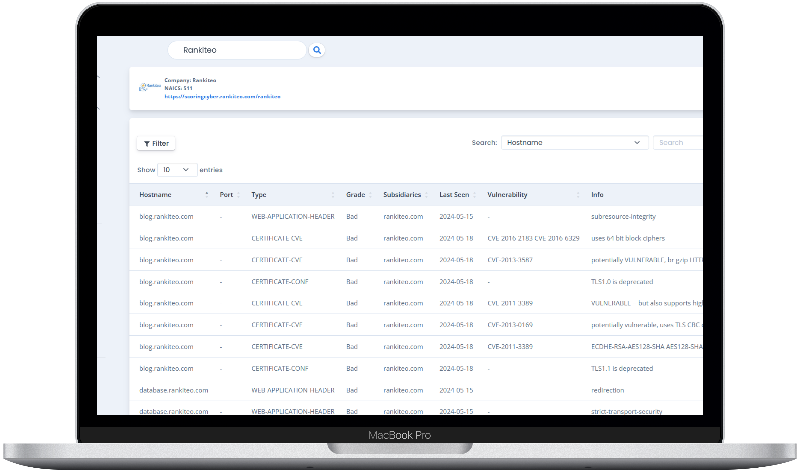
Identify exposed access points, detect misconfigured SSL certificates, and uncover vulnerabilities across the network infrastructure.
Gain visibility into the software components used within an organization to detect vulnerabilities, manage risk, and ensure supply chain security.
Monitor and manage all IT assets and their configurations to ensure accurate, real-time visibility across the company's technology environment.
Leverage real-time insights on active threats, malware campaigns, and emerging vulnerabilities to proactively defend against evolving cyberattacks.








 Rapid
Rapid