










Farmers Insurance
Company Details
Linkedin ID:
farmers-insurance
Employees number:
45,550
Number of followers:
240,291
NAICS:
524
Industry Type:
Homepage:
farmers.com
IP Addresses:
0
Company ID:
FAR_6813817
Scan Status:
In-progress

Farmers Insurance Vendor Cyber Rating & Cyber Score
farmers.comThe companies comprising the Farmers Insurance Group of Companies® currently make up one of the country's largest insurers of vehicles, homes and small businesses, and provide a wide range of other specialty insurance and financial services products. In business since 1928, today at Farmers® we proudly serve millions of households across all 50 states through an extensive network of exclusive and independent agents and approximately 18,000 employees. Our experience provides a rich history and legacy of service and strong customer relationships, while our focus on smart innovation, technology and entrepreneurship helps us to stay creative, to continually improve our product offerings and to drive the evolution of the insurance industry. Every interaction with our customers is a chance to stand out through personalized service and make a meaningful difference in their lives. We take pride in empowering individuals and businesses to become smarter and better prepared to protect what matters most. Giving back is also a core part of who we are. Our culture is rooted in volunteerism and a shared commitment to strengthening the communities where we live and work. At Farmers, we truly value your experience as a candidate, and part of that is helping you stay informed and protected. Please keep in mind that any email from a legitimate corporate Farmers Insurance employee will always come from an email address ending in @farmersinsurance.com, @bristolwest.com, or @foremost.com. If you see a message from a different domain, even one that looks close, it's best to treat it with caution. Knowing this helps ensure your communication with us stays safe, secure, and authentic. And if you are ever suspicious of an email and want to verify the legitimacy, please feel free to send an email to [email protected]
Company Details
farmers-insurance
45,550
240,291
524
farmers.com
0
FAR_6813817
In-progress
 Farmers Insurance Risk Score (AI oriented)
Between 550 and 599
 Farmers Insurance Global Score (TPRM)
XXXX
Description: Farmers Insurance suffered a data breach linked to a third-party hack at Salesforce, compromising over 1 million customers’ sensitive information, including names, addresses, birth dates, and driver’s licenses. Among the affected were agricultural producers, whose personal and operational data were exposed. The breach fueled follow-on phishing scams, exploiting the stolen data to trick victims into revealing further credentials or financial details. While the attack did not involve ransomware, the exposure of personally identifiable information (PII) critical for farm operations, loan applications, and subsidy eligibility posed severe risks of identity theft, financial fraud, and reputational damage. The incident underscored vulnerabilities in rural sectors, where reliance on third-party platforms (like Salesforce) and shared email systems heightens exposure. No evidence suggested the breach directly disrupted farm operations, but the leak of customer data including ag producers aligned with broader trends targeting the industry’s digital dependencies.
Description: A data breach at Farmers Insurance, discovered via a third-party vendor, exposed the personal information of over 1.07 million customers. The incident occurred on May 29–30, 2025, when an unauthorized actor accessed a vendor’s database containing Farmers’ customer records. The compromised data included names, addresses, dates of birth, driver’s license numbers, and the last four digits of Social Security numbers. The breach was detected through monitoring tools, prompting containment measures, including blocking unauthorized access. Farmers launched an investigation, confirming on July 24, 2025, that customer data had been accessed and acquired. Affected individuals were notified starting August 22, 2025, with offers of 24 months of free credit monitoring and identity protection services. While no evidence suggested further data exposure, the breach highlights vulnerabilities in third-party vendor security, raising concerns over potential identity theft or fraud for impacted policyholders. The incident aligns with a broader trend of cyber threats targeting U.S. insurers in 2025.
Description: The California Office of the Attorney General reported that Farmers Insurance experienced a data breach between January 20, 2021, and February 12, 2021, potentially exposing personal information such as names, addresses, dates of birth, and driver's license numbers. The breach was reported on May 4, 2021.
Description: The California Office of the Attorney General disclosed a data breach affecting Farmers Insurance, which transpired on March 31, 2019, but was reported later on December 3, 2019. The incident involved unauthorized access to sensitive customer data, including names, Social Security numbers, and medical history. While the precise number of impacted individuals remains undisclosed, the exposure of such highly personal information poses severe risks, including identity theft, financial fraud, and privacy violations. The breach underscores vulnerabilities in Farmers Insurance’s data protection measures, potentially eroding customer trust and triggering regulatory scrutiny. Given the nature of the compromised data particularly medical records and Social Security numbers the long-term repercussions for affected individuals could be substantial, ranging from targeted phishing attacks to fraudulent credit applications. The delay in public disclosure further compounds concerns about transparency and incident response protocols within the organization.
Description: The New York Department of Financial Services (DFS) fined Farmers Insurance Exchange $2.8 million for inadequate cybersecurity controls that exposed consumer data including driver’s license numbers and birth dates through vulnerable online quoting platforms. The breach stemmed from systemic failures in safeguarding sensitive personal information, compounded by the company’s delay in reporting the incident, which further undermined consumer protections. DFS mandated remedial measures, including a comprehensive review of data storage and access protocols, to prevent future exposures. The enforcement action highlights regulatory scrutiny under New York’s cybersecurity framework (enacted in 2017, updated in 2023), which serves as a benchmark for financial sector oversight. While Farmers Insurance acknowledged the penalties, the case remains part of an ongoing DFS investigation into broader industry vulnerabilities. The incident underscores the risks of unsecured digital platforms in handling high-value consumer data, particularly in sectors like auto insurance where personally identifiable information (PII) is routinely processed.


No incidents recorded for Farmers Insurance in 2026.
No incidents recorded for Farmers Insurance in 2026.
No incidents recorded for Farmers Insurance in 2026.
Farmers Insurance cyber incidents detection timeline including parent company and subsidiaries

The companies comprising the Farmers Insurance Group of Companies® currently make up one of the country's largest insurers of vehicles, homes and small businesses, and provide a wide range of other specialty insurance and financial services products. In business since 1928, today at Farmers® we proudly serve millions of households across all 50 states through an extensive network of exclusive and independent agents and approximately 18,000 employees. Our experience provides a rich history and legacy of service and strong customer relationships, while our focus on smart innovation, technology and entrepreneurship helps us to stay creative, to continually improve our product offerings and to drive the evolution of the insurance industry. Every interaction with our customers is a chance to stand out through personalized service and make a meaningful difference in their lives. We take pride in empowering individuals and businesses to become smarter and better prepared to protect what matters most. Giving back is also a core part of who we are. Our culture is rooted in volunteerism and a shared commitment to strengthening the communities where we live and work. At Farmers, we truly value your experience as a candidate, and part of that is helping you stay informed and protected. Please keep in mind that any email from a legitimate corporate Farmers Insurance employee will always come from an email address ending in @farmersinsurance.com, @bristolwest.com, or @foremost.com. If you see a message from a different domain, even one that looks close, it's best to treat it with caution. Knowing this helps ensure your communication with us stays safe, secure, and authentic. And if you are ever suspicious of an email and want to verify the legitimacy, please feel free to send an email to [email protected]


Zurich Insurance Group (Zurich) is a leading global multi-line insurer founded more than 150 years ago, which has grown into a business serving more than 75 million customers in more than 200 countries and territories, while delivering industry-leading total shareholder returns. Our customers includ

At Mapfre, we’ve spent more than 90 years supporting people and businesses around the world, taking care of what matters most to them. We offer insurance, financial, and service solutions that evolve with you. Our experience and commitment, combined with a constant focus on innovation, allow us to a
HDFC Life, one of India’s leading private life insurance companies, offers a range of individual and group insurance solutions. It is a joint venture between Housing Development Finance Corporation Limited (HDFC), India’s leading housing finance institution and abrdn plc, the leading provider of fin

At QBE we’re driven by our purpose of enabling a more resilient future. QBE is an international insurer and reinsurer headquartered in Sydney, Australia, with local presence in 26 countries. We don't just see ourselves as an insurer, but a partner to our customers in helping to navigate uncertai
China Pacific Life Insurance Co., Ltd (CPIC Life in short) was formed on the basis of life insurance business of China Pacific Insurance Co., Ltd., which was founded on May 13th 1991, and is held by CPIC Group. The company was incorporated in November 11, 2001, headquartered in Shanghai and register

At Canada Life, we’re focused on improving the financial, physical and mental well-being of Canadians. Whether handling policy claims, help growing and protecting clients’ retirement and investment savings, providing workplace mental health support for all employers or helping build stronger communi

Founded in October 1949, The People’s Insurance Company (Group) of China is the first nation-wide insurance company in the People’s Republic of China and has developed into a leading large-scale integrated insurance financial group in the PRC, ranking 208th on the Global 500 (2014) published by the
« Etre là pour les autres, j'ai décidé d'en faire mon métier. » Portée par nos 32 000 collaborateurs, notre campagne de communication employeur souligne ce qui nous rassemble et nous rend fiers au quotidien : notre métier, le point de départ de belles histoires, humaines avant tout. Cette campagne
Every journey has a beginning, and wherever you are on your career path, we want to help you along the way. At Progressive, we exist to help people move forward and live fully. We strive to create a welcoming and flexible work environment for everyone, where employees are encouraged to risk, learn,
.png)
March 2, 2026 To: Members of the House Committee on Agriculture From: Bryan Riley, Director, Free Trade Initiative, National Taxpayers Union...
Farming is a critical part of national infrastructure, yet many farmers still underestimate the risk that cybercrime poses to their...
New York DFS fined eight auto insurers and agencies $19 mn for weak cybersecurity controls that exposed personal data through online quoting...
As Canadian farmers embrace automation, cybersecurity is the new front line. Here's how to protect your on-farm data from digital threats.
2025 was a big year for cybersecurity, with cyberattacks, data breaches, threat groups reaching new notoriety levels, and, of course,...
Cybersecurity joins a familiar roll call of challenges for agricultural producers. Stay proactive to protect your farm from risk.
Farmers Insurance becomes a TGL founding partner alongside brands such as Best Buy, Businessolver, Genesis, Hankook Tires, and Shriners...
Cybersecurity firm Blackwired has announced enhancements to its ThirdWatch platform, introducing AI-driven 3D Threat Visualisation,...
New York State Department of Financial Services (DFS) Superintendent Adrienne A. Harris has collected more than $19 million in penalties for...

Explore insights on cybersecurity incidents, risk posture, and Rankiteo's assessments.
The official website of Farmers Insurance is http://www.farmers.com/careers/corporate.
According to Rankiteo, Farmers Insurance’s AI-generated cybersecurity score is 580, reflecting their Very Poor security posture.
According to Rankiteo, Farmers Insurance currently holds 0 security badges, indicating that no recognized compliance certifications are currently verified for the organization.
According to Rankiteo, Farmers Insurance has not been affected by any supply chain cyber incidents, and no incident IDs are currently listed for the organization.
According to Rankiteo, Farmers Insurance is not certified under SOC 2 Type 1.
According to Rankiteo, Farmers Insurance does not hold a SOC 2 Type 2 certification.
According to Rankiteo, Farmers Insurance is not listed as GDPR compliant.
According to Rankiteo, Farmers Insurance does not currently maintain PCI DSS compliance.
According to Rankiteo, Farmers Insurance is not compliant with HIPAA regulations.
According to Rankiteo,Farmers Insurance is not certified under ISO 27001, indicating the absence of a formally recognized information security management framework.
Farmers Insurance operates primarily in the Insurance industry.
Farmers Insurance employs approximately 45,550 people worldwide.
Farmers Insurance presently has no subsidiaries across any sectors.
Farmers Insurance’s official LinkedIn profile has approximately 240,291 followers.
Farmers Insurance is classified under the NAICS code 524, which corresponds to Insurance Carriers and Related Activities.
Yes, Farmers Insurance has an official profile on Crunchbase, which can be accessed here: https://www.crunchbase.com/organization/farmers-insurance-6c6a.
Yes, Farmers Insurance maintains an official LinkedIn profile, which is actively utilized for branding and talent engagement, which can be accessed here: https://www.linkedin.com/company/farmers-insurance.
As of April 03, 2026, Rankiteo reports that Farmers Insurance has experienced 5 cybersecurity incidents.
Farmers Insurance has an estimated 15,377 peer or competitor companies worldwide.
Incident Types: The types of cybersecurity incidents that have occurred include Breach.
Total Financial Loss: The total financial loss from these incidents is estimated to be $19.30 million.
Detection and Response: The company detects and responds to cybersecurity incidents through an incident response plan activated with yes, and third party assistance with yes (vendor containment measures), and law enforcement notified with yes, and containment measures with blocked unauthorized access to vendor database, and recovery measures with 24 months of free cyberscout credit monitoring for affected individuals, and communication strategy with written notices to affected individuals (sent ~2025-08-22), communication strategy with public disclosure via website and maine ag notification, communication strategy with dedicated helpline (1-833-426-6809), and containment measures with review of consumer data storage and access, and remediation measures with full review of data handling practices, and communication strategy with public statements (e.g., liberty mutual’s acknowledgment), and incident response plan activated with yes (google issued warnings and forced password resets), and containment measures with password reset enforcement, containment measures with phishing scam alerts, and remediation measures with user education on mfa, remediation measures with encouragement to update security software, and communication strategy with public announcements by google, communication strategy with media coverage highlighting agricultural risks..
Title: Farmers Insurance Data Breach
Description: The California Office of the Attorney General reported that Farmers Insurance experienced a data breach between January 20, 2021, and February 12, 2021, potentially exposing personal information such as names, addresses, dates of birth, and driver's license numbers. The breach was reported on May 4, 2021.
Date Publicly Disclosed: 2021-05-04
Type: Data Breach
Title: Farmers Insurance Data Breach (2019)
Description: The California Office of the Attorney General reported a data breach involving Farmers Insurance on December 3, 2019. The breach occurred on March 31, 2019, and involved unauthorized access to customer information, including names, Social Security numbers, and medical history. The exact number of individuals affected is unknown.
Date Publicly Disclosed: 2019-12-03
Type: Data Breach
Title: Farmers Insurance Data Breach Impacting Over One Million Customers
Description: A data breach at Farmers Insurance, detected via a third-party vendor, exposed personal information of over 1.07 million policyholders. The breach involved unauthorized access to a vendor’s database containing customer data, including names, addresses, dates of birth, driver’s license numbers, and the last four digits of Social Security numbers. Farmers launched an investigation, notified law enforcement, and offered 24 months of free credit monitoring to affected individuals.
Date Detected: 2025-05-30
Date Publicly Disclosed: 2025-08-22
Type: Data Breach
Attack Vector: Third-party vendor compromise (unauthorized database access)
Threat Actor: Unauthorized actor (unknown)
Title: New York DFS Fines Eight Auto Insurers $19M for Inadequate Cybersecurity Controls Exposing Consumer Data
Description: The New York Department of Financial Services (DFS) fined eight auto insurers and agencies over $19 million for inadequate cybersecurity controls that exposed consumer data, including driver’s license numbers and birth dates, through online quoting platforms. Farmers Insurance Exchange and Infinity Insurance Co. were additionally penalized for failing to report incidents in a timely manner. The settlements mandate remedial measures, including a full review of consumer data storage and access protocols.
Type: Data Breach
Attack Vector: Insecure Online Quoting PlatformsPoor Access Controls
Vulnerability Exploited: Inadequate Data Protection MeasuresLack of Timely Incident Reporting
Title: Massive Data Breach in Gmail and Salesforce Affecting Agricultural Sector
Description: Google warned Gmail users of a massive data breach tied to a third-party hack at Salesforce, exposing sensitive data and sparking phishing scams. The breach affected 2.5 billion accounts, including those of farmers and ranchers using Gmail for business. The incident highlights growing cyber threats in the agriculture sector, where ransomware and phishing attacks have surged by 607% since 2020. Farmers Insurance also suffered a Salesforce-linked hack, compromising over 1 million customers' personal data, including agricultural producers. The breach underscores vulnerabilities in rural businesses, which often lack dedicated IT staff and rely on common email services like Gmail (76% U.S. market share).
Type: data breach
Attack Vector: phishing emailsexploited software vulnerabilities (Salesforce)credential harvesting
Vulnerability Exploited: third-party vendor (Salesforce) security flawweak password practiceslack of multi-factor authentication (MFA)
Motivation: financial gaindata theft for phishing/scamspotential espionage (agricultural data)
Common Attack Types: The most common types of attacks the company has faced is Breach.
Identification of Attack Vectors: The company identifies the attack vectors used in incidents through Third-party vendor database and Salesforce third-party vulnerability.

Data Compromised: Names, Addresses, Dates of birth, Driver's license numbers
Data Compromised: Names, Social security numbers, Medical history
Identity Theft Risk: High (PII exposed)
Data Compromised: Name, Address, Date of birth, Driver’s license number, Last four digits of social security number
Systems Affected: Third-party vendor database
Brand Reputation Impact: Potential reputational damage due to exposure of 1M+ customer records
Identity Theft Risk: High (PII exposed)
Financial Loss: $19,300,000 (Total Fines)
Data Compromised: Driver’s license numbers, Birth dates, Personal details
Systems Affected: Online Quoting Platforms
Operational Impact: Regulatory ScrutinyMandatory Remedial Measures
Brand Reputation Impact: Potential Trust Erosion Due to Data Exposure
Legal Liabilities: Regulatory FinesOngoing Investigations
Identity Theft Risk: ['High (Due to Exposure of PII)']
Data Compromised: Names, Addresses, Birth dates, Driver’s licenses, Business email data, Potential farm-specific data (crop records, gps mappings, precision ag info)
Systems Affected: Gmail accountsSalesforce platformslinked agricultural business systems
Operational Impact: increased phishing scams targeting farmersurgent password resets for 2.5 billion accountspotential disruption to farm operations if ransomware spreads
Customer Complaints: ['reports of spoofed emails', 'identity theft concerns']
Brand Reputation Impact: erosion of trust in Gmail/Salesforce securityheightened awareness of agricultural sector vulnerabilities
Identity Theft Risk: high (due to exposed PII like driver’s licenses and birth dates)
Payment Information Risk: potential (if linked financial data was accessed)
Average Financial Loss: The average financial loss per incident is $3.86 million.
Commonly Compromised Data Types: The types of data most commonly compromised in incidents are Names, Addresses, Dates Of Birth, Driver'S License Numbers, , Personally Identifiable Information (Pii), Protected Health Information (Phi), , Personally Identifiable Information (Pii), Partial Social Security Numbers (Last 4 Digits), Driver’S License Numbers, , Personally Identifiable Information (Pii), , Personal Identifiable Information (Pii), Business Email Data, Potential Agricultural Operational Data and .
Entity Name: Farmers Insurance
Entity Type: Insurance Company
Industry: Insurance
Location: California
Entity Name: Farmers Insurance
Entity Type: Insurance Company
Industry: Insurance
Location: California, USA
Customers Affected: Unknown
Entity Name: Farmers Insurance Exchange
Entity Type: Insurance Provider
Industry: Insurance
Location: United States
Customers Affected: 1,071,172
Entity Name: Farmers Group Inc.
Entity Type: Insurance Holding Company
Industry: Insurance
Location: United States
Customers Affected: 1,071,172
Entity Name: Unnamed Third-Party Vendor
Entity Type: Service Provider
Entity Name: Farmers Insurance Exchange
Entity Type: Insurance Company
Industry: Automotive Insurance
Location: USA (New York)
Entity Name: Hagerty Insurance Agency LLC
Entity Type: Insurance Agency
Industry: Automotive Insurance
Location: USA (New York)
Entity Name: Hartford Fire Insurance Co.
Entity Type: Insurance Company
Industry: Automotive Insurance
Location: USA (New York)
Entity Name: Infinity Insurance Co.
Entity Type: Insurance Company
Industry: Automotive Insurance
Location: USA (New York)
Entity Name: Liberty Mutual Insurance Co.
Entity Type: Insurance Company
Industry: Automotive Insurance
Location: USA (New York)
Entity Name: Metromile Insurance Co.
Entity Type: Insurance Company
Industry: Automotive Insurance
Location: USA (New York)
Entity Name: Midvale Indemnity Co.
Entity Type: Insurance Company
Industry: Automotive Insurance
Location: USA (New York)
Entity Name: Safe Automobile Mutual Insurance Co.
Entity Type: Insurance Company
Industry: Automotive Insurance
Location: USA (New York)
Entity Name: Google (Gmail)
Entity Type: technology company
Industry: cloud services/email
Location: global (U.S. market focus)
Size: 2.5 billion affected accounts
Customers Affected: 2.5 billion
Entity Name: Salesforce
Entity Type: CRM/enterprise software
Industry: technology
Location: global
Entity Name: Farmers Insurance
Entity Type: insurance provider
Industry: financial services
Location: U.S.
Customers Affected: 1 million+ (including agricultural producers)
Entity Name: U.S. Agricultural Sector (small family farms/ranches)
Entity Type: businesses
Industry: agriculture
Location: U.S. (focus on rural/High Plains regions)
Incident Response Plan Activated: Yes
Third Party Assistance: Yes (vendor containment measures)
Law Enforcement Notified: Yes
Containment Measures: Blocked unauthorized access to vendor database
Recovery Measures: 24 months of free Cyberscout credit monitoring for affected individuals
Communication Strategy: Written notices to affected individuals (sent ~2025-08-22)Public disclosure via website and Maine AG notificationDedicated helpline (1-833-426-6809)
Containment Measures: Review of Consumer Data Storage and Access
Remediation Measures: Full Review of Data Handling Practices
Communication Strategy: Public Statements (e.g., Liberty Mutual’s Acknowledgment)
Incident Response Plan Activated: yes (Google issued warnings and forced password resets)
Containment Measures: password reset enforcementphishing scam alerts
Remediation Measures: user education on MFAencouragement to update security software
Communication Strategy: public announcements by Googlemedia coverage highlighting agricultural risks
Incident Response Plan: The company's incident response plan is described as Yes, .
Third-Party Assistance: The company involves third-party assistance in incident response through Yes (vendor containment measures).
Type of Data Compromised: Names, Addresses, Dates of birth, Driver's license numbers
Type of Data Compromised: Personally identifiable information (pii), Protected health information (phi)
Number of Records Exposed: Unknown
Sensitivity of Data: High
Personally Identifiable Information: namesSocial Security numbers
Type of Data Compromised: Personally identifiable information (pii), Partial social security numbers (last 4 digits), Driver’s license numbers
Number of Records Exposed: 1,071,172
Sensitivity of Data: High (PII with identity theft risk)
Data Exfiltration: Yes (unauthorized access and acquisition confirmed)
Personally Identifiable Information: Yes
Type of Data Compromised: Personally identifiable information (pii)
Sensitivity of Data: High (Driver’s License Numbers, Birth Dates)
Personally Identifiable Information: Driver’s License NumbersBirth Dates
Type of Data Compromised: Personal identifiable information (pii), Business email data, Potential agricultural operational data
Number of Records Exposed: 2.5 billion (Gmail) + 1 million (Farmers Insurance)
Sensitivity of Data: high (PII, financial, and farm-specific data)
Data Exfiltration: yes
Personally Identifiable Information: namesaddressesbirth datesdriver’s licenses
Prevention of Data Exfiltration: The company takes the following measures to prevent data exfiltration: Full Review of Data Handling Practices, , user education on MFA, encouragement to update security software, .
Handling of PII Incidents: The company handles incidents involving personally identifiable information (PII) through by blocked unauthorized access to vendor database, , review of consumer data storage and access, , password reset enforcement, phishing scam alerts and .
Data Recovery from Ransomware: The company recovers data encrypted by ransomware through 24 months of free Cyberscout credit monitoring for affected individuals, .
Regulations Violated: Potential HIPAA (PHI exposure), Potential state data breach laws (e.g., California Civil Code § 1798.82),
Regulatory Notifications: California Office of the Attorney General
Regulatory Notifications: Maine Attorney General
Regulations Violated: New York DFS Cybersecurity Regulation (2017, Updated 2023),
Fines Imposed: $19,300,000 (Total)
Legal Actions: Settlements with Mandatory Remedial Measures,
Regulatory Notifications: Delayed Reporting by Farmers Insurance Exchange and Infinity Insurance Co.
Regulatory Notifications: potential reporting under state data breach laws (e.g., California CCPA)
Ensuring Regulatory Compliance: The company ensures compliance with regulatory requirements through Settlements with Mandatory Remedial Measures, .
Lessons Learned: Timely incident reporting is critical to compliance and consumer protection., Robust access controls and data protection measures are essential for online platforms handling PII., Regulatory frameworks like NY DFS’s cybersecurity rules set enforceable standards for financial institutions.
Lessons Learned: Agricultural sector is increasingly targeted due to weak cybersecurity practices and high-value data (crop/GPS/financial records)., Third-party vulnerabilities (e.g., Salesforce) can cascade into sector-wide risks., Rural businesses lack awareness: 82% of farms believe they’ve never been attacked, despite evidence to the contrary., Basic measures (MFA, password hygiene, antivirus) are critically underutilized in agriculture.
Recommendations: Implement comprehensive vulnerability scanning and access reviews for online platforms., Ensure timely incident reporting to regulators to avoid compounded penalties., Invest in cybersecurity programs to align with evolving regulatory requirements (e.g., NY DFS 2023 updates)., Adopt basic cyber preparedness measures, such as incident response plans, to mitigate risks.Implement comprehensive vulnerability scanning and access reviews for online platforms., Ensure timely incident reporting to regulators to avoid compounded penalties., Invest in cybersecurity programs to align with evolving regulatory requirements (e.g., NY DFS 2023 updates)., Adopt basic cyber preparedness measures, such as incident response plans, to mitigate risks.Implement comprehensive vulnerability scanning and access reviews for online platforms., Ensure timely incident reporting to regulators to avoid compounded penalties., Invest in cybersecurity programs to align with evolving regulatory requirements (e.g., NY DFS 2023 updates)., Adopt basic cyber preparedness measures, such as incident response plans, to mitigate risks.Implement comprehensive vulnerability scanning and access reviews for online platforms., Ensure timely incident reporting to regulators to avoid compounded penalties., Invest in cybersecurity programs to align with evolving regulatory requirements (e.g., NY DFS 2023 updates)., Adopt basic cyber preparedness measures, such as incident response plans, to mitigate risks.
Recommendations: Enable multi-factor authentication (MFA) on all email and business accounts., Use strong, unique passwords (12+ characters) and change them post-breach., Invest in reputable antivirus software (e.g., Norton, McAfee, Bitdefender) with phishing protection., Regularly update software and patch vulnerabilities., Back up data to external drives/clouds to mitigate ransomware risks., Train employees/family to recognize phishing (e.g., spoofed USDA/supplier emails)., Avoid public Wi-Fi for sensitive transactions., Conduct cybersecurity assessments using free resources (e.g., CISA for agriculture)., Monitor for breaches using tools like McAfee/Norton’s personal data cleanup., Consider encrypted email services for farm-specific data., Support legislative efforts like the Farm and Food Cybersecurity Act (2025).Enable multi-factor authentication (MFA) on all email and business accounts., Use strong, unique passwords (12+ characters) and change them post-breach., Invest in reputable antivirus software (e.g., Norton, McAfee, Bitdefender) with phishing protection., Regularly update software and patch vulnerabilities., Back up data to external drives/clouds to mitigate ransomware risks., Train employees/family to recognize phishing (e.g., spoofed USDA/supplier emails)., Avoid public Wi-Fi for sensitive transactions., Conduct cybersecurity assessments using free resources (e.g., CISA for agriculture)., Monitor for breaches using tools like McAfee/Norton’s personal data cleanup., Consider encrypted email services for farm-specific data., Support legislative efforts like the Farm and Food Cybersecurity Act (2025).Enable multi-factor authentication (MFA) on all email and business accounts., Use strong, unique passwords (12+ characters) and change them post-breach., Invest in reputable antivirus software (e.g., Norton, McAfee, Bitdefender) with phishing protection., Regularly update software and patch vulnerabilities., Back up data to external drives/clouds to mitigate ransomware risks., Train employees/family to recognize phishing (e.g., spoofed USDA/supplier emails)., Avoid public Wi-Fi for sensitive transactions., Conduct cybersecurity assessments using free resources (e.g., CISA for agriculture)., Monitor for breaches using tools like McAfee/Norton’s personal data cleanup., Consider encrypted email services for farm-specific data., Support legislative efforts like the Farm and Food Cybersecurity Act (2025).Enable multi-factor authentication (MFA) on all email and business accounts., Use strong, unique passwords (12+ characters) and change them post-breach., Invest in reputable antivirus software (e.g., Norton, McAfee, Bitdefender) with phishing protection., Regularly update software and patch vulnerabilities., Back up data to external drives/clouds to mitigate ransomware risks., Train employees/family to recognize phishing (e.g., spoofed USDA/supplier emails)., Avoid public Wi-Fi for sensitive transactions., Conduct cybersecurity assessments using free resources (e.g., CISA for agriculture)., Monitor for breaches using tools like McAfee/Norton’s personal data cleanup., Consider encrypted email services for farm-specific data., Support legislative efforts like the Farm and Food Cybersecurity Act (2025).Enable multi-factor authentication (MFA) on all email and business accounts., Use strong, unique passwords (12+ characters) and change them post-breach., Invest in reputable antivirus software (e.g., Norton, McAfee, Bitdefender) with phishing protection., Regularly update software and patch vulnerabilities., Back up data to external drives/clouds to mitigate ransomware risks., Train employees/family to recognize phishing (e.g., spoofed USDA/supplier emails)., Avoid public Wi-Fi for sensitive transactions., Conduct cybersecurity assessments using free resources (e.g., CISA for agriculture)., Monitor for breaches using tools like McAfee/Norton’s personal data cleanup., Consider encrypted email services for farm-specific data., Support legislative efforts like the Farm and Food Cybersecurity Act (2025).Enable multi-factor authentication (MFA) on all email and business accounts., Use strong, unique passwords (12+ characters) and change them post-breach., Invest in reputable antivirus software (e.g., Norton, McAfee, Bitdefender) with phishing protection., Regularly update software and patch vulnerabilities., Back up data to external drives/clouds to mitigate ransomware risks., Train employees/family to recognize phishing (e.g., spoofed USDA/supplier emails)., Avoid public Wi-Fi for sensitive transactions., Conduct cybersecurity assessments using free resources (e.g., CISA for agriculture)., Monitor for breaches using tools like McAfee/Norton’s personal data cleanup., Consider encrypted email services for farm-specific data., Support legislative efforts like the Farm and Food Cybersecurity Act (2025).Enable multi-factor authentication (MFA) on all email and business accounts., Use strong, unique passwords (12+ characters) and change them post-breach., Invest in reputable antivirus software (e.g., Norton, McAfee, Bitdefender) with phishing protection., Regularly update software and patch vulnerabilities., Back up data to external drives/clouds to mitigate ransomware risks., Train employees/family to recognize phishing (e.g., spoofed USDA/supplier emails)., Avoid public Wi-Fi for sensitive transactions., Conduct cybersecurity assessments using free resources (e.g., CISA for agriculture)., Monitor for breaches using tools like McAfee/Norton’s personal data cleanup., Consider encrypted email services for farm-specific data., Support legislative efforts like the Farm and Food Cybersecurity Act (2025).Enable multi-factor authentication (MFA) on all email and business accounts., Use strong, unique passwords (12+ characters) and change them post-breach., Invest in reputable antivirus software (e.g., Norton, McAfee, Bitdefender) with phishing protection., Regularly update software and patch vulnerabilities., Back up data to external drives/clouds to mitigate ransomware risks., Train employees/family to recognize phishing (e.g., spoofed USDA/supplier emails)., Avoid public Wi-Fi for sensitive transactions., Conduct cybersecurity assessments using free resources (e.g., CISA for agriculture)., Monitor for breaches using tools like McAfee/Norton’s personal data cleanup., Consider encrypted email services for farm-specific data., Support legislative efforts like the Farm and Food Cybersecurity Act (2025).Enable multi-factor authentication (MFA) on all email and business accounts., Use strong, unique passwords (12+ characters) and change them post-breach., Invest in reputable antivirus software (e.g., Norton, McAfee, Bitdefender) with phishing protection., Regularly update software and patch vulnerabilities., Back up data to external drives/clouds to mitigate ransomware risks., Train employees/family to recognize phishing (e.g., spoofed USDA/supplier emails)., Avoid public Wi-Fi for sensitive transactions., Conduct cybersecurity assessments using free resources (e.g., CISA for agriculture)., Monitor for breaches using tools like McAfee/Norton’s personal data cleanup., Consider encrypted email services for farm-specific data., Support legislative efforts like the Farm and Food Cybersecurity Act (2025).Enable multi-factor authentication (MFA) on all email and business accounts., Use strong, unique passwords (12+ characters) and change them post-breach., Invest in reputable antivirus software (e.g., Norton, McAfee, Bitdefender) with phishing protection., Regularly update software and patch vulnerabilities., Back up data to external drives/clouds to mitigate ransomware risks., Train employees/family to recognize phishing (e.g., spoofed USDA/supplier emails)., Avoid public Wi-Fi for sensitive transactions., Conduct cybersecurity assessments using free resources (e.g., CISA for agriculture)., Monitor for breaches using tools like McAfee/Norton’s personal data cleanup., Consider encrypted email services for farm-specific data., Support legislative efforts like the Farm and Food Cybersecurity Act (2025).Enable multi-factor authentication (MFA) on all email and business accounts., Use strong, unique passwords (12+ characters) and change them post-breach., Invest in reputable antivirus software (e.g., Norton, McAfee, Bitdefender) with phishing protection., Regularly update software and patch vulnerabilities., Back up data to external drives/clouds to mitigate ransomware risks., Train employees/family to recognize phishing (e.g., spoofed USDA/supplier emails)., Avoid public Wi-Fi for sensitive transactions., Conduct cybersecurity assessments using free resources (e.g., CISA for agriculture)., Monitor for breaches using tools like McAfee/Norton’s personal data cleanup., Consider encrypted email services for farm-specific data., Support legislative efforts like the Farm and Food Cybersecurity Act (2025).
Key Lessons Learned: The key lessons learned from past incidents are Timely incident reporting is critical to compliance and consumer protection.,Robust access controls and data protection measures are essential for online platforms handling PII.,Regulatory frameworks like NY DFS’s cybersecurity rules set enforceable standards for financial institutions.Agricultural sector is increasingly targeted due to weak cybersecurity practices and high-value data (crop/GPS/financial records).,Third-party vulnerabilities (e.g., Salesforce) can cascade into sector-wide risks.,Rural businesses lack awareness: 82% of farms believe they’ve never been attacked, despite evidence to the contrary.,Basic measures (MFA, password hygiene, antivirus) are critically underutilized in agriculture.
Source: California Office of the Attorney General
Source: California Office of the Attorney General
Source: Farmers Insurance Breach Notice (Website)
Source: Maine Attorney General Notification
Source: New York Department of Financial Services (DFS)
Source: Aon’s Global Cyber Risk Report
Source: Google Security Blog (hypothetical, based on described announcement)
Source: Farmers Insurance Data Breach Notification
Source: USDA Reports on Agricultural Cybersecurity (2025)
Source: Critical Infrastructure Security and Resilience in America’s Cyber Defense Agency (CISA)
URL: https://www.cisa.gov
Additional Resources: Stakeholders can find additional resources on cybersecurity best practices at and Source: California Office of the Attorney General, and Source: California Office of the Attorney General, and Source: Farmers Insurance Breach Notice (Website), and Source: Maine Attorney General Notification, and Source: New York Department of Financial Services (DFS), and Source: Aon’s Global Cyber Risk Report, and Source: Google Security Blog (hypothetical, based on described announcement), and Source: Farmers Insurance Data Breach Notification, and Source: USDA Reports on Agricultural Cybersecurity (2025), and Source: Critical Infrastructure Security and Resilience in America’s Cyber Defense Agency (CISA)Url: https://www.cisa.gov.
Investigation Status: Completed (as of 2025-07-24)
Investigation Status: Ongoing (DFS investigation into related breaches continues)
Investigation Status: ongoing (no resolution details provided)
Communication of Investigation Status: The company communicates the status of incident investigations to stakeholders through Written Notices To Affected Individuals (Sent ~2025-08-22), Public Disclosure Via Website And Maine Ag Notification, Dedicated Helpline (1-833-426-6809), Public Statements (E.G., Liberty Mutual’S Acknowledgment), Public Announcements By Google and Media Coverage Highlighting Agricultural Risks.
Customer Advisories: Written notices with credit monitoring offerHelpline for eligibility checks
Stakeholder Advisories: Google Urged Users To Reset Passwords And Enable Mfa., Agricultural Organizations (E.G., Farm Bureaus) Advised Members To Audit Cybersecurity Practices., Usda Promoted Resources For Rural Cybersecurity Awareness..
Customer Advisories: Gmail users received breach notifications with phishing warnings.Farmers Insurance customers were notified of PII exposure and offered credit monitoring.
Advisories Provided: The company provides the following advisories to stakeholders and customers following an incident: were Written Notices With Credit Monitoring Offer, Helpline For Eligibility Checks, , Google Urged Users To Reset Passwords And Enable Mfa., Agricultural Organizations (E.G., Farm Bureaus) Advised Members To Audit Cybersecurity Practices., Usda Promoted Resources For Rural Cybersecurity Awareness., Gmail Users Received Breach Notifications With Phishing Warnings., Farmers Insurance Customers Were Notified Of Pii Exposure And Offered Credit Monitoring. and .
Entry Point: Third-party vendor database
High Value Targets: Customer Pii,
Data Sold on Dark Web: Customer Pii,
Entry Point: Salesforce third-party vulnerability
High Value Targets: Agricultural Producers' Pii, Farm Operational Data,
Data Sold on Dark Web: Agricultural Producers' Pii, Farm Operational Data,
Root Causes: Third-Party Vendor Security Vulnerability,
Root Causes: Inadequate Cybersecurity Controls On Online Quoting Platforms., Failure To Report Incidents Promptly (Farmers Insurance Exchange, Infinity Insurance Co.)., Lack Of Basic Preparedness (E.G., Response Plans, Vulnerability Scans).,
Corrective Actions: Mandatory Review Of Consumer Data Storage And Access Protocols., Enhanced Compliance With Ny Dfs Cybersecurity Regulations., Investment In Cybersecurity Programs (E.G., Liberty Mutual’S Ongoing Efforts).,
Root Causes: Third-Party Vendor (Salesforce) Security Failure., Overreliance On Consumer-Grade Email (Gmail) For Business Operations In Agriculture., Lack Of Mfa And Weak Password Practices In Rural Sectors., Low Cybersecurity Awareness Among Farmers (82% Believed They Were Never Attacked)., Outdated Software And Unpatched Systems In Agricultural Businesses.,
Corrective Actions: Google Enforced Password Resets And Phishing Alerts., Agricultural Sector Urged To Adopt Mfa, Antivirus, And Employee Training., Legislative Push For Farm And Food Cybersecurity Act (2025) To Fund Rural Cyber Defenses., Cisa And Usda Expanded Free Cybersecurity Resources For Farmers.,
Corrective Actions Taken: The company has taken the following corrective actions based on post-incident analysis: Mandatory Review Of Consumer Data Storage And Access Protocols., Enhanced Compliance With Ny Dfs Cybersecurity Regulations., Investment In Cybersecurity Programs (E.G., Liberty Mutual’S Ongoing Efforts)., , Google Enforced Password Resets And Phishing Alerts., Agricultural Sector Urged To Adopt Mfa, Antivirus, And Employee Training., Legislative Push For Farm And Food Cybersecurity Act (2025) To Fund Rural Cyber Defenses., Cisa And Usda Expanded Free Cybersecurity Resources For Farmers., .
Last Attacking Group: The attacking group in the last incident was an Unauthorized actor (unknown).
Most Recent Incident Detected: The most recent incident detected was on 2025-05-30.
Most Recent Incident Publicly Disclosed: The most recent incident publicly disclosed was on 2025-08-22.
Highest Financial Loss: The highest financial loss from an incident was $19,300,000 (Total Fines).
Most Significant Data Compromised: The most significant data compromised in an incident were names, addresses, dates of birth, driver's license numbers, , names, Social Security numbers, medical history, , Name, Address, Date of birth, Driver’s license number, Last four digits of Social Security number, , Driver’s License Numbers, Birth Dates, Personal Details, , names, addresses, birth dates, driver’s licenses, business email data, potential farm-specific data (crop records, GPS mappings, precision ag info) and .
Most Significant System Affected: The most significant system affected in an incident was Third-party vendor database and Online Quoting Platforms and Gmail accountsSalesforce platformslinked agricultural business systems.
Containment Measures in Most Recent Incident: The containment measures taken in the most recent incident were Blocked unauthorized access to vendor database, Review of Consumer Data Storage and Access and password reset enforcementphishing scam alerts.
Most Sensitive Data Compromised: The most sensitive data compromised in a breach were Last four digits of Social Security number, medical history, Address, Personal Details, addresses, potential farm-specific data (crop records, GPS mappings, precision ag info), birth dates, Date of birth, dates of birth, Name, Driver’s license number, driver's license numbers, driver’s licenses, business email data, Social Security numbers, names, Driver’s License Numbers and Birth Dates.
Number of Records Exposed in Most Significant Breach: The number of records exposed in the most significant breach was 2.5B.
Highest Fine Imposed: The highest fine imposed for a regulatory violation was $19,300,000 (Total).
Most Significant Legal Action: The most significant legal action taken for a regulatory violation was Settlements with Mandatory Remedial Measures, .
Most Significant Lesson Learned: The most significant lesson learned from past incidents was Basic measures (MFA, password hygiene, antivirus) are critically underutilized in agriculture.
Most Significant Recommendation Implemented: The most significant recommendation implemented to improve cybersecurity was Train employees/family to recognize phishing (e.g., spoofed USDA/supplier emails)., Avoid public Wi-Fi for sensitive transactions., Invest in cybersecurity programs to align with evolving regulatory requirements (e.g., NY DFS 2023 updates)., Ensure timely incident reporting to regulators to avoid compounded penalties., Use strong, unique passwords (12+ characters) and change them post-breach., Back up data to external drives/clouds to mitigate ransomware risks., Consider encrypted email services for farm-specific data., Support legislative efforts like the Farm and Food Cybersecurity Act (2025)., Conduct cybersecurity assessments using free resources (e.g., CISA for agriculture)., Implement comprehensive vulnerability scanning and access reviews for online platforms., Regularly update software and patch vulnerabilities., Invest in reputable antivirus software (e.g., Norton, McAfee, Bitdefender) with phishing protection., Monitor for breaches using tools like McAfee/Norton’s personal data cleanup., Enable multi-factor authentication (MFA) on all email and business accounts., Adopt basic cyber preparedness measures, such as incident response plans and to mitigate risks..
Most Recent Source: The most recent source of information about an incident are Farmers Insurance Data Breach Notification, Farmers Insurance Breach Notice (Website), USDA Reports on Agricultural Cybersecurity (2025), Maine Attorney General Notification, Aon’s Global Cyber Risk Report, Critical Infrastructure Security and Resilience in America’s Cyber Defense Agency (CISA), New York Department of Financial Services (DFS), California Office of the Attorney General, Google Security Blog (hypothetical and based on described announcement).
Most Recent URL for Additional Resources: The most recent URL for additional resources on cybersecurity best practices is https://www.cisa.gov .
Current Status of Most Recent Investigation: The current status of the most recent investigation is Completed (as of 2025-07-24).
Most Recent Stakeholder Advisory: The most recent stakeholder advisory issued was Google urged users to reset passwords and enable MFA., Agricultural organizations (e.g., Farm Bureaus) advised members to audit cybersecurity practices., USDA promoted resources for rural cybersecurity awareness., .
Most Recent Customer Advisory: The most recent customer advisory issued were an Written notices with credit monitoring offerHelpline for eligibility checks and Gmail users received breach notifications with phishing warnings.Farmers Insurance customers were notified of PII exposure and offered credit monitoring.
Most Recent Entry Point: The most recent entry point used by an initial access broker were an Third-party vendor database and Salesforce third-party vulnerability.
Most Significant Root Cause: The most significant root cause identified in post-incident analysis was Third-party vendor security vulnerability, Inadequate cybersecurity controls on online quoting platforms.Failure to report incidents promptly (Farmers Insurance Exchange, Infinity Insurance Co.).Lack of basic preparedness (e.g., response plans, vulnerability scans)., Third-party vendor (Salesforce) security failure.Overreliance on consumer-grade email (Gmail) for business operations in agriculture.Lack of MFA and weak password practices in rural sectors.Low cybersecurity awareness among farmers (82% believed they were never attacked).Outdated software and unpatched systems in agricultural businesses..
Most Significant Corrective Action: The most significant corrective action taken based on post-incident analysis was Mandatory review of consumer data storage and access protocols.Enhanced compliance with NY DFS cybersecurity regulations.Investment in cybersecurity programs (e.g., Liberty Mutual’s ongoing efforts)., Google enforced password resets and phishing alerts.Agricultural sector urged to adopt MFA, antivirus, and employee training.Legislative push for Farm and Food Cybersecurity Act (2025) to fund rural cyber defenses.CISA and USDA expanded free cybersecurity resources for farmers..
.png)
Hirschmann EagleSDV version 05.4.01 prior to 05.4.02 contains a denial-of-service vulnerability that causes the device to crash during session establishment when using TLS 1.0 or TLS 1.1. Attackers can trigger a crash by initiating TLS connections with these protocol versions to disrupt service availability.
The stored API keys in temporary browser client is not marked as protected allowing for JavScript console or other errors to allow for extraction of the encryption credentials.
XSS vulnerability in cveInterface.js allows for inject HTML to be passed to display, as cveInterface trusts input from CVE API services
Multiple reflected cross-site scripting (XSS) vulnerabilities in the login.php endpoint of Interzen Consulting S.r.l ZenShare Suite v17.0 allows attackers to execute arbitrary Javascript in the context of the user's browser via a crafted URL injected into the codice_azienda and red_url parameters.
A reflected cross-site scripting (XSS) vulnerability in the login_newpwd.php endpoint of Interzen Consulting S.r.l ZenShare Suite v17.0 allows attackers to execute arbitrary Javascript in the context of the user's browser via a crafted URL injected into the codice_azienda parameter.

Get company history

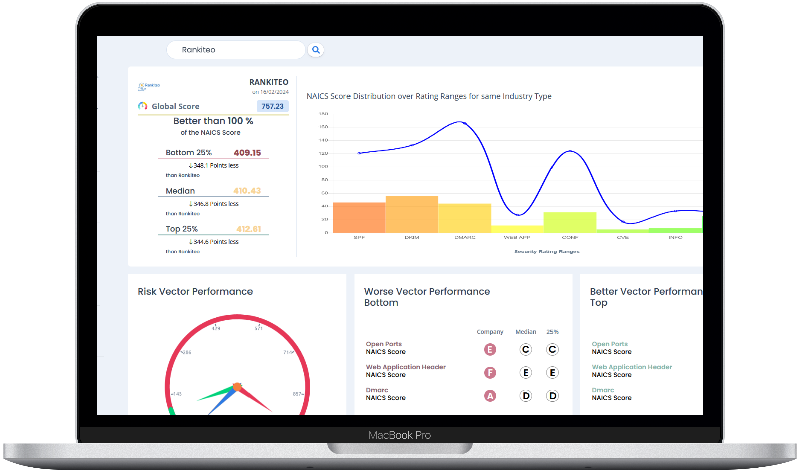
Every week, Rankiteo analyzes billions of signals to give organizations a sharper, faster view of emerging risks. With deeper, more actionable intelligence at their fingertips, security teams can outpace threat actors, respond instantly to Zero-Day attacks, and dramatically shrink their risk exposure window.
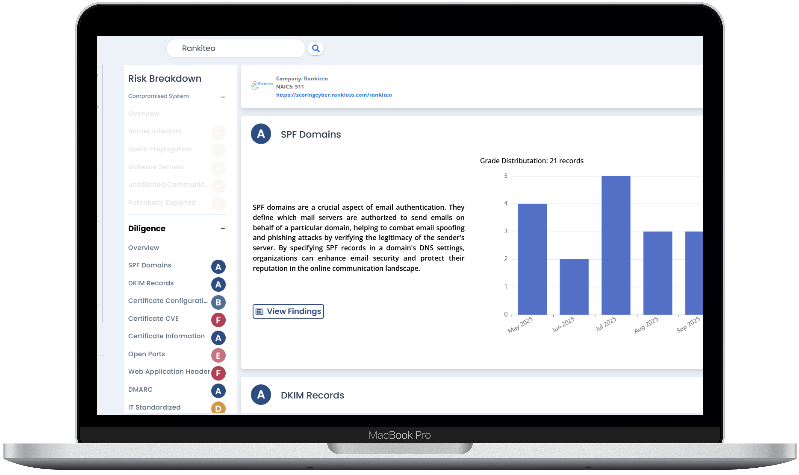
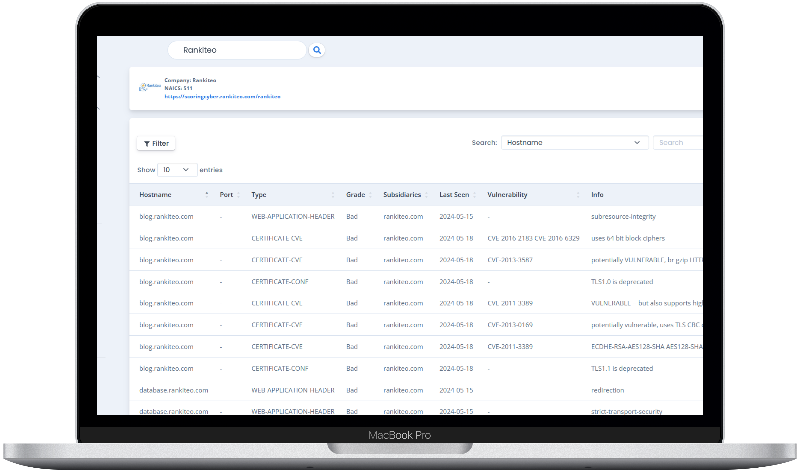
Identify exposed access points, detect misconfigured SSL certificates, and uncover vulnerabilities across the network infrastructure.
Gain visibility into the software components used within an organization to detect vulnerabilities, manage risk, and ensure supply chain security.
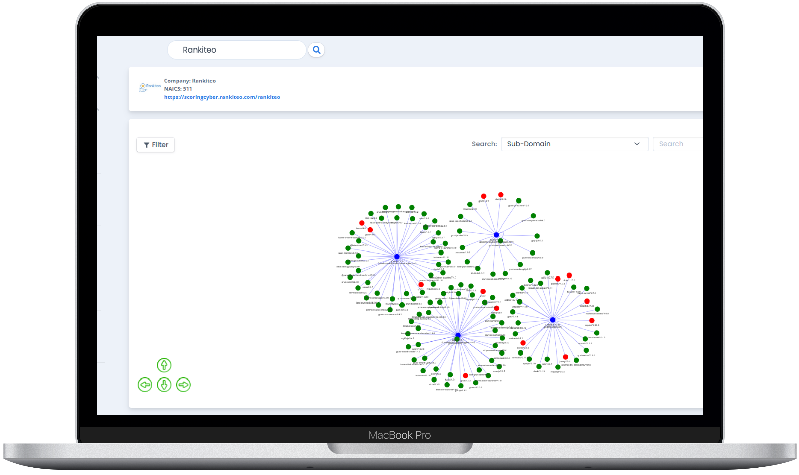
Monitor and manage all IT assets and their configurations to ensure accurate, real-time visibility across the company's technology environment.
Leverage real-time insights on active threats, malware campaigns, and emerging vulnerabilities to proactively defend against evolving cyberattacks.









 Rapid
Rapid