








Clemson University
Company Details
Linkedin ID:
clemson-university
Website:
Employees number:
11,690
Number of followers:
243,567
NAICS:
6113
Industry Type:
Homepage:
tig.rs
IP Addresses:
0
Company ID:
CLE_2241989
Scan Status:
In-progress


Clemson University Vendor Cyber Rating & Cyber Score
tig.rsFor over 130 years, Clemson University has shown unwavering dedication to the people of South Carolina. The University was founded with a land-grant mission and innovative vision — to increase the material resources of the State as a high seminary of learning. Since that time, the University has grown in esteem and impact, earning the R1 classification as one of the nation’s most active research institutions, developing international leaders and instilling our core values of honesty, integrity and respect in more than 160,000 graduates. At Clemson, we see the potential in diverse fields, unexpected applications and determined individuals. Join our journey to develop the skills and inspire the hearts of Tigers working to create significant impact in the profession that calls their name.
Company Details
clemson-university
11,690
243,567
6113
tig.rs
0
CLE_2241989
In-progress
 Clemson University Risk Score (AI oriented)
Between 700 and 749
 Clemson University Global Score (TPRM)
XXXX
Description: Higher Education Under Siege: A Wave of Cyberattacks Exposes Systemic Vulnerabilities In the first half of 2025, a surge of cyberattacks has targeted major U.S. universities, exposing critical weaknesses in higher education’s cybersecurity defenses. The University of Pennsylvania, Harvard University, and Princeton University all reported breaches within the past two months, following earlier incidents at Columbia University, Dartmouth College, and New York University. Each institution confirmed the attacks stemmed from social engineering, with Harvard and Princeton specifically citing phone-based phishing as the entry point. Officials at the affected schools stated they acted swiftly to contain the breaches and are reinforcing security measures. However, experts warn that universities face an uphill battle. Mike Corn, a former chief information security officer in higher education and current consultant at Vantage Technology, noted that colleges operate like "small cities," with decentralized networks, personal devices, and diverse user behaviors creating countless vulnerabilities. Even robust investments in cybersecurity, he argued, cannot guarantee immunity from attacks especially as AI-driven threats grow more sophisticated. The challenges extend beyond technology. Brian Nichols, CIO at the University of Kentucky, highlighted that while phishing simulations and training have improved awareness, they are not foolproof. Anita Nikolich, director of research and technology innovation at the University of Illinois at Urbana-Champaign, warned that punitive security measures can backfire, alienating faculty who may resist protocols perceived as restrictive. A core tension lies in academic freedom versus centralized IT control: many universities allow individual departments such as medical or business schools to maintain separate IT teams, increasing risk. Nikolich, who previously led IT infrastructure at the University of Chicago, described this fragmentation as a "huge risk factor," as decentralized systems complicate consistent security enforcement. Faculty resistance further complicates the issue. Janice Lanham, a nursing lecturer at Clemson University, nearly fell victim to a phishing scam but caught the deception in time. Yet, as Brian Voss, Clemson’s CIO, observed, some professors view security protocols as obstacles to research and teaching. Voss described a "culture of subservience" in higher-ed IT, where departments prioritize faculty demands over security, often retaining excessive data including sensitive information like Social Security numbers despite the risks. His efforts to reduce data storage have met resistance, with one university even retaining personal data for voter registration purposes, creating what he called "piles of gold for bad guys." The conflict between research needs and security is particularly acute. Nikolich, who also conducts quantum computing research, faced initial pushback when requesting network data for her work. After demonstrating the data’s non-sensitive nature and potential security benefits, she gained access but noted that other universities default to blanket denials. When researchers are blocked, she warned, they often bypass official channels, increasing exposure. The solution, Nikolich suggested, lies in collaboration: IT, security teams, and faculty must treat cybersecurity as a shared priority, balancing innovation with protection. Until then, universities remain prime targets caught between the demands of open academic environments and the escalating sophistication of cyber threats.


Clemson University has 45.05% fewer incidents than the average of same-industry companies with at least one recorded incident.
Clemson University has 13.79% fewer incidents than the average of all companies with at least one recorded incident.
Clemson University reported 1 incidents this year: 0 cyber attacks, 0 ransomware, 0 vulnerabilities, 1 data breaches, compared to industry peers with at least 1 incident.
Clemson University cyber incidents detection timeline including parent company and subsidiaries

For over 130 years, Clemson University has shown unwavering dedication to the people of South Carolina. The University was founded with a land-grant mission and innovative vision — to increase the material resources of the State as a high seminary of learning. Since that time, the University has grown in esteem and impact, earning the R1 classification as one of the nation’s most active research institutions, developing international leaders and instilling our core values of honesty, integrity and respect in more than 160,000 graduates. At Clemson, we see the potential in diverse fields, unexpected applications and determined individuals. Join our journey to develop the skills and inspire the hearts of Tigers working to create significant impact in the profession that calls their name.

McGill University is one of Canada's best-known institutions of higher learning and one of the leading universities in the world. With students coming to McGill from some 150 countries, our student body is the most internationally diverse of any research-intensive university in the country. McGill

For more than 300 years, Yale University has inspired the minds that inspire the world. Based in New Haven, Connecticut, Yale brings people and ideas together for positive impact around the globe. A research university that focuses on students and encourages learning as an essential way of life, Yal

The University of Pittsburgh is a top-ranked, public institution in Pennsylvania and a member of the Association of American Universities of leading research universities. With our discoveries, we are recognized as one of the most innovative universities in the world. We invent the paths of the futu

Syracuse University is a private, international research university with distinctive academics, diversely unique offerings and an undeniable spirit. Located in the geographic heart of New York State, with a global footprint, and nearly 150 years of history, Syracuse University offers a quintessentia

The University of Kentucky is a public, research-extensive, land grant university dedicated to improving people's lives through excellence in teaching, research, health care, cultural enrichment, and economic development for over 150 years. The University of Kentucky: - Facilitates learning, inf

Located in historic Providence, Rhode Island and founded in 1764, Brown University is the seventh-oldest college in the United States. Brown is an independent, coeducational Ivy League institution comprising undergraduate and graduate programs, plus the Alpert Medical School, School of Public Health

No other university does as much for so many as the University of California. For almost 150 years, the University of California has educated the brightest minds and helped California become a beacon of innovation. Our campuses routinely are ranked among the best in the world. But our reach extends

Ain Shams University, as the third Egyptian university, was founded in July 1950 under the name of "Ibrahim Pasha University". It participated with the two earlier universities, "Cairo University" (Fua'd the 1st ) and "Alexandria University" (Farouk the 1st) in fulfilling the message of universities

L’Università degli Studi di Milano è un ateneo a vocazione interdisciplinare e internazionale, che riesce a coniugare tradizione e innovazione per rispondere alle sfide di una società in forte cambiamento. Fondata nel 1924, a 100 dalla sua nascita, l’Università milanese si prepara a diventare, entr
.png)
Clemson University is expanding quantum computing research, coursework and student programs to prepare South Carolina.
Clemson researchers are playing a key role in helping South Carolina and its industries stay competitive in the quantum era.
University of South Carolina and Clemson University are launching initiatives that build on South Carolina's quantum readiness strategy.
South Carolina has transitioned its quantum technology strategy from state-level coordination to university-anchored project execution...
The Office of University Compliance and Ethics will celebrate Data Privacy Week with two events on February 10 and 11, highlighting the ways...
Clemson University leaders have announced a new initiative that will begin with the development of a strategic plan to advance the...
A new student-run security operations center is intended to boost the institution's security posture, bolster the workforce and attract...
COLUMBIA, S.C. (WIS) - Some Camden residents said they're left with more questions than answers after getting a notice from a local...
Clemson University has appointed J. Cole Smith '96 as its new Executive Vice President for Academic Affairs and Provost, following approval...

Explore insights on cybersecurity incidents, risk posture, and Rankiteo's assessments.
The official website of Clemson University is http://go.tig.rs/r2mdym.
According to Rankiteo, Clemson University’s AI-generated cybersecurity score is 730, reflecting their Moderate security posture.
According to Rankiteo, Clemson University currently holds 0 security badges, indicating that no recognized compliance certifications are currently verified for the organization.
According to Rankiteo, Clemson University has been affected by a supply chain cyber incident involving Oracle, with the incident ID DARHARPRICOLCLE1767881845.
According to Rankiteo, Clemson University is not certified under SOC 2 Type 1.
According to Rankiteo, Clemson University does not hold a SOC 2 Type 2 certification.
According to Rankiteo, Clemson University is not listed as GDPR compliant.
According to Rankiteo, Clemson University does not currently maintain PCI DSS compliance.
According to Rankiteo, Clemson University is not compliant with HIPAA regulations.
According to Rankiteo,Clemson University is not certified under ISO 27001, indicating the absence of a formally recognized information security management framework.
Clemson University operates primarily in the Higher Education industry.
Clemson University employs approximately 11,690 people worldwide.
Clemson University presently has no subsidiaries across any sectors.
Clemson University’s official LinkedIn profile has approximately 243,567 followers.
Clemson University is classified under the NAICS code 6113, which corresponds to Colleges, Universities, and Professional Schools.
No, Clemson University does not have a profile on Crunchbase.
Yes, Clemson University maintains an official LinkedIn profile, which is actively utilized for branding and talent engagement, which can be accessed here: https://www.linkedin.com/company/clemson-university.
As of April 02, 2026, Rankiteo reports that Clemson University has experienced 1 cybersecurity incidents.
Clemson University has an estimated 15,823 peer or competitor companies worldwide.
Incident Types: The types of cybersecurity incidents that have occurred include Breach.
Detection and Response: The company detects and responds to cybersecurity incidents through an incident response plan activated with yes, and containment measures with removed hackers' access to internal systems, and remediation measures with stepped up security protocols, and communication strategy with public statements to stakeholders..
Title: Multiple University Data Breaches Due to Social Engineering Attacks
Description: In the past two months, the University of Pennsylvania, Harvard University, and Princeton University have fallen victim to data breaches attributed to social engineering attacks, specifically phone-based phishing. Earlier in 2025, Columbia University, Dartmouth College, and New York University also experienced similar incidents. These breaches highlight vulnerabilities in higher education cybersecurity infrastructure.
Type: Data Breach
Attack Vector: Social Engineering (Phone-based Phishing)
Vulnerability Exploited: Human error, lack of centralized IT control, decentralized IT departments
Common Attack Types: The most common types of attacks the company has faced is Breach.
Identification of Attack Vectors: The company identifies the attack vectors used in incidents through Phone-based phishing (social engineering).
Data Compromised: Personal data of students, faculty, and staff
Systems Affected: Internal university systems
Operational Impact: Disruption of university operations, increased security protocols
Brand Reputation Impact: Reputational damage to affected universities
Identity Theft Risk: High (potential exposure of personally identifiable information)
Commonly Compromised Data Types: The types of data most commonly compromised in incidents are Personal data and potentially including personally identifiable information.
Entity Name: University of Pennsylvania
Entity Type: University
Industry: Higher Education
Location: United States
Size: Large
Customers Affected: Thousands of students, faculty, and staff
Entity Name: Harvard University
Entity Type: University
Industry: Higher Education
Location: United States
Size: Large
Customers Affected: Thousands of students, faculty, and staff
Entity Name: Princeton University
Entity Type: University
Industry: Higher Education
Location: United States
Size: Large
Customers Affected: Thousands of students, faculty, and staff
Entity Name: Columbia University
Entity Type: University
Industry: Higher Education
Location: United States
Size: Large
Customers Affected: Thousands of students, faculty, and staff
Entity Name: Dartmouth College
Entity Type: University
Industry: Higher Education
Location: United States
Size: Large
Customers Affected: Thousands of students, faculty, and staff
Entity Name: New York University
Entity Type: University
Industry: Higher Education
Location: United States
Size: Large
Customers Affected: Thousands of students, faculty, and staff
Incident Response Plan Activated: Yes
Containment Measures: Removed hackers' access to internal systems
Remediation Measures: Stepped up security protocols
Communication Strategy: Public statements to stakeholders
Incident Response Plan: The company's incident response plan is described as Yes.
Type of Data Compromised: Personal data, potentially including personally identifiable information
Sensitivity of Data: High (personal and potentially sensitive information)
Personally Identifiable Information: Likely (e.g., Social Security numbers, payroll data)
Prevention of Data Exfiltration: The company takes the following measures to prevent data exfiltration: Stepped up security protocols.
Handling of PII Incidents: The company handles incidents involving personally identifiable information (PII) through by removed hackers' access to internal systems.
Lessons Learned: Universities are highly vulnerable to cyberattacks due to decentralized IT structures, lack of centralized control, and human error. Cybersecurity training and awareness are critical but not sufficient alone. There is a need for better collaboration between IT departments and faculty to balance security with academic freedom.
Recommendations: Implement more centralized IT control to reduce vulnerabilities from decentralized departments., Enhance cybersecurity training and awareness programs, focusing on non-punitive approaches., Limit data retention to reduce the risk of exposure (e.g., avoid storing unnecessary sensitive data like Social Security numbers)., Foster partnerships between IT, security teams, and faculty to align research needs with cybersecurity protocols., Adopt adaptive security measures like behavioral WAFs and enhanced monitoring to detect and respond to threats more effectively.Implement more centralized IT control to reduce vulnerabilities from decentralized departments., Enhance cybersecurity training and awareness programs, focusing on non-punitive approaches., Limit data retention to reduce the risk of exposure (e.g., avoid storing unnecessary sensitive data like Social Security numbers)., Foster partnerships between IT, security teams, and faculty to align research needs with cybersecurity protocols., Adopt adaptive security measures like behavioral WAFs and enhanced monitoring to detect and respond to threats more effectively.Implement more centralized IT control to reduce vulnerabilities from decentralized departments., Enhance cybersecurity training and awareness programs, focusing on non-punitive approaches., Limit data retention to reduce the risk of exposure (e.g., avoid storing unnecessary sensitive data like Social Security numbers)., Foster partnerships between IT, security teams, and faculty to align research needs with cybersecurity protocols., Adopt adaptive security measures like behavioral WAFs and enhanced monitoring to detect and respond to threats more effectively.Implement more centralized IT control to reduce vulnerabilities from decentralized departments., Enhance cybersecurity training and awareness programs, focusing on non-punitive approaches., Limit data retention to reduce the risk of exposure (e.g., avoid storing unnecessary sensitive data like Social Security numbers)., Foster partnerships between IT, security teams, and faculty to align research needs with cybersecurity protocols., Adopt adaptive security measures like behavioral WAFs and enhanced monitoring to detect and respond to threats more effectively.Implement more centralized IT control to reduce vulnerabilities from decentralized departments., Enhance cybersecurity training and awareness programs, focusing on non-punitive approaches., Limit data retention to reduce the risk of exposure (e.g., avoid storing unnecessary sensitive data like Social Security numbers)., Foster partnerships between IT, security teams, and faculty to align research needs with cybersecurity protocols., Adopt adaptive security measures like behavioral WAFs and enhanced monitoring to detect and respond to threats more effectively.
Key Lessons Learned: The key lessons learned from past incidents are Universities are highly vulnerable to cyberattacks due to decentralized IT structures, lack of centralized control, and human error. Cybersecurity training and awareness are critical but not sufficient alone. There is a need for better collaboration between IT departments and faculty to balance security with academic freedom.
Source: Chronicle of Higher Education
Additional Resources: Stakeholders can find additional resources on cybersecurity best practices at and Source: Chronicle of Higher Education.
Investigation Status: Ongoing
Communication of Investigation Status: The company communicates the status of incident investigations to stakeholders through Public statements to stakeholders.
Stakeholder Advisories: Universities have issued public statements to stakeholders about the breaches and steps taken to mitigate risks.
Advisories Provided: The company provides the following advisories to stakeholders and customers following an incident: was Universities have issued public statements to stakeholders about the breaches and steps taken to mitigate risks..
Entry Point: Phone-based phishing (social engineering)
Root Causes: Human Error (Falling For Phishing Attacks), Decentralized It Departments Creating Inconsistent Security Protocols, Lack Of Centralized Control Over Technology Use, Excessive Data Retention (E.G., Storing Social Security Numbers Unnecessarily), Faculty Resistance To It Policies Due To Perceived Restrictions On Academic Freedom,
Corrective Actions: Removing Hackers' Access To Systems, Stepping Up Security Protocols, Enhancing Cybersecurity Training For Faculty And Staff,
Corrective Actions Taken: The company has taken the following corrective actions based on post-incident analysis: Removing Hackers' Access To Systems, Stepping Up Security Protocols, Enhancing Cybersecurity Training For Faculty And Staff, .
Most Significant Data Compromised: The most significant data compromised in an incident were Personal data of students, faculty and and staff.
Containment Measures in Most Recent Incident: The containment measures taken in the most recent incident was Removed hackers' access to internal systems.
Most Sensitive Data Compromised: The most sensitive data compromised in a breach were Personal data of students, faculty and and staff.
Most Significant Lesson Learned: The most significant lesson learned from past incidents was Universities are highly vulnerable to cyberattacks due to decentralized IT structures, lack of centralized control, and human error. Cybersecurity training and awareness are critical but not sufficient alone. There is a need for better collaboration between IT departments and faculty to balance security with academic freedom.
Most Significant Recommendation Implemented: The most significant recommendation implemented to improve cybersecurity was Adopt adaptive security measures like behavioral WAFs and enhanced monitoring to detect and respond to threats more effectively., Enhance cybersecurity training and awareness programs, focusing on non-punitive approaches., Implement more centralized IT control to reduce vulnerabilities from decentralized departments., Limit data retention to reduce the risk of exposure (e.g., avoid storing unnecessary sensitive data like Social Security numbers)., Foster partnerships between IT, security teams and and faculty to align research needs with cybersecurity protocols..
Most Recent Source: The most recent source of information about an incident is Chronicle of Higher Education.
Current Status of Most Recent Investigation: The current status of the most recent investigation is Ongoing.
Most Recent Stakeholder Advisory: The most recent stakeholder advisory issued was Universities have issued public statements to stakeholders about the breaches and steps taken to mitigate risks., .
Most Recent Entry Point: The most recent entry point used by an initial access broker was an Phone-based phishing (social engineering).
.png)
A vulnerability was found in Nothings stb up to 1.26. Impacted is the function stbtt_InitFont_internal in the library stb_truetype.h of the component TTF File Handler. Performing a manipulation results in out-of-bounds read. Remote exploitation of the attack is possible. The exploit has been made public and could be used. The vendor was contacted early about this disclosure but did not respond in any way.
V-SFT versions 6.2.10.0 and prior contain an out-of-bounds read in VS6ComFile!get_macro_mem_COM. Opening a crafted V7 file may lead to information disclosure from the affected product.
V-SFT versions 6.2.10.0 and prior contain a stack-based buffer overflow in VS6ComFile!CSaveData::_conv_AnimationItem. Opening a crafted V7 file may lead to arbitrary code execution on the affected product.
V-SFT versions 6.2.10.0 and prior contain an out-of-bounds read vulnerability in VS6MemInIF!set_temp_type_default. Opening a crafted V7 file may lead to information disclosure from the affected product.
V-SFT versions 6.2.10.0 and prior contain an out-of-bounds read vulnerability in VS6ComFile!load_link_inf. Opening a crafted V7 file may lead to information disclosure from the affected product.
Get company history

Every week, Rankiteo analyzes billions of signals to give organizations a sharper, faster view of emerging risks. With deeper, more actionable intelligence at their fingertips, security teams can outpace threat actors, respond instantly to Zero-Day attacks, and dramatically shrink their risk exposure window.
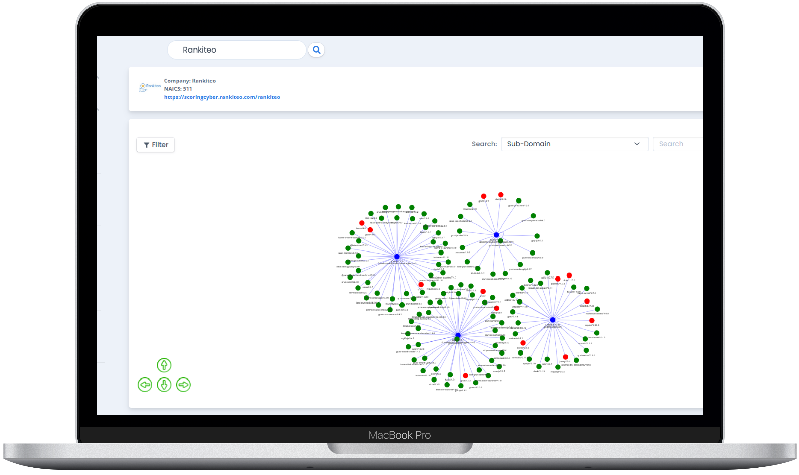
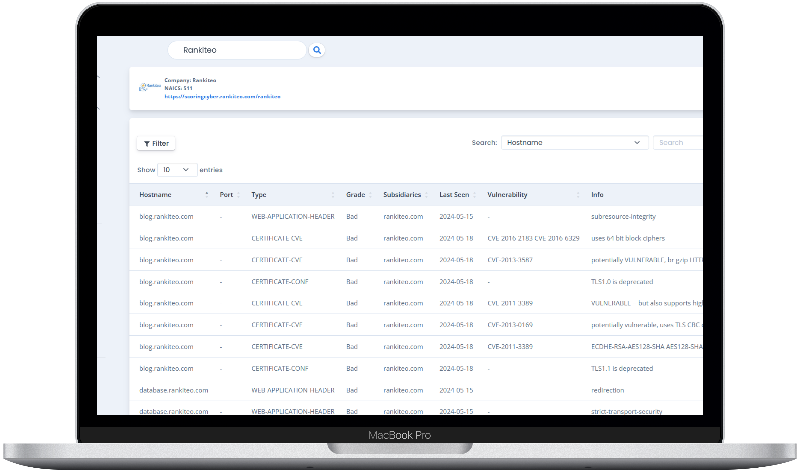
Identify exposed access points, detect misconfigured SSL certificates, and uncover vulnerabilities across the network infrastructure.
Gain visibility into the software components used within an organization to detect vulnerabilities, manage risk, and ensure supply chain security.
Monitor and manage all IT assets and their configurations to ensure accurate, real-time visibility across the company's technology environment.
Leverage real-time insights on active threats, malware campaigns, and emerging vulnerabilities to proactively defend against evolving cyberattacks.



 Oracle

 Rapid
Rapid