













Agoda
Company Details
Linkedin ID:
agoda
Website:
Employees number:
10,430
Number of followers:
817,588
NAICS:
5112
Industry Type:
Homepage:
careersatagoda.com
IP Addresses:
0
Company ID:
AGO_2316008
Scan Status:
In-progress

Agoda Vendor Cyber Rating & Cyber Score
careersatagoda.comAt Agoda, we bridge the world through travel. We aim to make it easy and rewarding for more travelers to explore and experience the amazing world we live in. We do so by enabling more people to see the world for less – with our best-value deals across our 6,000,000+ hotels and holiday properties, 130,000+ flight routes, 360,000+ activities, and more. Agoda was founded in 2005 in Thailand by two lifelong friends with a shared passion for travel. Today, Agoda is part of Booking Holdings [BKNG], and we have more than 7,000 employees from 90 nationalities in offices across Asia Pacific, the Middle East, Europe, and the Americas. In every department – from engineering to customer support – you’ll find that data and technology are at the heart of our culture. There’s never a boring day at Agoda as we aim to make travel hassle-free for everyone. If you’re ready to begin your best journey with us and help us build travel for the world, join us. For properties seeking partnership with Agoda, visit https://connect.agoda.com
Company Details
agoda
10,430
817,588
5112
careersatagoda.com
0
AGO_2316008
In-progress
 Agoda Risk Score (AI oriented)
Between 750 and 799
 Agoda Global Score (TPRM)
XXXX
Description: The rise of clandestine 'travel agencies' on darknet forums has led to significant financial losses for travel and hospitality industries. These agencies sell fraudulently booked flights, hotels, and other services at discounted rates, starting with credential theft and ending with fraudulent bookings. Airlines lose seat inventory, hotels absorb charge-backs, and travelers face drained reward balances. Trustwave reported one agency processed over 2,000 bookings in Q1 2025, netting $1.4 million in illicit revenue.
Description: The ClickFix phishing campaign targeted Booking.com and its affiliated hotels by exploiting compromised accounts to distribute PureRAT malware via phishing emails and WhatsApp messages. Attackers purchased stolen Booking.com administrator credentials from dark web forums (e.g., LolzTeam) to craft convincing scams. Victims both hotels and guests were lured into fake Booking/Expedia login pages, where their login credentials and payment card data were harvested. The malware (PureRAT) enabled remote access, keystroke logging, and surveillance via webcam/microphone, allowing attackers to map hotel customer databases for further fraud. Fraudulent wire transactions were also executed using stolen data. The campaign, active since at least April 2025, leveraged real reservation details to enhance credibility, amplifying financial and reputational damage. While the exact scale of compromise remains undisclosed, the attack disrupted trust in Booking.com’s platform, exposed sensitive customer financial data, and enabled downstream fraud against hotels and guests.
Description: A large-scale phishing campaign orchestrated by Russian threat actors has targeted Booking.com since February, involving the registration of over 4,300 fraudulent domains mimicking legitimate booking and rental platforms like Expedia and Agoda. The attack specifically aimed to deceive hotel guests into divulging their payment details, including credit card information, bank account credentials, and personal identification data. By impersonating trusted booking services, the threat actors exploited user trust to harvest sensitive financial information, leading to potential fraudulent transactions, identity theft, and financial losses for affected customers. The scale of the operation suggests a systematic effort to compromise a high volume of users, leveraging social engineering tactics to bypass traditional security measures. While the exact number of victims remains undisclosed, the prolonged duration of the campaign (since February) indicates a sustained and evolving threat, with potential long-term reputational damage to Booking.com due to eroded customer confidence in its platform’s security.
Description: Booking.com Security Breach Exposes Hundreds of Travelers to Fraud A significant security breach at Booking.com has resulted in hundreds of Dutch travelers falling victim to fraud, with losses exceeding €65,000 in early 2026 alone. Hackers compromised hotel accounts on the platform, sending convincing fake messages to guests via the Booking.com app, WhatsApp, and email, demanding payments for alleged missing deposits. The attackers gained access to booking details, including guest contact information, by exploiting weak security practices. Ethical hacker Sijmen Ruwhof noted that criminals use AI tools to replicate hotel communications with near-perfect accuracy, making the scams difficult to detect. Compromised accounts often stem from reused passwords from data leaks or phishing attacks targeting hotels with malware-laden attachments. The fraud has surged globally, with reported cases in the UK, France, and Singapore, alongside the Netherlands. While Booking.com claims its security measures have improved citing a decline in internal victim counts public reporting has increased, with 200 Dutch victims in 2025 compared to 89 in 2024. The company acknowledged the issue has persisted since 2023, affecting multiple major platforms. Booking.com advises travelers to verify payment requests directly with hotels and treat unsolicited links with suspicion, though it offers assistance in recovering lost funds when possible. The breach highlights ongoing vulnerabilities in third-party account security and the growing sophistication of AI-driven fraud.


No incidents recorded for Agoda in 2026.
No incidents recorded for Agoda in 2026.
No incidents recorded for Agoda in 2026.
Agoda cyber incidents detection timeline including parent company and subsidiaries

At Agoda, we bridge the world through travel. We aim to make it easy and rewarding for more travelers to explore and experience the amazing world we live in. We do so by enabling more people to see the world for less – with our best-value deals across our 6,000,000+ hotels and holiday properties, 130,000+ flight routes, 360,000+ activities, and more. Agoda was founded in 2005 in Thailand by two lifelong friends with a shared passion for travel. Today, Agoda is part of Booking Holdings [BKNG], and we have more than 7,000 employees from 90 nationalities in offices across Asia Pacific, the Middle East, Europe, and the Americas. In every department – from engineering to customer support – you’ll find that data and technology are at the heart of our culture. There’s never a boring day at Agoda as we aim to make travel hassle-free for everyone. If you’re ready to begin your best journey with us and help us build travel for the world, join us. For properties seeking partnership with Agoda, visit https://connect.agoda.com

About KPIT KPIT is reimagining the future of mobility, forging ahead with group companies and partners to shape a world that is cleaner, smarter, and safer. With over 25 years of specialized expertise in Mobility, KPIT is accelerating the transformation towards Software and AI-Defined Vehicles thr

With our unique ability to offer end-to-end solutions that connect the three pillars of IoT - Sensors, Software, and Services, we enable businesses to move from the traditional to the digital, or improve businesses by introducing a digital element in their products and processes. Now more than ever

About Lazada Group Founded in 2012, Lazada Group is the leading eCommerce platform in Southeast Asia. We are accelerating progress in Indonesia, Malaysia, the Philippines, Singapore, Thailand and Vietnam through commerce and technology. With the largest logistics and payments networks in the regio

On the Fulfillment Technologies & Robotics Team, we build dynamic partnerships between people and intelligent machines. This intricate collaboration helps Amazon fulfill orders with unmatched accuracy. Since we began working with robotics, we've added over a million new jobs worldwide. Working in s

A career at Booking.com is all about the journey, helping you explore new challenges in a place where you can be your best self. With plenty of exciting twists, turns and opportunities along the way. We’ve always been pioneers, on a mission to shape the future of travel through cutting edge techno
Synopsys is the leader in engineering solutions from silicon to systems, enabling customers to rapidly innovate AI-powered products. We deliver industry-leading silicon design, IP, simulation and analysis solutions, and design services. We partner closely with our customers across a wide range of

Thomson Reuters (TSX/NDAQ: TRI) informs the way forward by bringing together the trusted content and technology that people and organizations need to make the right decisions. We serve professionals across legal, tax, accounting, compliance, government, and media. Our products combine highly special

Zoho offers beautifully smart software to help you grow your business. With over 100 million users worldwide, Zoho's 55+ products aid your sales and marketing, support and collaboration, finance, and recruitment needs—letting you focus only on your business. Zoho respects user privacy and does not h
Wolters Kluwer (EURONEXT: WKL) is a global leader in information, software solutions, and services for professionals in healthcare; tax and accounting; financial and corporate compliance; legal and regulatory; corporate performance and ESG. We help our customers make critical decisions every day by
.png)
SINGAPORE, Dec. 10, 2025 /PRNewswire/ — Digital travel platform Agoda has published its 2026 Travel Outlook Report, spotlighting five key...
A Russian-speaking threat behind an ongoing, mass phishing campaign has registered more than 4,300 domain names since the start of the year.
Cybersecurity researchers have called attention to a massive phishing campaign targeting the hospitality industry that lures hotel managers...
The 18th JCB World Conference Held in Incheon, Republic of Korea. 168 Partner Companies from 24 Countries and Regions Gather to Explore the...
Booking.com account compromise - Cybersecurity researchers at Sekoia have uncovered a sophisticated phishing campaign targeting hospitality.
Agoda's latest data shows that food is fast becoming the main course of travel in Asia, with culinary activities ranking among the top five...
Police say 2148 online employment scams recorded from January to May, up about 92 per cent over same period last year.
The travel sector has experienced a major technological transformation in recent years, making it more accessible, convenient,...
Explore the top 10 best paid tech jobs in Thailand for 2025, from Cloud Architects to Full-Stack Developers, and the skills driving their...

Explore insights on cybersecurity incidents, risk posture, and Rankiteo's assessments.
The official website of Agoda is http://careersatagoda.com/.
According to Rankiteo, Agoda’s AI-generated cybersecurity score is 789, reflecting their Fair security posture.
According to Rankiteo, Agoda currently holds 0 security badges, indicating that no recognized compliance certifications are currently verified for the organization.
According to Rankiteo, Agoda has not been affected by any supply chain cyber incidents, and no incident IDs are currently listed for the organization.
According to Rankiteo, Agoda is not certified under SOC 2 Type 1.
According to Rankiteo, Agoda does not hold a SOC 2 Type 2 certification.
According to Rankiteo, Agoda is not listed as GDPR compliant.
According to Rankiteo, Agoda does not currently maintain PCI DSS compliance.
According to Rankiteo, Agoda is not compliant with HIPAA regulations.
According to Rankiteo,Agoda is not certified under ISO 27001, indicating the absence of a formally recognized information security management framework.
Agoda operates primarily in the Software Development industry.
Agoda employs approximately 10,430 people worldwide.
Agoda presently has no subsidiaries across any sectors.
Agoda’s official LinkedIn profile has approximately 817,588 followers.
Agoda is classified under the NAICS code 5112, which corresponds to Software Publishers.
No, Agoda does not have a profile on Crunchbase.
Yes, Agoda maintains an official LinkedIn profile, which is actively utilized for branding and talent engagement, which can be accessed here: https://www.linkedin.com/company/agoda.
As of April 02, 2026, Rankiteo reports that Agoda has experienced 4 cybersecurity incidents.
Agoda has an estimated 29,309 peer or competitor companies worldwide.
Incident Types: The types of cybersecurity incidents that have occurred include Breach and Cyber Attack.
Total Financial Loss: The total financial loss from these incidents is estimated to be $65 thousand.
Detection and Response: The company detects and responds to cybersecurity incidents through an containment measures with geo-fenced mfa on loyalty portals, containment measures with velocity limits tied to device-id, containment measures with dark-web telemetry that flags brand mentions, and third party assistance with sekoia (cybersecurity research), and communication strategy with advises travelers to verify payment requests directly with hotels and treat unsolicited links with suspicion, and enhanced monitoring with improved security measures (claimed by booking.com)..
Title: Dark Web Travel Agency Fraud
Description: The rise of clandestine travel agencies on darknet forums has led to a full-fledged service economy that sells half-priced flights, five-star hotels, and even yacht charters using stolen credentials and fraudulent bookings.
Type: Fraud
Attack Vector: Mass-phishingInfostealer trojans
Vulnerability Exploited: Credential theft, Stolen payment tokens
Threat Actor: Dark web travel agencies
Motivation: Financial gain
Title: ClickFix phishing campaign targets hotels and guests with PureRAT malware
Description: Attackers exploit compromised Booking.com accounts and sell stolen credentials on dark web forums. Guests are tricked into fake Booking/Expedia sites, losing login and payment card data. Hotels and their guests are targeted by a sophisticated ClickFix campaign delivering PureRAT malware, stealing credentials, and enabling fraudulent wire transactions. The campaign involves phishing emails, fake reCAPTCHA challenges, and personalized WhatsApp messages with real reservation details to deceive victims. PureRAT grants remote access, keystroke logging, and data exfiltration capabilities. The campaign has been active since at least April 2025 and remains operational as of early October 2025.
Date Publicly Disclosed: 2025-10-01
Type: phishing
Attack Vector: compromised email accountsphishing linksfake reCAPTCHA challengemalware download (PureRAT)personalized WhatsApp messagesfake Booking/Expedia websites
Vulnerability Exploited: human trust (social engineering)compromised Booking.com accountslack of multi-factor authentication (MFA)
Motivation: financial gaindata theftfraudulent transactions
Title: Phishing Campaign Targeting Booking and Rental Services by Russian Threat Actors
Description: More than 4,300 domains have been registered by Russian threat actors to impersonate widely known booking and rental services, such as Booking.com, Expedia, and Agoda, as part of a phishing campaign that has sought to pilfer hotel guests' payment details since February 2025.
Date Publicly Disclosed: 2025-11-14
Type: phishing
Attack Vector: malicious domain registrationsocial engineeringphishing emails/websites
Threat Actor: Russian threat actors
Motivation: financial gaintheft of payment details
Title: Booking.com Security Breach Exposes Hundreds of Travelers to Fraud
Description: A significant security breach at Booking.com resulted in hundreds of Dutch travelers falling victim to fraud, with losses exceeding €65,000 in early 2026. Hackers compromised hotel accounts on the platform, sending convincing fake messages to guests via the Booking.com app, WhatsApp, and email, demanding payments for alleged missing deposits. The attackers exploited weak security practices to gain access to booking details, including guest contact information.
Type: Fraud/Scam
Attack Vector: PhishingCompromised AccountsMalware
Vulnerability Exploited: Reused passwords from data leaksWeak security practices
Motivation: Financial gain
Common Attack Types: The most common types of attacks the company has faced is Cyber Attack.
Identification of Attack Vectors: The company identifies the attack vectors used in incidents through Mass-phishing, Infostealer trojans, compromised Booking.com accountspurchased administrator contact info from dark web, phishing domains impersonating booking services and Reused passwordsPhishing attacks targeting hotels.

Financial Loss: Airlines lose seat inventory, hotels absorb charge-backs, travelers face drained reward balances
Systems Affected: Booking systems, payment gateways
Payment Information Risk: High
Data Compromised: Login credentials, Payment card data, Reservation details
Brand Reputation Impact: potential loss of trust in Booking.com and affected hotels
Identity Theft Risk: ['high (due to stolen credentials and payment data)']
Payment Information Risk: ['high (credit card data stolen)']
Data Compromised: Payment details
Brand Reputation Impact: potential reputational damage to Booking.com, Expedia, Agoda, and other impersonated brands
Identity Theft Risk: ['high (due to stolen payment details)']
Payment Information Risk: ['high (primary target of the campaign)']
Financial Loss: €65,000+ (early 2026)
Data Compromised: Guest contact information, Booking details
Systems Affected: Booking.com platformHotel accounts
Brand Reputation Impact: Significant
Identity Theft Risk: High
Payment Information Risk: High
Average Financial Loss: The average financial loss per incident is $16.25 thousand.
Commonly Compromised Data Types: The types of data most commonly compromised in incidents are Loyalty credentials, Payment tokens, Login Credentials, Payment Card Information, Reservation Details, , Payment Details, , Guest Contact Information, Booking Details and .
Entity Type: Airlines, Hotels, Travel Agencies
Industry: Travel and Hospitality
Entity Name: Booking.com
Entity Type: Online Travel Agency (OTA)
Industry: Hospitality/Travel
Location: Global
Entity Name: Expedia
Entity Type: Online Travel Agency (OTA)
Industry: Hospitality/Travel
Location: Global
Entity Name: Unspecified Hotels
Entity Type: Hospitality Business
Industry: Hospitality
Location: Global
Entity Name: Hotel Guests
Entity Type: Individual Consumers
Location: Global
Entity Name: Booking.com
Entity Type: company
Industry: travel/booking services
Location: global
Entity Name: Expedia
Entity Type: company
Industry: travel/booking services
Location: global
Entity Name: Agoda
Entity Type: company
Industry: travel/booking services
Location: global
Entity Name: Hotel guests (unspecified hotels)
Entity Type: individuals
Location: global
Entity Name: Booking.com
Entity Type: Company
Industry: Travel/Hospitality
Location: Global
Customers Affected: Hundreds (Dutch travelers primarily, with cases in UK, France, and Singapore)
Containment Measures: Geo-fenced MFA on loyalty portalsVelocity limits tied to device-IDDark-web telemetry that flags brand mentions
Third Party Assistance: Sekoia (Cybersecurity Research).
Communication Strategy: Advises travelers to verify payment requests directly with hotels and treat unsolicited links with suspicion
Enhanced Monitoring: Improved security measures (claimed by Booking.com)
Third-Party Assistance: The company involves third-party assistance in incident response through Sekoia (cybersecurity research), .
Type of Data Compromised: Loyalty credentials, Payment tokens
Sensitivity of Data: High
Type of Data Compromised: Login credentials, Payment card information, Reservation details
Sensitivity of Data: high (financial and personal data)
Data Exfiltration: credentials sold on dark web forums (e.g., LolzTeam)
Personally Identifiable Information: potentially included (names, contact details, payment info)
Type of Data Compromised: Payment details
Sensitivity of Data: high
Data Exfiltration: likely (payment details stolen)
Personally Identifiable Information: potentially (linked to payment details)
Type of Data Compromised: Guest contact information, Booking details
Sensitivity of Data: High (personally identifiable information)
Personally Identifiable Information: Yes
Handling of PII Incidents: The company handles incidents involving personally identifiable information (PII) through by geo-fenced mfa on loyalty portals, velocity limits tied to device-id, dark-web telemetry that flags brand mentions and .
Lessons Learned: Layered countermeasures are effective at disrupting high-speed fraud loops
Lessons Learned: Highlights ongoing vulnerabilities in third-party account security and the growing sophistication of AI-driven fraud.
Recommendations: Implement geo-fenced MFA on loyalty portals, velocity limits tied to device-ID, and dark-web telemetry that flags brand mentions
Recommendations: Verify payment requests directly with hotels, Treat unsolicited links with suspicion, Avoid reusing passwordsVerify payment requests directly with hotels, Treat unsolicited links with suspicion, Avoid reusing passwordsVerify payment requests directly with hotels, Treat unsolicited links with suspicion, Avoid reusing passwords
Key Lessons Learned: The key lessons learned from past incidents are Layered countermeasures are effective at disrupting high-speed fraud loopsHighlights ongoing vulnerabilities in third-party account security and the growing sophistication of AI-driven fraud.
Implemented Recommendations: The company has implemented the following recommendations to improve cybersecurity: Avoid reusing passwords, Treat unsolicited links with suspicion, Implement geo-fenced MFA on loyalty portals, velocity limits tied to device-ID, and dark-web telemetry that flags brand mentions and Verify payment requests directly with hotels.
Source: Trustwave
Source: TechRadar Pro
Source: Sekoia Cybersecurity Research
Source: Ethical hacker Sijmen Ruwhof
Additional Resources: Stakeholders can find additional resources on cybersecurity best practices at and Source: Trustwave, and Source: TechRadar Pro, and Source: Sekoia Cybersecurity Research, and Source: The Hacker NewsDate Accessed: 2025-11-14, and Source: Ethical hacker Sijmen Ruwhof.
Investigation Status: Ongoing (as of October 2025)
Investigation Status: ongoing (as of disclosure date)
Communication of Investigation Status: The company communicates the status of incident investigations to stakeholders through Advises travelers to verify payment requests directly with hotels and treat unsolicited links with suspicion.
Customer Advisories: Verify payment requests directly with hotels and treat unsolicited links with suspicion
Advisories Provided: The company provides the following advisories to stakeholders and customers following an incident: was Verify payment requests directly with hotels and treat unsolicited links with suspicion.
Entry Point: Mass-phishing, Infostealer trojans
High Value Targets: Loyalty credentials, Payment tokens
Data Sold on Dark Web: Loyalty credentials, Payment tokens
Entry Point: Compromised Booking.Com Accounts, Purchased Administrator Contact Info From Dark Web,
Backdoors Established: ['PureRAT malware']
High Value Targets: Hotel Administrators, Booking.Com Account Holders, Hotel Guests,
Data Sold on Dark Web: Hotel Administrators, Booking.Com Account Holders, Hotel Guests,
Entry Point: Phishing Domains Impersonating Booking Services,
Reconnaissance Period: ['since at least February 2025']
High Value Targets: Hotel Guests' Payment Details,
Data Sold on Dark Web: Hotel Guests' Payment Details,
Entry Point: Reused Passwords, Phishing Attacks Targeting Hotels,
High Value Targets: Hotel accounts
Data Sold on Dark Web: Hotel accounts
Root Causes: Credential theft, Stolen payment tokens
Corrective Actions: Implement layered countermeasures
Root Causes: Successful Phishing Attacks, Lack Of Mfa On Booking.Com Accounts, Trust In Legitimate-Looking Communications,
Root Causes: Weak Security Practices, Reused Passwords From Data Leaks, Phishing Attacks,
Corrective Actions: Improved Security Measures (Claimed By Booking.Com),
Post-Incident Analysis Process: The company's process for conducting post-incident analysis is described as Sekoia (Cybersecurity Research), , Improved security measures (claimed by Booking.com).
Corrective Actions Taken: The company has taken the following corrective actions based on post-incident analysis: Implement layered countermeasures, Improved Security Measures (Claimed By Booking.Com), .
Last Attacking Group: The attacking group in the last incident were an Dark web travel agencies and Russian threat actors.
Most Recent Incident Publicly Disclosed: The most recent incident publicly disclosed was on 2025-11-14.
Most Significant Data Compromised: The most significant data compromised in an incident were login credentials, payment card data, reservation details, , payment details, , Guest contact information, Booking details and .
Most Significant System Affected: The most significant system affected in an incident was Booking.com platformHotel accounts.
Third-Party Assistance in Most Recent Incident: The third-party assistance involved in the most recent incident was sekoia (cybersecurity research), .
Containment Measures in Most Recent Incident: The containment measures taken in the most recent incident was Geo-fenced MFA on loyalty portalsVelocity limits tied to device-IDDark-web telemetry that flags brand mentions.
Most Sensitive Data Compromised: The most sensitive data compromised in a breach were payment card data, Guest contact information, Booking details, login credentials, payment details and reservation details.
Most Significant Lesson Learned: The most significant lesson learned from past incidents was Layered countermeasures are effective at disrupting high-speed fraud loops, Highlights ongoing vulnerabilities in third-party account security and the growing sophistication of AI-driven fraud.
Most Significant Recommendation Implemented: The most significant recommendation implemented to improve cybersecurity was Avoid reusing passwords, Treat unsolicited links with suspicion, Implement geo-fenced MFA on loyalty portals, velocity limits tied to device-ID, and dark-web telemetry that flags brand mentions and Verify payment requests directly with hotels.
Most Recent Source: The most recent source of information about an incident are TechRadar Pro, Trustwave, The Hacker News, Ethical hacker Sijmen Ruwhof and Sekoia Cybersecurity Research.
Current Status of Most Recent Investigation: The current status of the most recent investigation is Ongoing (as of October 2025).
Most Recent Customer Advisory: The most recent customer advisory issued was an Verify payment requests directly with hotels and treat unsolicited links with suspicion.
Most Recent Entry Point: The most recent entry point used by an initial access broker were an Mass-phishing and Infostealer trojans.
Most Recent Reconnaissance Period: The most recent reconnaissance period for an incident was since at least February 2025.
Most Significant Root Cause: The most significant root cause identified in post-incident analysis was Credential theft, Stolen payment tokens, successful phishing attackslack of MFA on Booking.com accountstrust in legitimate-looking communications, Weak security practicesReused passwords from data leaksPhishing attacks.
Most Significant Corrective Action: The most significant corrective action taken based on post-incident analysis was Implement layered countermeasures, Improved security measures (claimed by Booking.com).
.png)
A vulnerability was found in Nothings stb up to 1.26. Impacted is the function stbtt_InitFont_internal in the library stb_truetype.h of the component TTF File Handler. Performing a manipulation results in out-of-bounds read. Remote exploitation of the attack is possible. The exploit has been made public and could be used. The vendor was contacted early about this disclosure but did not respond in any way.
V-SFT versions 6.2.10.0 and prior contain an out-of-bounds read in VS6ComFile!get_macro_mem_COM. Opening a crafted V7 file may lead to information disclosure from the affected product.
V-SFT versions 6.2.10.0 and prior contain a stack-based buffer overflow in VS6ComFile!CSaveData::_conv_AnimationItem. Opening a crafted V7 file may lead to arbitrary code execution on the affected product.
V-SFT versions 6.2.10.0 and prior contain an out-of-bounds read vulnerability in VS6MemInIF!set_temp_type_default. Opening a crafted V7 file may lead to information disclosure from the affected product.
V-SFT versions 6.2.10.0 and prior contain an out-of-bounds read vulnerability in VS6ComFile!load_link_inf. Opening a crafted V7 file may lead to information disclosure from the affected product.

Get company history

Every week, Rankiteo analyzes billions of signals to give organizations a sharper, faster view of emerging risks. With deeper, more actionable intelligence at their fingertips, security teams can outpace threat actors, respond instantly to Zero-Day attacks, and dramatically shrink their risk exposure window.
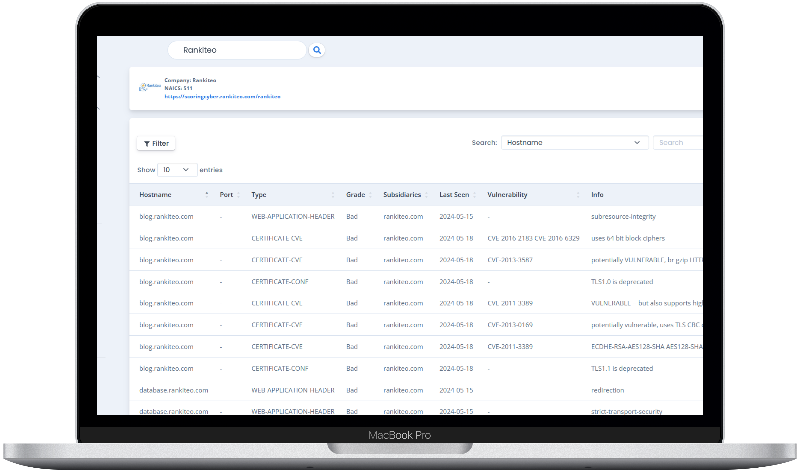
Identify exposed access points, detect misconfigured SSL certificates, and uncover vulnerabilities across the network infrastructure.
Gain visibility into the software components used within an organization to detect vulnerabilities, manage risk, and ensure supply chain security.
Monitor and manage all IT assets and their configurations to ensure accurate, real-time visibility across the company's technology environment.
Leverage real-time insights on active threats, malware campaigns, and emerging vulnerabilities to proactively defend against evolving cyberattacks.





 Rapid
Rapid